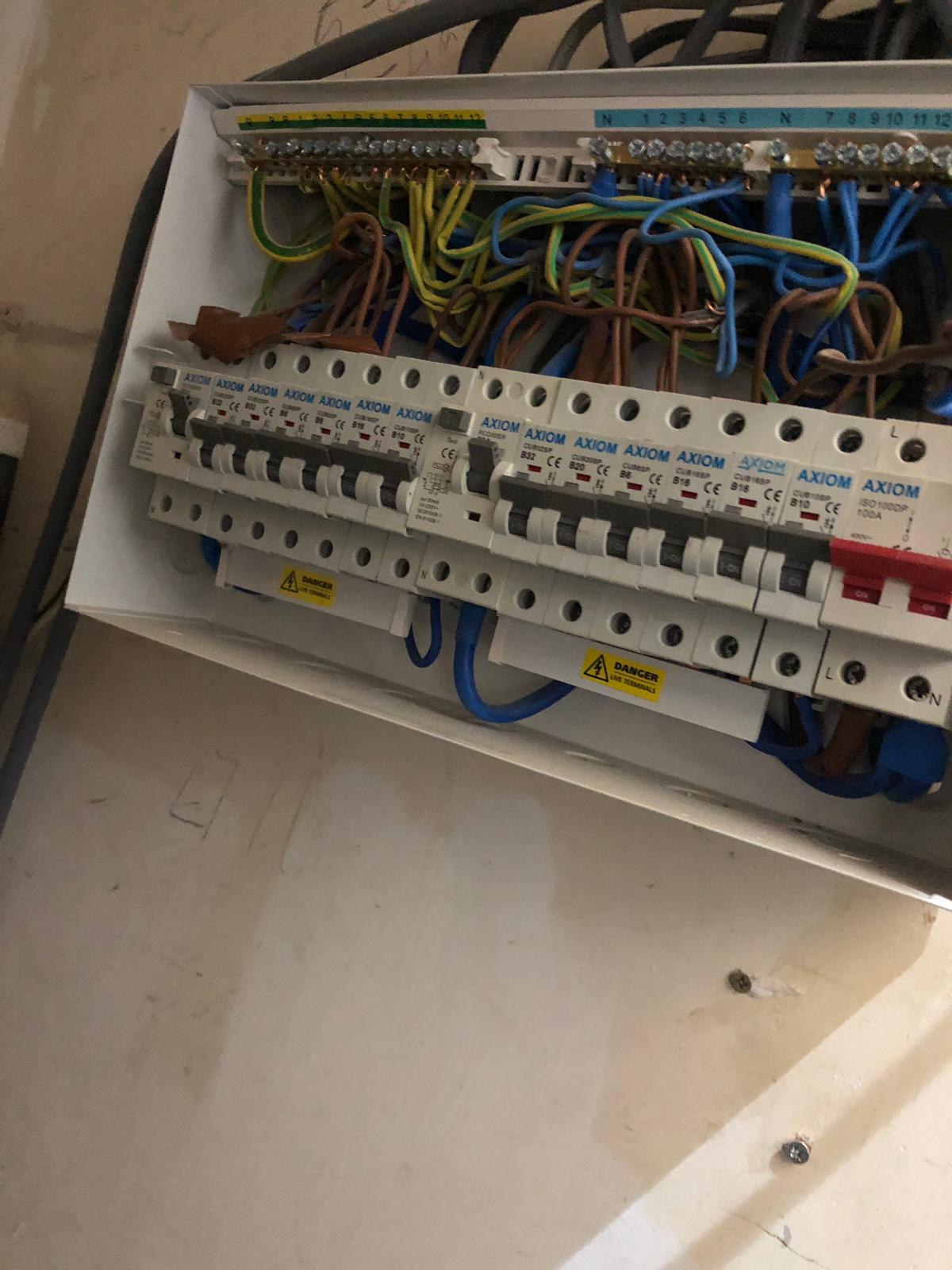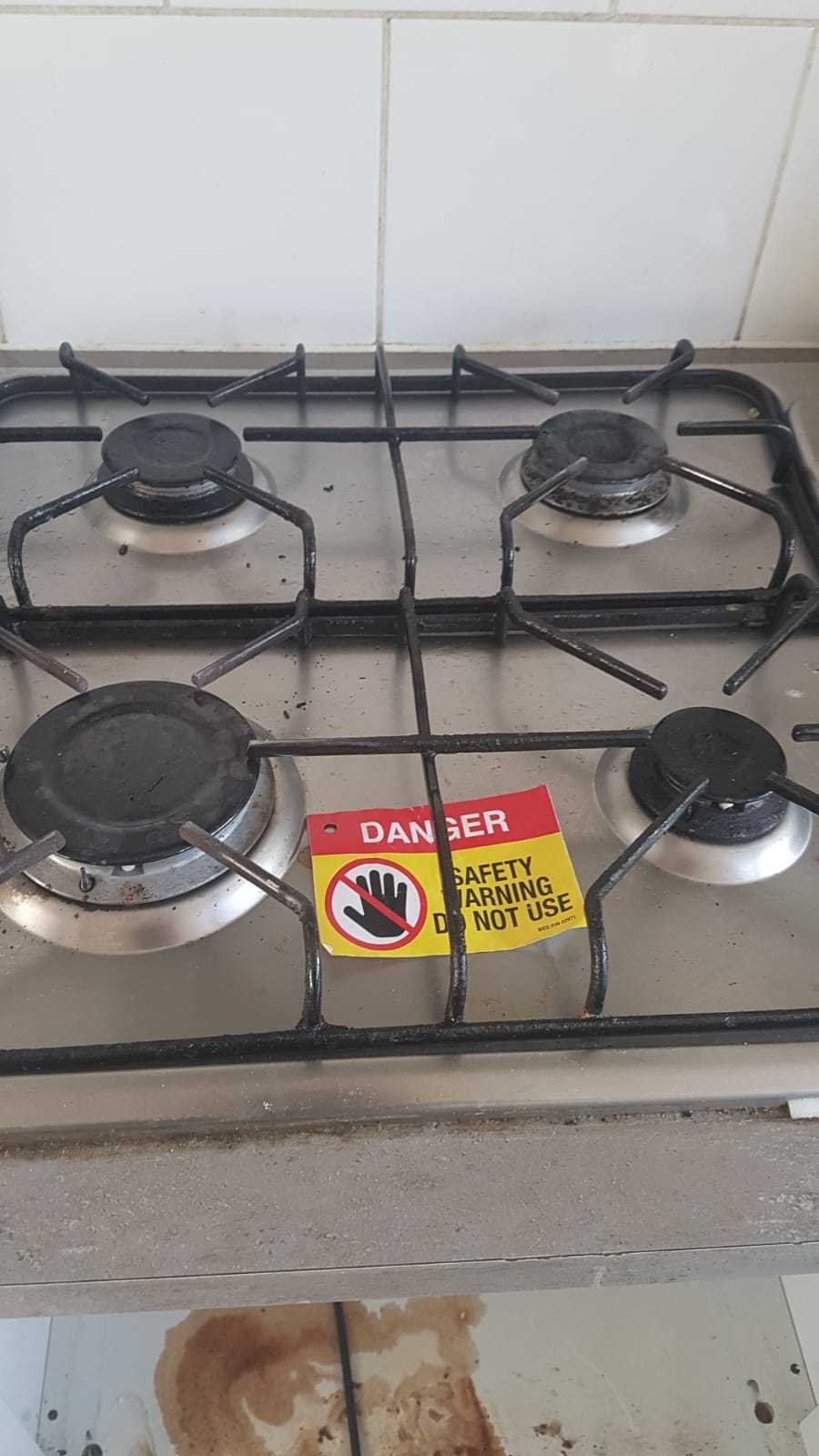
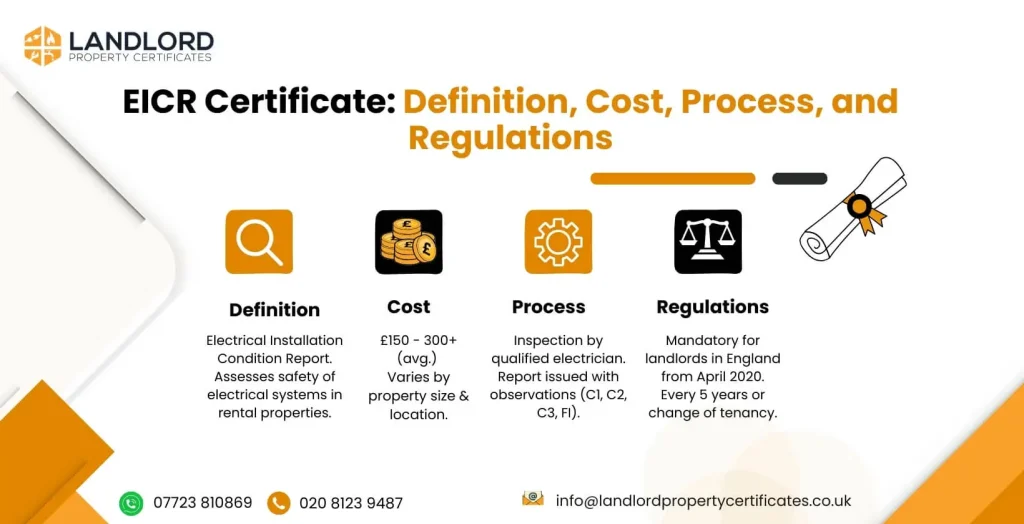
An Electrical Installation Condition Report (EICR) is a formal document issued by a qualified electrician after assessing the safety condition of a property’s electrical system.
The two main types of EICR certificates are Domestic EICR and Commercial EICR.
To get an EICR, A landlord hires a qualified electrician who performs a visual inspection of the electrical system and conducts different tests (insulation resistance test, earth and bonding checks) to document all the outputs as codes and provide recommendations in the EICR.
The cost of a domestic EICR and Commercial EICR in the UK is between £120 and £300, and £12 to £50 per circuit, respectively. A qualified electrician takes 2 to 4 hours of inspection to issue a domestic EICR certification. The EICR Certificate is valid for up to 5 years and needs to be renewed after expiry.
According to the Direct Line Research in May 2025, many UK landlords remain unclear about their legal responsibilities. 21% of UK landlords are unaware that lacking a valid EICR can result in fines,8% do not have a valid EICR or are unsure of its status, and only 10% fully understand the documents required to evict a tenant.
Three main regulations that make an EICR certificate mandatory for UK landlords of private rental properties are: BS 7671 (IET Wiring Regulations), the Electricity at Work Regulations 1989, and the Electrical Safety Standards in the Private Rented Sector (England) Regulations 2020.
What is an EICR Certificate?
The electrical installation condition report is a formal document issued by a qualified electrician after a detailed assessment of the fixed electrical system of a property. A qualified electrician inspects a fixed electrical system to identify potential safety hazards, defects, damage, and faults in existing wiring, sockets, fuse boards, and lighting installations. This comprehensive inspection is performed to ensure that all electrical installations are in good working condition and are fully compliant with the British Standard for electrical safety BS 7671.
What does EICR stand for?
EICR stands for Electrical Installation Condition Report. The previous name of EICR was Fixed Wire Testing. Other names of EICR are periodic inspection, hard-wire testing, and electrical safety certificate. A qualified electrician examines wiring, sockets, consumer units/fuse boxes, and other fixed electrical components. This testing verifies that electrical systems of a property are safe and comply with the Electrical Safety Standards in the Private Rented Sector (England) Regulations 2020.
What is the history of EICR?
The origins of the Electrical Installation Condition Report (EICR) trace back to the Electric Lighting Act of 1882, which established the UK’s first formal wiring rules and gave rise to the IET Wiring Regulations. The National Register of Electrical Contractors was created in 1923 to protect consumers from unsafe electrical installations. The first standardised electrical certificate appeared in 1939 within the 11th Edition of the IEE Wiring Regulations. The NICEIC (National Inspection Council for Electrical Installation Contracting) was formally founded in 1956 and registered as a charity in 1971.
UK wiring regulations formally recommended periodic inspection of electrical installations during the 1960s, producing the Periodic Inspection Report (PIR), the direct predecessor of the EICR. The Electricity at Work Regulations 1989 imposed a statutory duty on employers to maintain electrical systems safely. BS 7671 was adopted as a full British Standard in 1992, giving the wiring regulations formal legal authority across the UK.
Amendment 1 to BS 7671:2008 came into force on 1 January 2012, and the EICR officially replaced the PIR, standardising inspection codes, terminology, and reporting structure across the UK. Scotland became the first UK nation to mandate EICRs for private rented properties from 1 December 2015 for new tenancies, extended to all existing tenancies by 1 December 2016. BS 7671:2018 (18th Edition) updated the technical standards that all EICRs must assess.
The Electrical Safety Standards in the Private Rented Sector (England) Regulations 2020 came into force on 1 June 2020, applied to all new tenancies from 1 July 2020, and covered all existing tenancies by 1 April 2021, with non-compliance penalties of up to £30,000. Revised regulations in England in November 2025 required EICRs to be issued to existing tenants within 28 days, to new tenants before occupation, and to local authorities within 7 days upon request.
Northern Ireland made EICRs mandatory for new private tenancies from 1 April 2025, and extended them to all existing tenancies from 1 December 2025. England’s social housing sector became subject to mandatory EICR requirements from 1 November 2025 for new tenancies, with the regulations formally applying to all pre-existing social housing tenancies from 1 May 2026, and a final deadline for completing all physical inspections set at 1 November 2026.
What are the 2 types of EICR certificates?
The 2 types of EICR certificates are listed below.
- Residential EICR
- Commercial EICR

1.Residential/ Domestic EICR
Domestic EICR is a formal certificate issued by a qualified electrician after inspecting the electrical safety of a residential building. Domestic EICR evaluates the safety risks of private homes and acts as a preventive measure against electrical hazards. A qualified electrician assesses the integrity and functioning of domestic wiring systems, safety devices, and connections as per the Institution of Engineering and Technology (IET )wiring regulation BS 7671. Electrical inspection aims to check the adequacy of earthing and bonding, functionality of service cables, and condition of switch gear/control gear. Each component of the electrical system is inspected to create a safety shield for residents and tenants against electrical shocks or fires.
Homeowners or landlords need to fix identified risks, and this proactive safety measure ensures that the electrical system upholds the highest standards. Homeowners must plan this testing every 10 years to ensure electrical safety while identifying issues like faulty wiring or overloaded circuits. Landlords need to perform EICR testing every 5 years to prove tenant safety and provide every tenant with a copy of the EICR. Qualified electricians take one or two days to complete the inspection and issue a certificate to ensure compliance. Landlords are legally required to have a valid EICR under the Electrical Safety Standards in the Private Rented Sector (England) Regulations 2020. Failure to meet this requirement leads to fines of up to £30,000. Homeowners are not legally bound to keep a valid EICR, but it is good practice to ensure home safety.
2. Commercial EICR
A commercial EICR is an official certificate issued by a qualified electrician after assessing the electrical systems of commercial environments such as shops, offices, and industrial spaces. A qualified electrician assesses a commercial space’s electrical system to identify wear and tear or any other issue that could jeopardise workplace safety. Commercial EICR ensures compliance with the Electricity at Work Regulations 1989. Business owners and employers are legally responsible for conducting this electrical system inspection and obtaining a commercial EICR as per the Work Regulations 1989.
Non-compliance leads to financial penalties (up to £30,000), enforcement notices (immediate remedial notice, repair by council at landlord’s expense), and even prosecution leading to a landlord banning order or court proceedings. Offices, shops, and schools must get an EICR every 5 years, while industrial sites, hotels, and public venues are required to plan an inspection 3 years. The scope of the electrical system in commercial and industrial environments is broad, and therefore, a qualified electrician requires one week or more to perform a thorough assessment. An experienced electrician provides a detailed inspection of all electrical installations, wiring systems, and equipment at commercial premises. The purpose of inspection is to ensure that the complete electrical system withstands the rigorous operational demands of a commercial place. EICR confirms safety at the workplace while preventing costly downtime by identifying electrical hazards and safety risks.
Is an electrical safety certificate a legal requirement for landlords in the UK?
Yes, an electrical safety certificate (EICR) is a legal requirement for landlords in the UK under the Electrical Safety Standards in the Private Rented Sector (England) Regulations 2020. This regulation applies to all private rented properties across Scotland, England, and Wales. A landlord must hire a qualified electrician for a detailed inspection of the electrical system of residential properties at least every 5 years.
It is the duty of the landlord to provide a copy of the EICR to every tenant and fix the safety risks identified in the EICR within 28 days of inspection. Non-compliance leads to fines up to £30,000 depending on the breach date. An electrical safety certificate (EICR) is a legal requirement for commercial areas in the UK, according to the Work Regulations 1989.
What does an EICR look like?
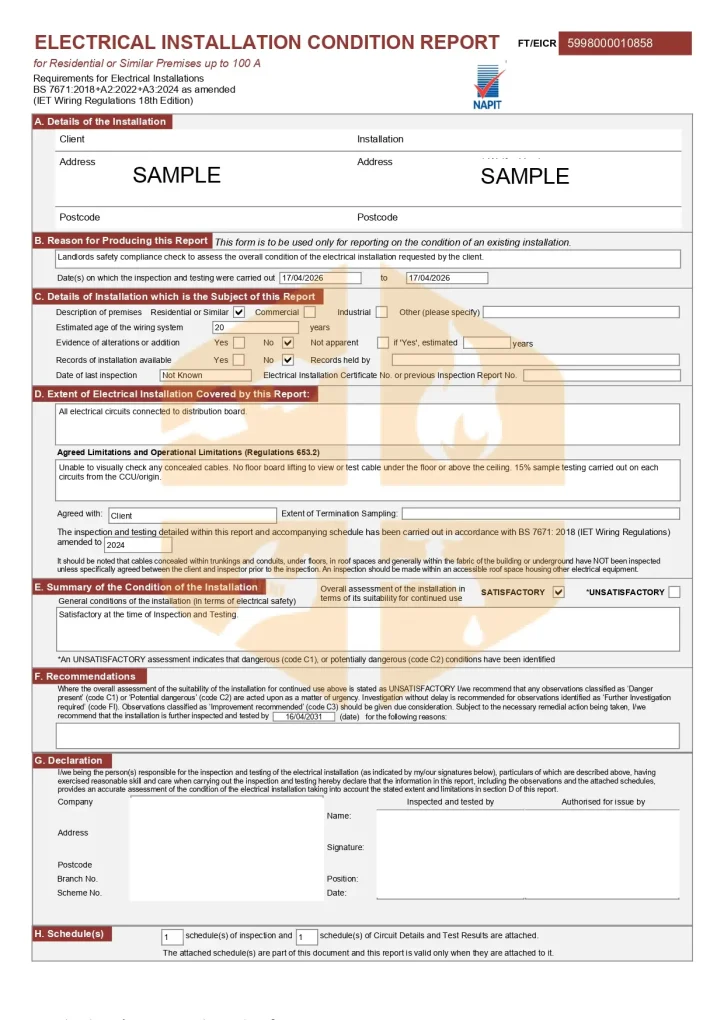
An EICR looks like an official certificate highlighting the details of the client (name, address), reason for producing this report, details of the installation (estimated age of wiring, premises type, installation record), extent and limitation of inspection, and summary of the condition of the installation (satisfactory, unsatisfactory).
What is the purpose of an EICR certificate?
The purpose of an EICR certificate is to assess the safety of a property while preventing electrical risks (overloaded circuits, fire hazards). An EICR certificate is more detailed than a visual inspection report, as a qualified technician tests various circuits and identifies possible hidden defects. This report determines whether electrical installations are in a satisfactory condition for continued service and do not have any potential electric shock risks, fire hazards, or defective electrical work. This report keeps a proper record of inspection and testing to ensure that electrical installations are safe to be used until the next inspection. It helps property owners find any electrical safety risks, damage, wear, or tear requiring immediate corrective actions.
The EICR certificate identifies any part of the electrical installation that does not meet the wiring regulations BS 7671. A qualified electrician can pinpoint any issue that may cause electrical shocks or high temperatures. The property owner can fix these issues to prevent non-compliance, fines, and legal issues arising from personal injury.
A landlord who rents out properties in the private sector is legally required to have an EICR certificate under the landlord certificates requirements and the Electrical Safety Standards in the Private Rented Sector (England) Regulations 2020. A landlord must have a valid EICR certificate before letting out a property to prevent non-compliance, delay the tenancy agreement, and reduce legal and insurance risks. Letting out private property without a satisfactory EICR certificate is a breach of the regulations and leads to fines up to £30,000.
A landlord needs an EICR to ensure that the property is safe for tenants and meets compliance requirements. It is the landlord’s duty of landlord is to send a copy to the existing tenants within 28 days of the inspection, once a landlord acquires an EICR report from a qualified electrician. A landlord must submit a copy to the local housing authority within 7 days of receiving a request. The landlord must share this copy with any prospective tenant within 28 days of receiving a request. The landlord must keep a record of a copy of an EICR certificate and provide it to the inspector during the next inspection.
What is the process for carrying out an EICR inspection?
An EICR inspection involves a safety assessment of a property’s fixed electrical installation to ensure that the system is compliant with current UK wiring regulations BS7671 and free from immediate or potential electrical hazards.
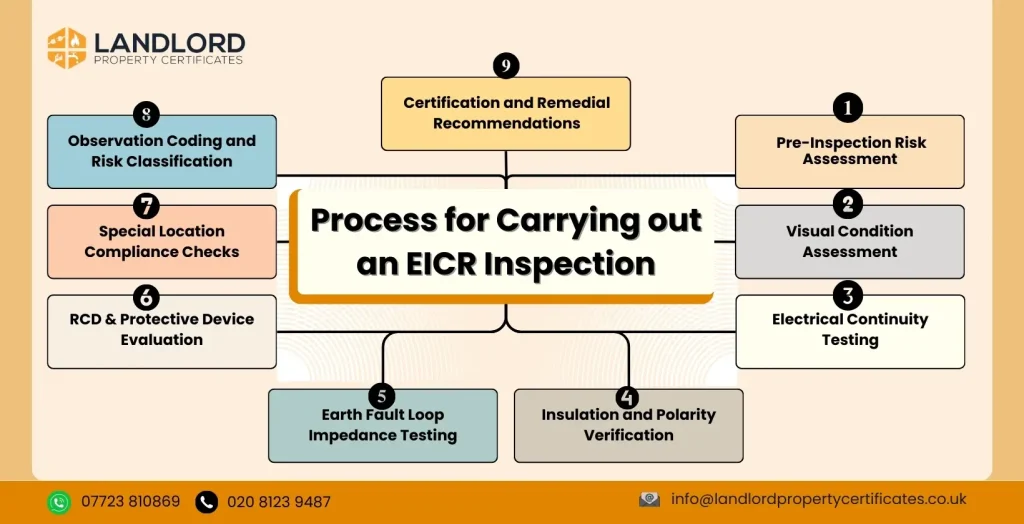
Listed below are the 9 steps of the EICR process.
- Pre-Inspection Risk Assessment
- Visual Condition Assessment
- Electrical Continuity Testing
- Insulation and Polarity Verification
- Earth Fault Loop Impedance Testing
- RCD and Protective Device Evaluation
- Special Location Compliance Checks
- Observation Coding and Risk Classification
- Certification and Remedial Recommendations
1. Pre-Inspection Risk Assessment
A qualified electrician performs a pre-inspection risk assessment and reviews age, layout, previous EICR reports, and usage of the property to determine testing limitations and potential hazards. An expert electrician checks old wiring systems, evaluates tenant occupancy, and looks into areas with restricted access. This electrician continues with a visual condition assessment after successful completion of the pre-inspection risk assessment.
2. Visual Condition Assessment
Visual condition assessment is a process of examining the electrical system’s visual aspects, such as damaged switches, outdated consumer units, cracked sockets, and exposed cables. A qualified electrician performs this non-intrusive inspection to identify visible signs of damage, wear and tear, poor artistry, and overheating. A qualified electrician starts testing conductors once a visual condition assessment is done.
3. Electrical Continuity Testing
Electrical continuity testing is a diagnostic procedure performed by a qualified electrician with the intention of validating the integrity of the electrical path within circuits, systems, and components. Continuity is an uninterrupted flow that is required for the proper functioning of an electronic device. A qualified technician performs an electrical continuity test to ensure that conductors (neutral, earth) are properly connected and continuous throughout the electrical system. An expert verifies insulation and polarity after performing electrical continuity tests.
4. Insulation and Polarity Verification
Insulation resistance is an overpotential test that a qualified electrician performs to measure leakage current between two conductors and another potential (ground). Expert operators check live and neutral connections to ensure that insulation is intact and conductors are properly wired. This testing is done by a qualified electrician to prevent leakage risks and to validate that connections are not reversed at sockets or switches to cause any electrical fault. This verification prevents hazards (electric shock and short-circuits) caused by deteriorating insulation within the electrical system. The electrician tests the Earth Fault Loop after verifying insulation resistance.
5. Earth Fault Loop Impedance Testing
A qualified electrician performs earth fault loop impedance testing on the electrical system by using a calibrated tester. The operator measures the resistance of the earth return path (Ze and Zs). This testing is conducted to ensure that enough fault current flows to trip circuit breakers/RCDs quickly and thereby reduce risks such as electric shock, fires, and equipment damage. The electrician examines the integrity of the entire circuit, including phase, earth conductors, and connections. Readings meet They check meet standards like BS 7671; if the results of testing show high impedance, they check. The electrician starts evaluating the protective device and RCD after impedance testing.
6. RCD and Protective Device Evaluation
A qualified electrician evaluates protective devices such as residual Current Devices and circuits to check how quickly they disconnect and to ensure that the system has proper shock protection mechanisms. The electrician presses the RCD test buttons to assess trip time to ensure that trip timing meets safety limits. RCD trip time limits are under 40 milliseconds (0.04 seconds) at 5x Rated Current (5 x IΔn) and under 300 milliseconds (0.3 seconds) at 1x Rated Current (IΔn). The electrician continues with compliance checks on high-risk areas (kitchen, bathroom) after a complete assessment of protective devices.
7. Special Location Compliance Checks
Higher-risk areas have stricter EICR (Electrical Installation Condition Report) rules under BS 7671 (18th Edition). A qualified electrician checks whether the electrical system has correct earth and bonding, mandatory 30 mA RCD protection, faster disconnection times, and suitable IP-rated equipment. Any inadequate and missing protection in a high-risk area is coded as C1 or C2 because the risk of electrical shock and fire is high. The electrician classifies defects found during testing after a thorough risk assessment in higher-risk areas.
8. Observation Coding and Risk Classification
A qualified technician formally records findings of all the testing and assessment. These findings are formally recorded and coded to demonstrate the level of risk and urgency of remedial work. The coding system ensures a clear legal and safety base for action. Immediate danger and risk of injury issues (exposed live conductors, damaged insulation) are coded as C1. Potentially dangerous faults (absence of RCD protection, inadequate earthing) are coded as C2. Unsafe installations like older consumer units without RCDs are classified as C3. An electrician adds code F1 in the report when the condition is not fully assessed. This qualified electrician issues a certificate after code classification.
9. Certification and Remedial Recommendations
A qualified electrician issues an EICR report with the results as “Satisfactory” or “Unsatisfactory” in line with BS 7671 (18th Edition) and UK housing regulations. The landlord needs to take immediate action for the C1 report and has 28 days to fix the issue mentioned in the C2. An electrician will issue a written confirmation that remedial work is done and issue a new certificate that demonstrates compliance with electrical safety standards.
Can you get an EICR online?
No, you can not get an EICR online because this inspection and testing require a qualified electrician to be present on-site. Electrical system inspection and testing involve live measurements, circuit testing, and visual checks that can not be done remotely. A landlord can book an EICR online and get a digital copy of the certificate online, but the inspection must take place at the property to meet the legal and safety requirements.
What are the common EICR issues uncovered during an EICR inspection?
The common EICR issues uncovered during an EICR inspection are described below.
- Outdated Wiring: Outdated wiring is one of the most frequently encountered findings in EICR reports, particularly in properties built before the 1970s. Inspectors flag it when the installed wiring no longer meets the current requirements of BS 7671, either due to age, material type, or degraded condition. The primary cause is simply the age of the property — older systems were designed for far lower electrical demands than modern households place on them, and materials such as rubber-insulated or lead-sheathed cables become brittle and crack over time. Outdated wiring is treated as a serious finding and will typically receive a C2 (Potentially Dangerous) code, causing the EICR to be rated Unsatisfactory. The risks are significant: exposed or degraded conductors can cause electric shock, short circuits, and electrical fires. Electrical Safety First reported that 53.4% of all accidental domestic fires in England in 2018/19 had an electrical origin. The solution is a targeted rewire of affected circuits or, in severe cases, a full property rewire carried out by a qualified electrician.
- Faulty Electrical Connections: Faulty electrical connections are a common EICR finding and occur when cable joints, terminal connections, or wiring within accessories become loose, corroded, or improperly made. Inspectors identify these through visual inspection and thermal testing, often discovering them inside consumer units, back boxes of sockets, and lighting pendants. The most frequent causes include DIY electrical work carried out without proper knowledge, vibration loosening terminals over time, and poor workmanship during original installation. A loose or faulty connection is classified as C2 or C1 depending on severity, and either code results in an Unsatisfactory EICR. Faulty connections generate localised heat at the point of resistance, which can ignite surrounding materials and cause electrical fires, often without any visible warning to the occupant. The remedy involves a qualified electrician opening all relevant accessories and consumer unit terminals, tightening or replacing connections, and re-testing the affected circuits.
- Insufficient Earthing and Bonding: Earthing and bonding deficiencies are among the most common causes of EICR failure across all property types. Insufficient earthing means the installation lacks an adequate path to carry fault current safely to earth, while inadequate bonding means metallic services such as gas and water pipes have not been properly connected to the earth system. Inspectors test earth loop impedance, continuity of protective conductors, and the presence of supplementary bonding in high-risk zones such as bathrooms and kitchens. This issue frequently arises in older properties where bonding cables are undersized, missing entirely, or incorrectly positioned — bonding must be installed within 3 metres of the water stopcock and gas meter and must be correctly labelled. Poor earthing is rated C1 or C2 and will always fail an EICR, as it elevates touch voltages and prevents protective devices from clearing faults quickly enough to protect occupants. The fix involves installing or upgrading main and supplementary bonding conductors using a minimum 10mm copper cable, verified by a competent electrician.
- Overloaded Circuits: Overloaded circuits are a particularly common finding in modern properties, driven by the growing number of high-power electrical devices connected to circuits that were designed for much lower loads. An EICR identifies overloading through inspection of the consumer unit, circuit breaker ratings, and assessment of connected loads versus circuit capacity. The issue arises when too many appliances draw current from a single circuit simultaneously, or when an installer has fitted an overrated overcurrent protective device that fails to trip under fault conditions. Overloaded circuits are coded C2 when the risk of overheating is present, rendering the EICR Unsatisfactory. Persistent overloading damages cable insulation, causes circuit breakers to trip repeatedly, and significantly increases the risk of fire. The solution is to redistribute electrical loads across additional circuits, upgrade the consumer unit, or install dedicated circuits for high-demand appliances.
- Defective Consumer Units: Defective or outdated consumer units are a very common EICR failure point, particularly in properties that have not been updated since the 1980s or 1990s. An EICR flags consumer units when they lack adequate RCD protection, show signs of heat damage, contain loose connections, have incorrect circuit labelling, or use older rewirable fuses instead of modern circuit breakers. The cause is typically age — older consumer units were manufactured to standards that are now superseded, and many do not incorporate the Type A or Type B RCD protection required for modern sockets and outdoor circuits. A defective consumer unit is rated C2 or C1 and will fail the EICR. The dangers include power surges, inability to safely disconnect under fault conditions, and electrical fires caused by heat damage within the unit itself. Replacement with a modern consumer unit containing full RCD protection, carried out by a Part P registered electrician, is the standard remedial action.
- Deteriorated Insulation: Deteriorated insulation is identified during EICR inspections through both visual examination and insulation resistance testing, and is a consistent finding in properties over 25 years old. The condition is defined as the breakdown of the protective outer sheathing or inner insulating material surrounding conductors, leaving live parts at risk of contact with earthed metalwork or occupants. Deterioration is caused by age, excessive heat, rodent damage, mechanical impact from fixings driven through cables, and the natural degradation of early PVC compounds. Low insulation resistance readings during testing will produce a C2 or C1 code and an Unsatisfactory EICR outcome. The risk is direct electric shock from exposed live conductors, earth faults, and fire from sustained arcing between conductors. Remedial action depends on the extent — localised deterioration may require replacing a section of cable, but widespread low resistance readings across multiple circuits typically necessitate a full or partial rewire.
- Non-Compliant Installations: Non-compliant installations are a broad but very common EICR category, covering any electrical work that does not meet the requirements of BS 7671 or the Building Regulations at the time of inspection. Inspectors encounter this most frequently where DIY alterations have been made, extensions added without notification, or where previous electricians carried out work to obsolete standards without updating affected circuits. The causes include unlicensed DIY work, unregistered contractors, and modifications made without the required Building Regulations notification under Part P. Non-compliant work is coded C2 or C1, depending on the danger it presents, and consistently results in Unsatisfactory EICR reports. The risks vary by nature of the non-compliance but include shock, fire, and — critically for landlords — regulatory penalties of up to £30,000 and invalidated insurance claims. Remediation requires a qualified and registered electrician to bring all affected work up to current BS 7671 standards and, where required, to obtain retrospective Building Regulations approval.
- Broken or Damaged Sockets and Switches: Broken or damaged sockets and switches are a routine finding in EICR reports, and while they may appear minor, they represent a genuine safety concern that inspectors take seriously. The issue is defined as any socket outlet, switch, or accessory that is physically cracked, has exposed internal components, shows signs of overheating, or has terminals that are loose or arcing. The causes include physical impact, age-related material fatigue, loose wiring behind the accessory, and sustained heat from poor connections over time. Depending on the severity, damaged accessories are coded C2 when live parts are exposed or overheating is present, causing the EICR to be rated Unsatisfactory. The danger to occupants is direct electric shock through cracked faceplates, particularly for children, and the risk of fire from sustained arcing within damaged terminals. Replacement of the affected accessory by a qualified electrician, including inspection and re-termination of the cables behind it, resolves the issue quickly and at low cost.
- Water Damage: Water damage to electrical installations is a serious EICR finding and is particularly common in bathrooms, kitchens, utility rooms, and properties with a history of roof or pipe leaks. Inspectors identify it through visual signs of corrosion, discolouration, rust on metalwork, moisture within consumer units or accessories, and failed insulation resistance tests on affected circuits. The cause is the ingress of water into electrical accessories, cables, or enclosures — either through ongoing leaks, condensation, flooding, or the installation of non-IP-rated fittings in wet zones such as bathroom shower areas. Water damage in proximity to live electrical parts is rated C1 (Danger Present) in severe cases, which is the highest risk code and demands immediate remedial action before the installation can be used safely. The risk to occupants is electrocution, as water dramatically reduces the resistance of the path through the human body, and the risk to the property is significant fire damage from short circuits and arcing within corroded components. Remediation involves removing and replacing all water-damaged components, addressing the source of water ingress, and ensuring all accessories in wet zones carry the correct IP rating as required by BS 7671.
- Lack of Residual Current Devices (RCDs): The absence or inadequacy of RCD protection is the single most common reason for EICR failure across all property types in the UK. An RCD is a life-saving device that detects imbalances in current caused by a fault and disconnects the circuit within milliseconds, before a fatal shock can occur. Older consumer units — particularly those installed before 2008 — frequently lack RCD protection on socket circuits, outdoor supplies, and bathroom circuits, all of which are now mandatory under BS 7671:2008 and the 18th Edition. Missing RCDs are coded C2 as standard, which immediately renders an EICR Unsatisfactory. Without RCD protection, a fault to earth — such as a person touching a live conductor — may not be cleared fast enough to prevent a fatal electric shock, and the installation remains at sustained risk of fire from undetected earth faults. The solution is either the installation of a new consumer unit incorporating full RCD protection, or the addition of individual RCBOs (combined circuit breaker and RCD devices) on circuits that currently lack protection.
- Inadequate Circuit Identification and Labelling: Inadequate circuit identification and labelling are common findings that are often underestimated in their importance during an EICR. It is defined as consumer unit circuits that are unlabelled, incorrectly labelled, or labelled in a way that does not correspond to the actual circuits they protect. This issue arises frequently after modifications, extensions, or consumer unit replacements where the installer failed to accurately document the updated circuit arrangement. Poor labelling on its own is typically coded C3 (Improvement Recommended), meaning it does not directly fail an EICR, but it can elevate the risk rating of other findings if it means faults cannot be safely isolated. The danger is practical but significant — in an emergency or during maintenance, an incorrectly labelled consumer unit can result in the wrong circuit being isolated, leaving live circuits exposed to workers or preventing a rapid response to a fault. The remedy is straightforward: a qualified electrician traces, tests, and correctly labels every circuit in the consumer unit, updating the circuit chart to reflect the current installation.
What is the Cost to get an EICR certificate?
The cost to get a domestic EICR certificate in the UK is between £120 and £300. The cost is dependent on the electrician’s cost per hour. The cost of getting a residential EICR certificate for a 3-bedroom house is more than for a 1-bedroom house. The cost for a 1-bedroom home is £150 – £180, a 2-3 bedroom house is £180– £200, and a 4- 5-bedroom house is £200– £30. An expert electrician charges £100 per consumer unit + £25 per circuit in London; the average cost is £200-300.

The cost of a commercial EICR certificate is £12 to £50 per circuit, excluding VAT. EICR cost in the United Kingdom is dependent on property size, geography, and the number of circuits. A medium-sized commercial building with several storeys and intricate electrical systems could range from £500 to £1,000. A qualified electrician charges £150 to £200 per day. An electrician quotes a fixed price for issuing an EICR certificate, and this quote includes the cost of the certificate and labour costs. An electrician provides an additional fee for repairs and fixes if your EICR certificate is not satisfactory.
Can you get an EICR free of cost?
No, you can not get an EICR free of cost because you need to hire a qualified electrician who charges £120 to £300 in the UK.
Does it cost to renew an EICR?
Yes, it costs around £120 to £300 to renew an EICR in the UK. Property owners hire a qualified electrician who inspects the electrical system and conducts various tests to determine the status and functionality of the current electrical system. The inspector issues an EICR certificate once testing and inspection are done. Property owners pay an additional price for getting repair services for issues identified in the EICR report.
How long does a landlord EICR last?
A landlord EICR lasts for only 5 years or according to the previous report in the entire UK. This EICR validity duration may become shorter, like one or two years, if an inspector recommends it. A landlord EICR validity period is five years in the four countries of the UK, namely England, Scotland, Northern Ireland, and Wales.
According to the Electrical Safety Standards in the Private Rented Sector (England) Regulations 2020, a landlord needs to renew an EICR certificate every five years.
According to The Renting Homes (Wales) Act 2022, a landlord must provide a valid EICR to tenants and plan an electrical system inspection every five years.
According to the Housing (Scotland) Act 2006, specially sections13-4A and 19B4, the landlord must get an electrical condition report and a portable appliance test before renting any private space.

Electrical inspections are mandatory by a competent person before a tenancy starts and at five-year intervals in Scotland. It is the legal duty of Scottish landlords to provide the latest EICR certificate copy to new and current tenants.
Section 10 of The Electrical Safety Standards for Private Tenancies Regulations (Northern Ireland) 2024 sets the regulations for the landlord’s EICR certificate. This regulation is enforced on 1st April, 2025. Northern Ireland’s Landlords are legally bound to provide a valid EICR to new tenants and existing tenants, while a landlord’s EICR will last for up to 5 years.
A general home’s EICR certificate is valid for up to 10 years. An exemption is for a residential property that is exposed to high risks like heavy moisture and extreme temperatures. For example, a property with a swimming pool requires a 1-year electrical system inspection, and its EICR certificate is valid for only one year. The property owner needs to hire a qualified electrician to inspect the pool’s special electrical system (pumps, lighting, and controls) annually.
A landlord needs to keep an EICR certificate for up to five years or till the next inspection. A landlord requires a valid electrical safety certificate every time before letting out a private home. An Electrical Installation Condition Report expires every 5 years for commercial properties, 3 years for industrial properties, 10 years for residential properties, and 5 years for private rented properties. An EICR must be renewed after its expiry date to maintain electrical safety and legal compliance.
How to renew an EICR certificate?
To renew an EICR certificate, a landlord checks the expiry date of the certificate and hire a qualified electrician who prepares the property by accessing consumer units, sockets, and fixed equipment to prevent inspection delay. An experienced electrician performs visual inspections and in-depth testing of the electrical system to assess its safety condition. A landlord receives the EICR report classifying the condition of the property as satisfactory or unsatisfactory, with observations coded as C1, C2, C3, and F1. A landlord hires an electrician to fix C1 or C2 issues within 28 days of getting an EICR report and obtains written confirmation about this remediation work from the electrician. A landlord receives a new EICR certificate from the inspector once the electrical system is fully compliant with the British Standard 7671.
How often EICR should be renewed?
An EICR should usually be renewed at least every 5 years for a rented property in England. This means the landlord must arrange a new electrical inspection and obtain a new Electrical Installation Condition Report before the existing report expires. The normal EICR frequency is 5 years, but the next inspection may be needed earlier if the current report gives a shorter date or if the electrical installation may no longer be safe. A landlord should also renew the EICR if major electrical work has been carried out, if the previous report is unsatisfactory, or if remedial work or further investigation was required. If the property is newly built or has been fully rewired, an Electrical Installation Certificate can usually be used instead of an EICR for the first 5 years.
What are the penalties of having no EICR?
The financial penalties for having no EICR for a landlord are up to £40,000. According to the Electrical Safety Standards in the Private Rented Sector (England) (Amendment) (Extension to the Social Rented Sector) Regulations 2025, the local council has regulatory duties and powers to ensure compliance with the regulations. The town council imposes an exact amount of financial penalty for non-compliance when a landlord fails to provide a valid EICR as requested by the authority. The monetary penalty for non-compliance with a valid EICR must not exceed £40,000.
According to the SouthWest Landlords Association (SWLA), a Hastings landlord has been fined £10,000 after failing to provide a satisfactory Electrical Installation Condition Report (EICR) to Hastings Borough Council in August 2024.
The local council has the authority to issue remedial notices and arrange emergency repairs at the landlord’s expense. The town council can restrict the ability to serve a Section 21 eviction notice that ultimately affects the landlord’s ability to manage and control the property and tenancy. A landlord may experience exposure to insurance invalidation, tenant legal claims, and reputation damage for non-compliance in London, especially when an electrical fire leads to personal injury or fire.
What are the 4 EICR classification codes?
The 4 EICR codes are used to demonstrate the urgency and severity of an electrical issue found during the inspection and testing of a property’s electrical system.
Listed below are the 4 EICR classification codes.
- C1: Code C1 indicates that an immediate life danger is present as the electrician’s installation is not safe at the moment. C1 demonstrates the highest electrical safety risk that needs immediate fixing by a qualified electrician on the same visit. Failure to take quick remedial action may lead to fire safety risks. C1 makes the results of EICR “unsatisfactory”. Exposed live wires and overheated sockets are some issues when qualified electricians mention Code C1 on the report.
- C2: Code C2 refers to a potentially dangerous condition and status of a property’s electrical system. It is a high-risk scenario that requires a landlord to arrange remedial actions urgently within 28 days or sooner. Code C2 on the EICR report automatically makes the condition of the electrical system UNSATISFACTORY. No earthing to metal light fittings and consumer units without adequate fault protection are some conditions considered potentially dangerous. These issues lead to fire risks if not fixed urgently.
- C3: Code C3 on the EICR report is interpreted as an improvement recommended by a qualified electrician. C3 is a low-risk code that indicates that the electrical installation is not unsafe, but they do not feel that current safety standards are complete. C3 makes the report satisfactory. The landlord fulfils safety standard requirements by following the improvements (replacing the old fuse box, integrating RCD protection on some circuits) recommended on the systems.
- F1: F1 code is translated as Further Investigation Required. An EICR report has F1 when the electrician has unclear test results and cannot confirm the safety status due to limited access. F1 makes the result report uncertain, as further investigation can clear the actual status of a specific electrical system. F1 makes EICR certification unsatisfactory until further investigation is completed. A qualified electrician issues an F1 code report upon getting inconsistent test readings for the underlying fault or inaccessibility to hidden wires in walls.
How long does an EICR safety check take?
An EICR safety check takes 2 to 4 hours. The main factors affecting the overall duration of EICR testing include age and condition of the electrical installation, property size, number of circuits, components (wiring, sockets, consumer units), accessibility, and presence of electrical defects.
What is an EICR testing Checklist?
An EICR testing checklist is a structured list of inspections and tests used by qualified electricians to assess the condition, compliance, and functionality of electrical installations while assessing the safety, condition, and compliance of an electrical installation.
An EICR testing checklist lets landlords identify and prevent electrical safety risks (fire hazards, electrical shocks) early while ensuring compliance and maintaining safety for occupants and tenants.
An EICR testing checklist includes non-intrusive visual inspection of electrical components (cables, circuits) for obvious defects (damaged sockets, signs of overheating. Inspectors perform earthing and bonding checks to ensure safe fault protection. This testing checklist verifies the correct operation of protective devices such as circuit breakers and Residual Current Devices/RCDs.
A qualified electrician performs tests on circuits such as polarity checks, sensitivity tests, insulation resistance tests, and RCD trip time testing. An EICR testing checklist involves testing functionality, usability, and safety of switches, sockets, and fixed equipment. This checklist includes additional testing for high-risk areas such as the bathroom, kitchen, outdoor circuits, and garage. A qualified electrician follows an EICR testing checklist, classifies each issue as C1, C2, or C3, and provides the outcome of testing in the report.
Who can conduct an EICR?
A qualified and competent person can conduct an EICR, according to the Electricity at Work Regulations (1989) and the Health and Safety at Work Act (1974). A qualified and competent person can perform an EICR because an electrician is trained under accredited Competent Person Schemes (NAPIT, NICEIC) and possesses qualifications such as City & Guilds 2391 or equivalent. This qualified person must understand IET BS 7671 Wiring Regulations and has practical knowledge and experience of electrical system inspection and testing. Anyone can carry out an EICR technically, but a report conducted by a registered electrician is considered valid for compliance and insurance purposes. Landlords are recommended to hire a registered electrician to get EICR reports.
At Landlord Property Certificates, we provide Electrical Installation Certificate Report services in London for all landlords. Our technicians are legally qualified to perform EICR at your property with 5+ years of experience.
What are the legal regulations for EICR in the UK?
The legal regulations for EICR in the UK are legal standards and rules designed to ensure electrical safety in rented properties.
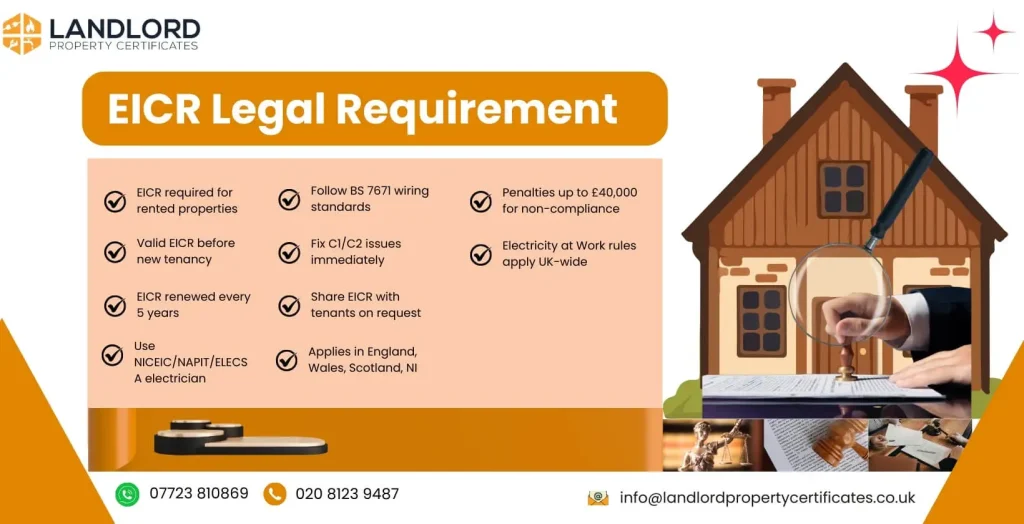
Listed below are six main legal regulations for EICR in the UK.
- Electrical Safety Standards in the Private Rented Sector (England) Regulations 2020: According to the Electrical Safety Standards in the Private Rented Sector (England) Regulations 2020, a landlord must obtain a valid EICR before letting out a property and provide a copy of the EICR report to existing and new tenants. A competent and qualified electrician, registered with NICEIC, NAPIT, or ELECSA, must be hired by a landlord to get an EICR certificate. A non-compliant landlord will pay £40,000 for not providing a valid EICR upon request.
- BS 7671 (IET Wiring Regulations) Compliance: The British Standard 7671 defines rules for all electrical inspections in the United Kingdom. BS 7671 sets the technical and safety requirements for the design, installation, inspection, and testing of electrical systems across the United Kingdom. A qualified and competent person confirms that circuits are safe for continued use. Any deviation from the set rules is coded as C1, C2, C3, or F1 in the EICR. This regulation sets the foundation for satisfactory or unsatisfactory outcomes of the EICR. Landlords, employers, and duty holders are legally bound to follow this electrical safety standard.
- Housing (Scotland) Act 2006: According to the Housing (Scotland) Act 2006, the EICR certificate is a legal requirement for all privately rented properties in Scotland. An EICR Inspection must be done every 5 years. This regulation is applicable to all tenancies, new and existing. A competent person must issue an EICR certificate after a complete inspection.
- Electrical Safety Standards in the Private Rented Sector (Wales) Regulations 2022: Electrical Safety Standards in the Private Rented Sector (Wales) Regulations 2022 make EICR a mandatory certificate for rented dwellings. The landlord needs to provide a report to the contract holder (tenant) and the local authority, if requested. This regulation made it clear that unsafe electrical installations must be fixed immediately.
- Electrical Safety Standards for Private Tenancies Regulations (Northern Ireland) 2024: The Electrical Safety Standards for Private Tenancies Regulations (Northern Ireland) 2024 mandate a valid EICR for private rented properties. This law requires electrical system inspection at least every 5 years by a qualified and competent person. According to the 2024 Electrical Safety Standards in Ireland, a landlord must provide a valid EICR to existing and new tenancies. It is the legal duty of the landlord to complete remedial work as required for unsatisfactory reports.
- Electricity at Work Regulations 1989: Electricity at Work Regulations 1989 is UK-wide legislation that mandates competency and inspection. This legislation sets rules that all electrical system to be safe, while only a competent person must carry out electrical system inspection and testing. This legislation considers the British Standards 7671 (IET Wiring Regulations) as a legal benchmark for wiring inspection.
When did EICR become mandatory?
EICR became mandatory for new tenancies in July 2020 and for all existing tenancies from April 2021 in London, according to the Electrical Safety Standards in the Private Rented Sector (England) Regulations 2020.
Who is responsible for EICR on commercial property?
The duty holder, a landlord, employer, or business owner, is responsible for EICR on commercial property, according to the Electricity at Work Regulations 1989 EAWR.
Do landlords have to provide an electrical certificate if unfurnished?
Yes, landlords have to provide an electrical certificate if unfurnished, as furnishing status does not affect EICR requirements. It is a legal duty of a landlord to give a valid EICR report to new and existing tenants, according to the Electrical Safety Standards in the Private Rented Sector Regulations 2020.
Do I need a new EICR for new tenants?
No, you do not need a new EICR for every new tenant if the existing EICR is still valid and satisfactory. The EICR frequency for rented homes is at least once every 5 years, unless the report gives an earlier next inspection date. A landlord must give a copy of the most recent valid EICR to a new tenant before they occupy the property. The landlord must also give the report to an existing tenant within 28 days of the inspection, to a prospective tenant within 28 days of a written request, and to the local council within 7 days if requested. A new EICR is needed if the previous report has expired, if the report required remedial work or further investigation, or if the landlord has reason to believe the electrical installation is no longer safe. If the EICR shows C1, C2, or FI observations, the landlord must complete the required work within 28 days or sooner if the report states a shorter deadline.
Does a plastic consumer unit fail an EICR?
No, a plastic consumer unit does not require an EICR if the plastic unit is in good working condition and shows no sign of damage, fault, or overheating.
Can you sell a property with an unsatisfactory EICR?
Yes, you can sell a property with an unsatisfactory EICR. An unsatisfactory EICR report may affect the sale price of a property as buyers negotiate the final offer based on the repair work to be done on the property. EICR is not legally required for a property sale, but a satisfactory EICR helps a property seller attract more buyers.
Can a tenant move in with an unsatisfactory EICR?
No, a tenant can not move in with an unsatisfactory EICR. A landlord must take all recommended remedial actions before letting the property out, according to the Electrical Safety Standards Regulations 2020.
Do holiday lets need an EICR?
Yes, holiday lets need an EICR in Scotland. It is mandatory for short-term let licenses to perform an EICR every 5 years and PAT testing under the Civic Government (Scotland) Act 1982 (Licensing of Short Term Lets) Order 2022. It is not legally required for holiday lets to have a valid EICR for holiday lets in England, Wales, and Northern Ireland, but it is recommended as best practice to get an EICR certificate.
What are EICR operational limitations?
EICR operational limitations are some conditions that prevent full inspections. Limitations include inaccessible areas (high ceilings, fixed furniture), safety risks to sensitive equipment (server racks, hospital machinery), and the client’s specified exclusions (not checking any specific area or circuit). Regulation 653.2 of BS 7671 requires that an electrical installation condition report (EICR) must detail the extent and any limitations of the inspection and testing. A competent person must include the reasons for those limitations and the name of the person who agreed to them.
What happens with an unsatisfactory EICR after 28 days?
Landlords face enforcement action by the local council, such as immediate remedial actions or repair at the landlord’s expense. Local councils impose fines up to £40,000 with an unsatisfactory EICR after 28 days, according to the Electrical Safety Standards Regulations 2020
How long does it take to get an EICR certificate?
It takes 1 or 2 days after an inspection to get an EICR certificate in the UK. Three factors affecting the duration of an EICR certificate are property size, number of circuits, and accessibility.
Who pays for the EICR: buyer or seller?
The seller usually pays for the EICR as part of due diligence, but sellers may pay for the report to speed up the process. There is no legal rule for the payee of an EICR; the buyer or seller negotiates this matter during the property sale.
Can domestic installers perform EICRs?
No, domestic installers do not perform EICRs as they are not qualified and certified enough to be considered a competent person for the job.
Can I produce an EICR without being NICEIC registered?
Yes, you can produce an EICR without being NICEIC registered, but you must be a competent person as defined by the Electricity at Work Regulations 1989.
Do I need an EICR for a structural survey?
You do not need an EICR for a structural survey because surveys and EICRs are separate inspections.
Do I need an EICR for a new fuseboard?
No, you do not need an EICR for a new fuseboard, but you need an Electrical Installation Certificate (EIC) for a new fuseboard to comply with BS 7671.
Do I need to be CPS registered to do EICRs?
No, you do not need to be CPS (Competent Person Scheme) registered to do EICRS.
What is the difference between EICR and EPC?
The main difference between an EICR and an EPC is what each document checks. An EICR checks the safety of the property’s fixed electrical installation, including wiring, sockets, switches, fuse board, earthing, and bonding. Private landlords must have the electrical installation inspected and tested by a qualified person at least every 5 years. If the EICR shows remedial work or further investigation is needed, the landlord must usually complete it within 28 days or sooner if the report says so.
An EPC (Energy Performance Certificate) checks the property’s energy efficiency, not electrical safety. It gives the property a rating from A to G, where A is the most efficient, and G is the least efficient. A landlord must usually have a valid EPC before marketing a property for rent, and the certificate is valid for 10 years. In most private rented homes, the property must have at least an EPC rating of E unless a valid exemption is registered.
What is the difference between EICR and EIC?
The main difference between EICR and EIC is that an EICR, or Electrical Installation Condition Report, is used to assess the safety and condition of an existing electrical installation, while an EIC, or Electrical Installation Certificate, is issued after new electrical work, a new circuit, or a major alteration has been completed. An EICR identifies faults, deterioration, damage, or safety risks in wiring, circuits, sockets, consumer units, and other fixed electrical parts, making it common for landlords, property buyers, and routine safety checks. An EIC confirms that newly installed electrical work has been designed, installed, inspected, and tested correctly at the time of completion. In simple terms, an EICR reports on the condition of existing electrics, while an EIC certifies newly completed electrical work.