A Fire alarm certificate is an official document confirming that the fire alarm system has been reviewed and meets the UK fire safety regulations. A fire alarm certificate proves that the fire system is operating as per the required standard and the property complies with fire safety legislation.
The main types of fire alarm certificates include installation certificates, testing certificates, design certificates, and servicing certificates.
A fire alarm installation certificate ensures that the system has been set up correctly, while the design certificate certifies that the design of the alarm system meets safety standards.
A fire alarm testing and commissioning certificate verifies that the system is operating as intended, whereas the servicing certificate demonstrates that the system has been inspected and well-maintained.
A design, installation, and commissioning certificate should be provided for fire detection and alarm systems, according to the 2019 Fire Safety Approved Document B edition.
What is a Fire Alarm Certificate?
A fire alarm certificate is an official document that verifies the operational and maintenance status of the fire detection and alarm system as per safety standards and regulations.
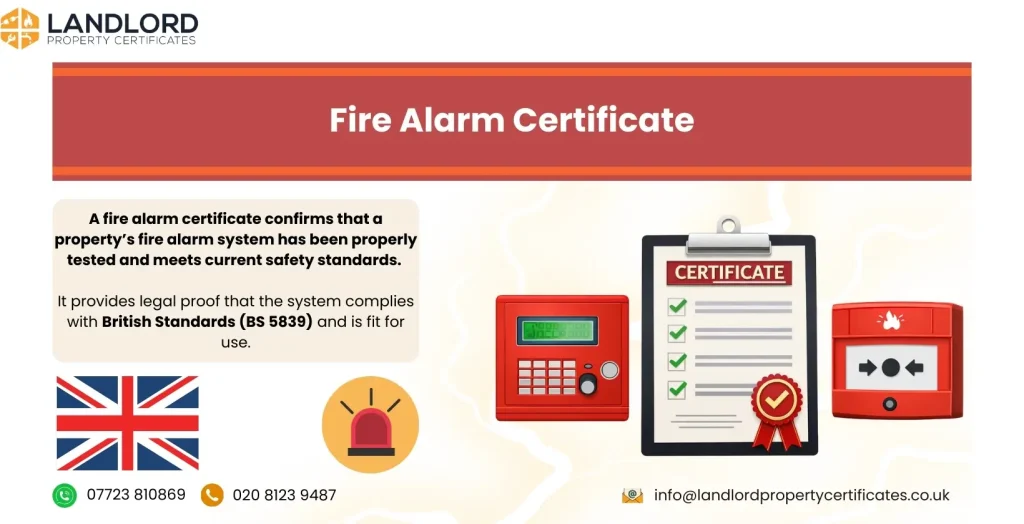
A fire alarm certificate acts as legal proof that the alarm system of a property is reliable to alert occupants in case of a fire. It proves that a certified body or qualified electrician has inspected the fire alarm system by following the current British standards (BS5839). Certified electricians and accredited firms issue a fire alarm certificate upon successful testing and compliance.
What does a fire alarm certificate look like?
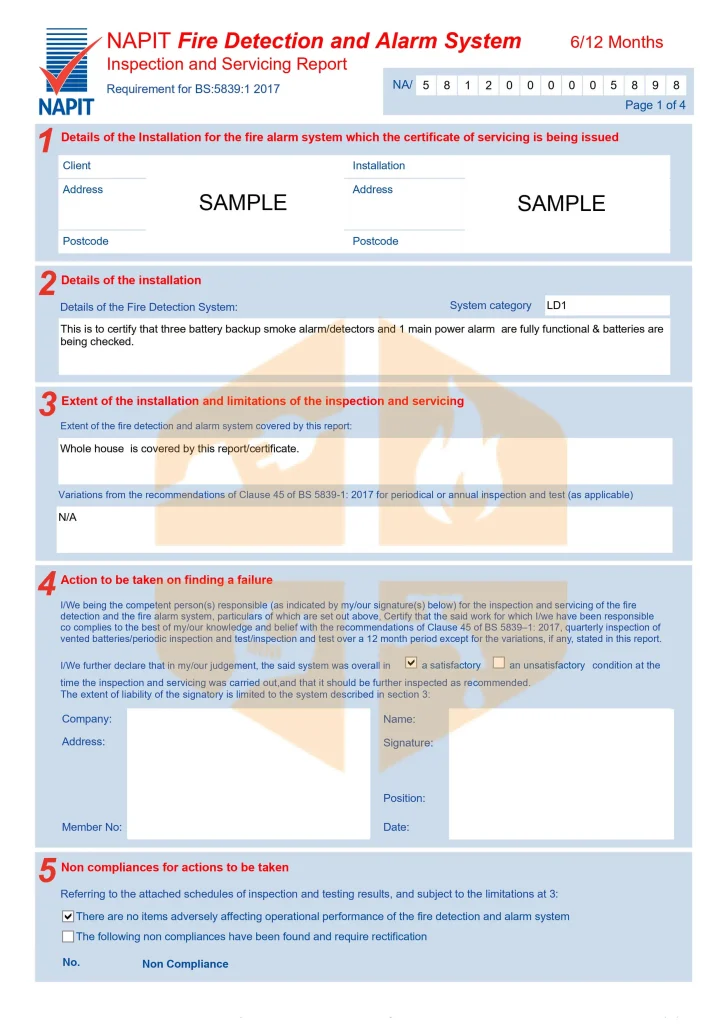
A fire alarm certificate looks like a BS 5849 form that includes details of the client, details of the fire alarm system, a complete record of system examination alongside maintenance recommendations, and the signature of qualified personnel responsible for the inspection with the date.
What are the differences between a domestic and commercial fire alarm certificate?
The main differences between a domestic and commercial fire alarm certificate lie in scope, compliance standards, certification body, certificate layout, and cost.
The scope of the domestic fire alarm certificate is limited to simple domestic properties with Grade D systems, such as standalone smoke or fire detectors. The scope of the commercial fire alarm is broader, as it covers large domestic properties and complex commercial properties with systems Grade A, Grade B, and Grade C.
A domestic fire alarm certificate is issued after verifying the fire alarm system functionality status based on British Standard/ BS 5839-6, whereas a commercial fire alarm certificate is issued based on BS 5839-1:2025.
Certification authorities for domestic fire alarm certificates are qualified installers, fire safety inspectors, or fire alarm companies registered with accredited bodies such as NICEIC (National Inspection Council for Electrical Installation Contracting) or FSA (Fire and Security Association). Certification authorities for commercial fire alarm certification are fire safety engineers or accredited fire protection companies, with certification verified by UKAS (United Kingdom Accreditation Service) accredited bodies or professional organisations like NSI (National Security Inspectorate) or FSA.
Domestic certificate layout includes details of the client (address, name), system grades (D1, D2), system category (LD, PD), design information (system overview, system design), dwelling type (size, class), and competent person information. Commercial fire alarm certificate layout is more complex than the domestic one; it includes client details, system grades, system category, component details, installation and maintenance details, safety codes, and a declaration from a qualified person or company. The cost of a domestic fire alarm certificate is lower than that of a commercial one. The cost for getting a domestic fire alarm certificate for up to 3 detectors is £49 to £90 + VAT, while the cost of a commercial fire alarm certificate is £100 to £140.
Who needs fire alarm certificates?
A responsible person needs a fire alarm certificate, according to the UK’s Regulatory Reform (Fire Safety) Order 2005. A responsible person is defined as an individual or entity having control over non-domestic premises, such as common areas of flats, rented properties, houses in multiple occupation/ HMOs. A responsible person could be an employer, owner, landlord, or property manager.
Listed below are all the entities that need fire alarm certificates in the UK.
- Business Owners: Business owners need a fire alarm certificate to meet legal standards and regulations under the Fire Safety Order (2005). A fire alarm certificate ensures that the building provides a safe environment for both employees and customers. The London Fire Brigade (LFB) provides extensive guidance for businesses and emphasises proper installation, maintenance, and testing of fire detection and suppression systems.
- Landlords: Landlords need a fire alarm certificate to protect tenants from fire hazards. According to the Smoke and Carbon Monoxide Regulations 2015, a landlord must install a smoke alarm on each floor and check the working condition of alarms at the start of tenancy. According to the Regulatory Reform (Fire Safety) Order 2005, landlords must take appropriate fire safety precautions in non-domestic and communal areas. The UK Government provides guidance for private landlords’ duties to install and maintain alarms by following fire safety regulations. A fire alarm certificate is categorised under the most important landlord certificates (Emergency Lighting Certificate, Gas Safety Certificate) as it helps landlords stay compliant with fire safety regulations in the UK.
- Educational Institutes: Educational institutes (schools, colleges) need a fire alarm certificate to meet fire safety regulations and protect students and staff from fire hazards. According to the Fire Safety Order 2005 for England, the responsible person of an educational institute must perform a fire risk assessment and implement appropriate fire safety measures, such as a fire detection and alarm system, emergency lighting, clear escape routes, and training.
- Healthcare Facilities: Healthcare facilities (Hospitals, Clinics, Care Homes) need a fire alarm certificate to protect facility staff and patients from fire hazards. According to the London Fire Brigade’s advice for residential care homes, a responsible person must install and maintain proper fire detection systems and sprinklers in the facility. It is the duty of a responsible person to provide a zone chart with the alarm so staff and firefighters can easily identify which alarm has been activated.
- Public Spaces: UK Public spaces (shops, restaurants) require a fire alarm certificate to provide a safe environment for customers and employees, under the Regulatory Reform (Fire Safety) Order 2005. The responsible person must install, maintain, and test the fire detection and alarm system to protect occupants of public spaces against fire hazards.
- Hotels and Hostels: Hotels and hostels require a fire alarm certificate to meet fire safety compliance requirements. According to the UK government guidelines regarding fire safety at the workplace, a responsible person must carry out a fire risk assessment and take necessary fire safety measures to protect staff and occupants at the workplace.
Is a fire alarm certificate the same as a smoke alarm certificate?
No, a fire alarm certificate is not the same as a smoke alarm certificate. A fire alarm certificate verifies the functionality status of smoke detectors, heat detectors, carbon monoxide detectors, and manual call points. A smoke detector certificate only verifies the functionality status of smoke alarms that detect smoke particles.
Fire alarm certificate in London covers complete fire detection and alarm systems, including call points, control panels, and different kinds of detectors. Fire alarm certificate verifies that the complete system is installed correctly and functioning properly while meeting British fire safety standards. A smoke alarm certificate is a legal proof that a smoke detector is installed properly and functions as per the safety standard requirements.
What are the different Fire alarm certificates?
The different fire alarm certificates are the fire alarm design certificate, fire alarm maintenance certificate, fire alarm installation certificate, fire alarm completion certificate, and fire alarm serving certificate.

What Certificates Are Required for Fire Alarm System Design?
The certificates required for fire alarm system design compliance include the Fire Alarm Design Certificate and Fire Detection and Alarm System Design Certificate.
Listed below are the certificates required for fire alarm system design.
- Fire Alarm Design Certificate: A fire alarm design certificate is an official document confirming that the fire alarm system has been designed to meet safety and regulatory standards BS 5839-1:2025. BS 5839-1:2025 is a code of practice that provides recommendations for the design, installation, commissioning, and maintenance of fire detection and fire alarm systems in non-domestic premises. Accredited organisations and fire safety professionals issue a fire alarm design certificate. It includes client details, system layout, the objective of protection proposed, types of premises, a brief description of the area covered, certification of design, and details of the certification authority (position, signature).
- Fire Detection and Alarm System Design Certificate: The Fire Detection and Alarm System Design Certificate is an official document confirming the proper design of a fire detection and alarm system. It ensures that system design is effective in detecting and alerting users in the event of fire. Fire engineers or specialists in fire safety design issues use this certificate. It includes system layout, power supply, and integration of detection and alarm design. Fire Detection and Alarm System Design Certificate confirms that the system has been designed to meet quality, performance, and safety requirements as per BS 5839.
- Professional Certification of Fire Alarm System Design: Professional certification of a fire alarm system design is a legal document verifying that the alarm system design has been reviewed and approved by a qualified fire safety expert as per British Standard 5839-1. This certification ensures that experts rigorously test the fire alarm design and that it is fully compliant with fire safety laws. Licensed professionals and fire safety certification bodies issue professional certification of Fire alarm System design. Professional certification of a fire alarm system design includes a complete review of the design document, confirmation of professional expertise, and verification of standards compliance.
What Certificates Are Issued for Fire Alarm Installation and Commissioning?
Fire alarm installer certification, fire alarm completion certificate, and certificate of design, installation, and commissioning are issued for fire alarm installation and commissioning.
Listed below are four certificates issued for fire alarm installation and commissioning.
- Fire Alarm Installation Certificate: A Fire Alarm Installation Certificate is an official document verifying that a fire alarm system has been installed by following fire safety compliance standards. An accredited fire safety professional or fire alarm installation company issues this certificate after testing components of the fire alarm system. This certificate ensures that the system meets all safety and regulatory requirements (Building Regulations 2010, Fire Safety Order 2005), and now it’s ready for use. Fire Alarm Installation Certificate layout includes client details, system details, inspection/testing of the wiring system, contractor details, competent person info, design specification, and reference document against the system that was installed.
- Fire Alarm Completion Certificate: A Fire Alarm Completion Certificate is an official document verifying that a fire alarm system has been installed and is available for commissioning. This certificate confirms that the system is ready for operation and testing. Fire safety engineers issue this certificate after completion of the fire alarm system setup. A fire alarm completion certificate is issued to confirm system readiness for the final stages of testing and commissioning.
- Certificate of Design, Installation, and Commissioning: A Certificate of Design, Installation, and Commissioning is an official document confirming that the fire alarm system has been designed, installed, and commissioned as per regulatory standards such as BS 5839-1. Certificate of Design, Installation, and Commissioning guarantees the safe functionality of the fire alarm system in case of a fire emergency. A qualified fire alarm engineer issues this certificate after testing the fire alarm system setup from its design to installation and commissioning based on safety codes. Certificate of Design, Installation, and Commissioning includes details of the client, details of the fire detection and alarm system, system category and grade info, user instructions, and the signature of a competent installer.
- Fire Alarm Installer Certification: A Fire Alarm Installer certification is a competency proof of an individual or company confirming that the certified person/company is qualified to install and maintain fire alarm systems. NICEIC and FIA issue Fire alarm installation certificates when a professional completes Level 3 Advanced Qualifications (Installer, Maintainer, Commissioner, Designer) with mandatory Foundation modules. Domestic or commercial building owners and landlords should check this certification to ensure that only a competent person installs a fire alarm system to meet safety compliance requirements. This certification is issued to a qualified person who has undergone necessary training and has the required experience and knowledge to carry out installation by following safety standards and regulations.
What Certificates Confirm Fire Alarm Testing, Inspection, and Verification?
Fire Alarm Maintenance Certificate and Fire Alarm Servicing Certificate confirm fire alarm testing, inspection, and verification.
Listed below are two main certificates used to confirm fire alarm testing, inspection, and verification.
- Fire Alarm Maintenance Certificate: A Fire Alarm Maintenance Certificate is an official document verifying that the fire alarm system has been inspected and maintained regularly. Fire Alarm Maintenance Certificate includes documentation of checks on system components (detectors, panels), details of the competent person performing routine checks, maintenance task descriptions, and details of the contractor. This certificate is used as proof that the alarm system is operational and fully compliant with regulations. Regular alarm maintenance reduces the risk of malfunction during an emergency.
- Fire Alarm Servicing Certificate: A Fire Alarm Servicing Certificate is an official document confirming that the fire alarm system has been inspected and serviced to maintain its optimal condition. Fire Alarm Servicing Certificate includes details of the client, system info, extent of installation, limitations of inspection and servicing, details of the electrical contractor, and a summary of inspection and servicing. Servicing of the fire alarm is done on an annual basis. Servicing frequency is based on system complexity and building type. Fire Alarm Servicing Certificate verifies that the system has been professionally serviced to prevent failure in case of a fire emergency.
What Certificate Is Needed for Fire Alarm System Modifications?
Fire Alarm Modification Certification is required for fire alarm system modifications.
- Fire Alarm Modification Certificate: A Fire Alarm Modification Certificate is an official document confirming that modifications have been made to an existing fire alarm system while staying compliant with fire safety standards and regulations. A Fire Alarm Modification Certificate covers any changes and upgrades made to an existing fire alarm system, such as replacement, reconfiguration, or addition of components (panels, detectors). A certified fire safety engineer or the installation company issues this certification after the modification is completed. This certificate works as legal proof that the system is modified correctly and continues to meet the required safety standards after all the modifications. The layout of the Fire Alarm Modification Certificate includes alarm system details, client details, modification info, testing, drawings, particulars of the contractor, and competent person details.
What Certificates Cover the Fire Alarm System and Its Core Components?
Fire Alarm System Certificate, Fire Alarm Panel Certification, Fire Alarm Safety Certificate, and Type Approval Certificate cover the fire alarm system and its core components.
Listed below are four main certificates covering the fire alarm system and its core components.
- Fire Alarm System Certificate: A Fire Alarm System Certificate is an official document confirming that the entire fire alarm system has been installed, designed, and tested by following fire safety standards and regulations (BS 5839). It includes details like system grade, system design, installation, testing, and a competent person’s signature. A fire alarm certificate is required by managers, employers, building owners, and businesses to demonstrate that the system meets fire safety compliance requirements. Accredited fire safety engineers or system installers issue the Fire Alarm System Certificate. This certificate ensures that the fire alarm system status is reliable and safe; this assurance is required for insurance.
- Fire Alarm Panel Certification: A Fire Alarm Panel Certification is an official document verifying that the control panel of the fire alarm has been installed and tested based on required safety standards. Fire Alarm Panel Certification is issued by UKAS-accredited third-party certification bodies ( SSAIB, NICEIC, NSI). Facility managers use this certificate to ensure that the system panel is properly tested and is working as a reliable central hub of the fire alarm system.
- Fire Alarm Safety Certificate: A Fire Alarm Safety Certificate is an official document stating that the fire alarm system is safe and reliable based on safety and operational standards. This certificate provides a detailed inspection report of all components of the system. Businesses, property owners, and managers use a fire alarm safety certificate to confirm that the system is safe and functional to prevent potential fire hazards. Accredited fire safety engineers issue a fire alarm safety certificate.
- Type Approval Certificate: A Type Approval certificate is an official document certifying that a fire alarm system and its components meet all required safety, environmental, and quality standards. This certificate serves as legal proof that the fire alarm system and its components have undergone all the necessary testing to prove safety and functionality as per the required quality standards. Manufacturers of fire alarm systems require a Type Approval certificate to continue mass production of fire alarm systems, and before using or selling the system. A type approval certificate is issued by the British Standards Institution (BSI) or Intertek Testing & Certification Ltd.
What Certifications Prove Fire Alarm Technician or Designer Competence?
Fire Alarm Technician Certification, Fire Alarm Designer Certification, ESA Certified Fire Alarm Designer (CFAD), and FD&A Advanced Designer qualification prove fire alarm technician and designer competence.
- Fire Alarm Technician Certification: A Fire Alarm Technician Certification is an official document certifying that an individual has the necessary skills, training, and knowledge to install, maintain,n and repair fire alarm systems. A Fire Alarm Technician Certification ensures that a fire alarm technician is qualified enough to install, test, and service an alarm system as per fire safety standards. FIA and the National Examination Board in Occupational Safety and Health (NEBOSH) issue the Fire Alarm Technician Certification. This certification covers practical knowledge of fire system components, compliance requirements, installation methods, testing processes, maintenance, and troubleshooting.
- Fire Alarm Designer Certification: The Fire Alarm Designer Certification is an official document confirming that an individual has the required expertise to design a fire alarm system while staying compliant with fire safety regulations and standards. A Fire Alarm Technician Certification ensures that a designer is capable of creating a fire alarm system layout and selecting appropriate components while integrating systems properly by following safety codes. The Fire Industry Association (FIA) and the British Standards Institution (BSI) issue Fire Alarm Designer Certification. A technician needs this certification to work as a fire alarm system designer for large and complex installations (industrial and commercial settings). The course outline of Fire Alarm Designer Certification includes system design, selection of appropriate components, fire risk assessment, and compliance guidelines.
- ESA Certified Fire Alarm Designer (CFAD): ESA Certified Fire Alarm Designer (CFAD) is an official document issued by the Electronic Security Association (ESA) certifying that a fire alarm designer has the required competency for designing systems as per national fire codes. A fire alarm system designer needs to pass an examination on fire alarm design concepts and safety compliance codes to obtain this certificate. The main focus of CFAD is system documentation, detector selection, code application, design development, supervisory devices, testing, and maintenance. This certification demonstrates that a fire alarm designer is competent to design complex fire alarm systems and has knowledge of stringent safety standards.
- FD&A Advanced Designer Qualification: The FD&A Advanced Designer Qualification is an advanced qualification provided by the Fire Detection & Alarm Association (FD&A) to a professional alarm system designer. The FD&A Advanced Designer Qualification ensures that a professional is an expert in designing and integrating complex fire alarm systems. This qualification is required for designers who intend to work on high-risk, complex, and large-scale environments needing advanced fire detection and alarm systems. A fire alarm system designer learns about designing and specifying advanced fire alarm systems for complex buildings and becomes an expert in complex detection strategies and system integration.
What fire alarm certificate is required for HMO properties?
The fire alarm certificate in compliance with BS 5839-1 is required for large HMO properties with 3-storey properties with Grade A LD1 fire alarm systems. The fire alarm certificate in compliance with BS 5839-6 is required for small HMO properties with Grade D LD2 fire alarm systems.
Do landlords need fire alarm certificates for rental properties?
Yes, landlords need fire alarm certificates for private rental properties. According to the Regulatory Reform (Fire Safety) Order 2005, a landlord must provide an alarm system and maintain a complete record of the system’s maintenance and servicing to meet compliance requirements. This UK law applies to communal areas of rental properties, flats, and HMOs
What are the specific fire alarm certification requirements in the UK?
In the UK, fire alarm certification requirements depend on the property type, fire risk level, and fire alarm category. BS 5839-1 applies to commercial buildings, non-domestic premises, and communal areas in residential blocks. BS 5839-6 applies to domestic properties, flats, houses, and individual dwellings.
A fire alarm certificate is normally required after installation, commissioning, major alteration, inspection, testing, or periodic servicing. The certificate should confirm that the fire alarm system has been checked against the relevant BS 5839 standard and should record any faults, limitations, defects, or recommendations.
Commercial properties, HMOs, blocks of flats, offices, shops, warehouses, and managed buildings usually need professional fire alarm servicing at least every six months. The responsible person, landlord, or managing agent should also arrange regular user checks, including weekly manual call point testing where required.
Fire alarm records must be kept in a fire logbook or property compliance file. These records should include commissioning certificates, servicing certificates, inspection reports, weekly test logs, fault records, false alarm records, and repair documents.
For domestic rented properties, landlords must provide suitable working smoke alarms and, where required, heat alarms. HMOs and licensed rental properties usually have stricter alarm requirements based on layout, occupancy, risk level, and local authority licensing rules.
The certificate should be issued by a competent fire alarm engineer with relevant BS 5839 knowledge, practical experience, and suitable training. Level 3 Fire Detection and Alarm qualifications, FIA training, EAL fire alarm qualifications, or equivalent certification can help prove competence. BAFE accreditation is not always legally required, but many insurers, landlords, housing providers, and commercial clients prefer it.
How much does a fire alarm test certificate cost?
A fire alarm test certificate costs around £49 to £90 + VAT for up to 3 alarm or smoke detectors. The cost for getting a domestic fire alarm certificate for up to 3 detectors is £49 to £90 + VAT. The cost of a commercial fire alarm certificate is £100 to £140.
Who is authorised to issue fire alarm certificates?
The certified fire alarm engineers and accredited companies registered with BAFE (British Approvals for Fire Equipment) or NICEIC (for electrical aspects) are authorised to issue fire alarm certificates. Firms with FIA membership are authorised to issue fire alarm certificates. Under the Regulatory Reform (Fire Safety) Order 2005, work must be carried out by competent persons. Registration with recognised third-party schemes such as BAFE, NICEIC, or membership of the Fire Industry Association is widely accepted as evidence of competence by fire authorities, local councils, and insurers.
What is a fire detection and alarm system inspection and test certificate?
A fire detection and alarm system inspection and test certificate is an official document certifying that the fire detection and alarm system has been inspected and tested in accordance with BS 5839 for safety and functionality purposes.
Can electronic signatures be used on fire alarm certificates?
Yes, electronic signatures can be used on a fire alarm certificate, according to the UK Electronic Communications Act 2000.
Are free verification certificate templates available for fire alarms?
Yes, free verification certificate templates (completion test certificates, commissioning forms based on BS 5839 standards) are available for fire alarms online.
How often must fire alarm certificates be renewed for HMO properties?
Fire alarm certificates must be renewed annually for HMO properties. This certificate must be renewed after major changes and repairs to the fire alarm system. BS 5839-6 recommends regular inspection, testing, and record-keeping for domestic systems.
Do HMO-licensed houses specifically require NICEIC fire alarm certificates?
HMO-licensed houses don’t require specific NICEIC fire alarm certificates. London Boroughs require proper documentation for the installation, maintenance, and testing of suitable fire alarms, as part of licensing applications or renewals.
What does a yearly fire alarm certificate cost for a 5-bedroom rental property?
A yearly fire alarm certificate costs range from £100 to £250 for a 5-bedroom rental property.
How much should landlords expect to pay for annual fire alarm certification?
Landlords should expect to pay £150–£300 for annual fire alarm certification of HMO properties with more complex systems. They expect to pay £80–£150 as an annual fire alarm testing and certification fee for a standard rental property (non-HMO).
What is the proper procedure for completing a fire alarm certificate?
The proper procedure for completing a fire alarm certificate includes hiring a competent person, getting alarm work done by a competent person, testing and maintenance of the alarm system, and finally getting a certificate.
Is fire alarm testing certification a legal requirement?
Yes, it is a legal requirement to acquire fire alarm testing certification under the Regulatory Reform (Fire Safety) Order 2005 for commercial, residential, and rental properties.
What qualifications are needed to test and certify fire alarm systems?
In the UK, there is no single mandatory legal qualification required to test and certify fire alarm systems.
However, fire alarm testing and certification must be carried out by a competent person with appropriate fire alarm training, practical experience, and working knowledge of BS 5839 standards. Qualifications such as the Level 3 Fire Detection & Alarm (FD&A) Certificate, FIA fire alarm training courses, and equivalent fire alarm system qualifications help demonstrate competence.
For commercial fire alarm systems, technicians should be trained in BS 5839-1, while domestic fire alarm systems require knowledge of BS 5839-6. Third-party certifications such as BAFE are not legally required, but they are widely recognised by landlords, insurers, housing providers, and commercial property owners as evidence of competence and compliance.
Who bears responsibility for signing fire alarm certificates?
Certified fire alarm engineers, Accredited companies, and contractors bear responsibility for signing fire alarm certificates. Under UK law, the Regulatory Reform 2005/ RRO, a competent person must sign a fire alarm certificate. A competent person has knowledge, training, and experience to ensure that the system is fully compliant with British Standards (BS 5839).
Who is authorized to sign fire alarm acceptance certificates?
A competent person, a qualified fire alarm technician or designer, is authorised to sign fire alarm acceptance certificates. According to British Standard 5839, a competent person must have knowledge, experience, tools, and training to certify the installation, design, and functionality of a fire alarm.