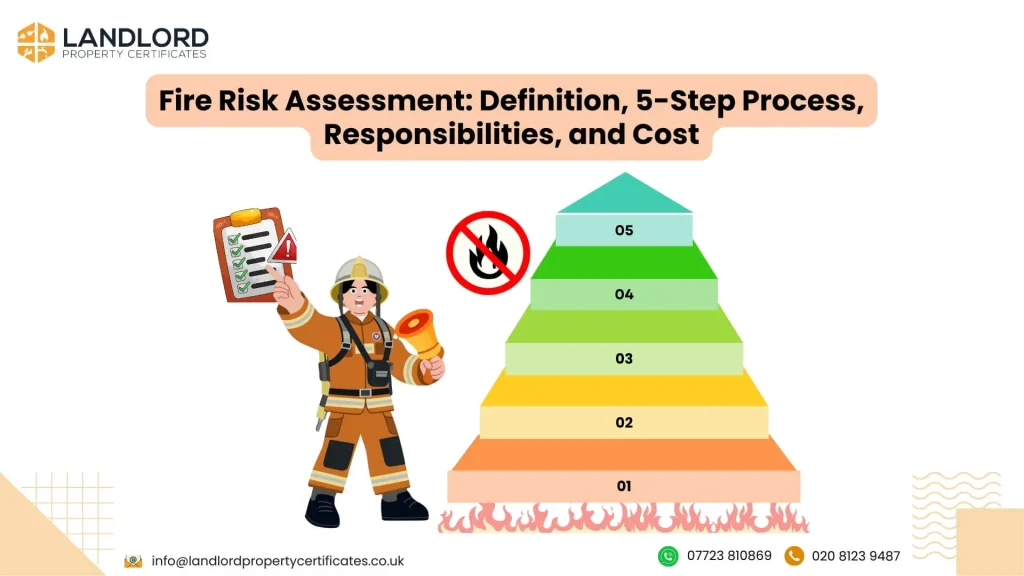
A Fire Risk Assessment (FRA) is a systematic evaluation and legal inspection of a building to identify fire hazards and suggest the safety measures to improve the safety of people.
The process of fire risk assessment includes fire risk assessment, elimination, documentation of results, training of employees, and assessment review. The landlord is legally responsible for conducting a fire assessment and has a duty to ensure it is done properly. A professional fire assessor or a person with proper training and experience in fire assessment can perform the fire assessment process.
FRAs do not have any expiry date, but it is necessary to review them regularly (once a year). The cost of a fire assessment in the UK is between £200 and £600 for small or residential premises. The cost of a fire assessment for commercial locations such as hospitals or multi-storey offices is £1000 -£1,500.
What is a Fire Risk Assessment?
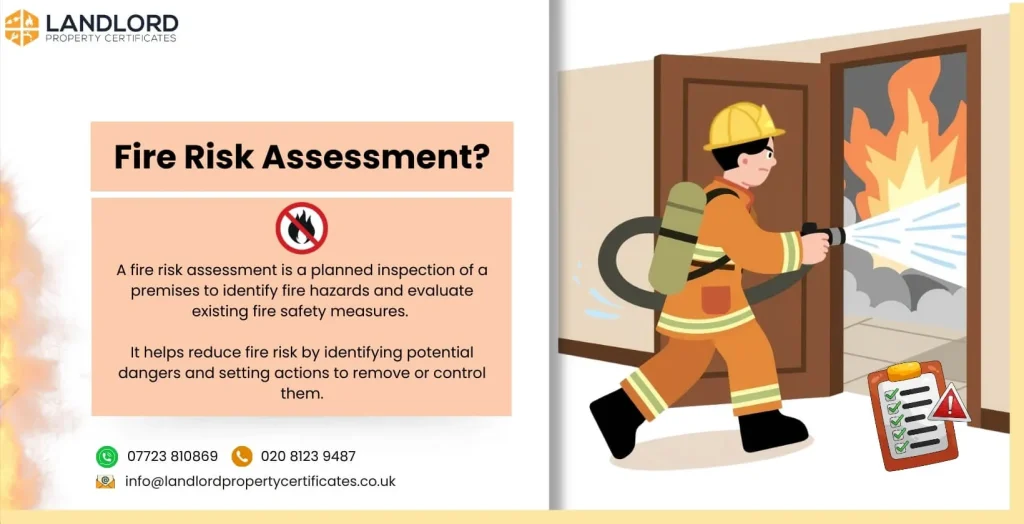
Fire Risk Assessment is a planned examination of a premise to recognise fire risks, how they harm a building, and measure the current fire safety controls. The fire risk assessment reduces the fire risk by determining fire risk and providing a strategy to avert or remove potential fire risks.
Fire risk assessment Certificates for a landlord in London are a legal requirement to ensure building safety. According to the UK Regulatory Reform (Fire Safety) Order 2005, fire risk assessment is a legal obligation to safeguard people from fire hazards.
What is the purpose of fire risk assessment?
The purpose of Fire Risk Assessment (FRA) is the examination of a premises to identify the fire hazards and take appropriate measures to decrease the chances of fire hazards and provide occupant safety. Fire Risk Assessment (FRA) is conducted as a legal procedure as specified by UK legislation, the Regulatory Reform (Fire Safety) Order 2005.
An FRA is a guidebook to eradicate or reduce risks with the installation of fire alarms, the presence of a clear escape route, and the provision of proper firefighting equipment. FRA is critical in safeguarding lives and property, as well as avoiding business interruption and responding to insurance requirements, in addition to legal compliance according to the LPC (London Plan Policy).
What are the components of fire risk assessment?
The components of fire risk assessment are to identify the fire hazards, the sources of ignition (fuel and oxygen), and provide safety measures to avoid fire hazards. The fire risk assessment provides the safety to people who are at the greatest fire risk, such as the factory workers, visitors,s and the vulnerable groups.
The fire risk assessment analyses the current safety precautions to eliminate or minimise the fire hazards. The fire risk assessors check the building construction in accordance with fire-resistance and the efficiency of fire detection facilities, alarms, and fire-fighting equipment such as extinguishers, according to the Building Safety Act 2022. The fire risk assessment records all findings, designs an emergency plan, and provides staff with fire safety training.
What is a Fire Risk Assessment Report?
A Fire Risk Assessment Report is a written, formal report that involves assessing a premises and the identification of fire hazards. This Report also involves the assessment of current or proposed fire safety measures and procedures to reduce the fire risk.
A Fire Risk Assessment Report finds the source of ignition and combustible substances, assessing the risk to people, and recording an action plan to eliminate or minimise the identified fire risks. This report offers a systematic way of safeguarding people and their property from fire hazards.
This Report is necessary under the UK law of the Fire Safety Order 2005. A Fire Risk Assessment Report sets a clear plan of action with respect to preventative and protective strategies and measures.
What does a Fire Risk assessment report look like?
A professional Fire Risk Assessment (FRA) report is a detailed, multi-page ( 20 to 50 pages) report in the UK, with a structured assessment of the fire risks of a building. It starts with an executive summary and builds details, including the type of construction and occupancy details of fire instruments and their safety.
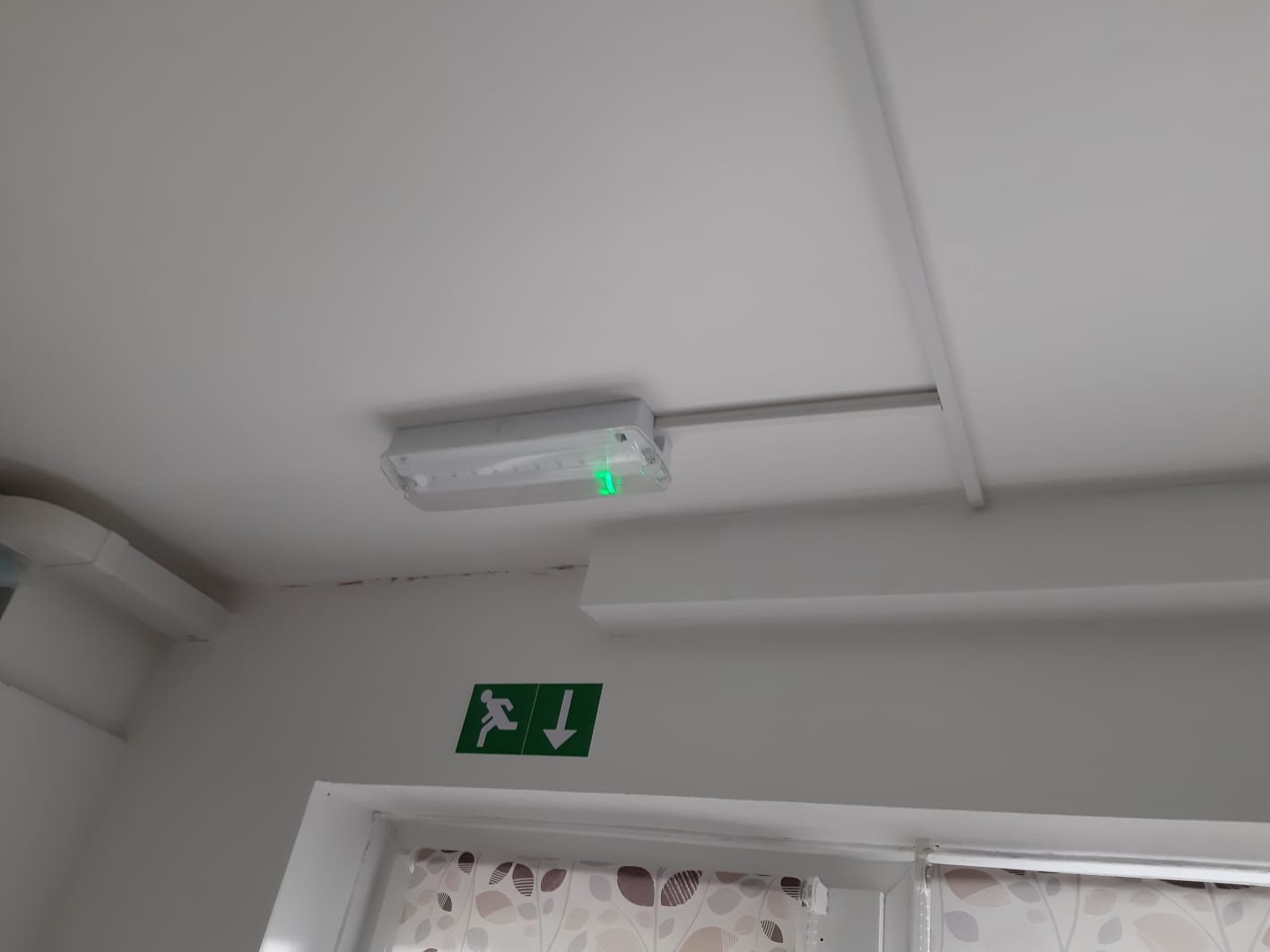
A professional Fire Risk Assessment (FRA) report has separate sections for each detail, such as the source of ignition (electrical equipment), the fuel (waste materials), and the welder at risk. The main body of the report is a set of detailed checklists and observations on fire protection, such as alarms, emergency lighting, and escape routes.
A Fire Risk Assessment (FRA) report has photographic evidence of a specific flaw, such as propped-open fire doors or blocked exits. The Fire Risk Assessment (FRA) report ends with a prioritised action plan which defines remedial activities, key individuals, and strict deadlines to implement the Regulatory Reform (Fire Safety) Order 2005.
What are the 5 Steps to perform a fire safety risk assessment?
Fire safety risk assessment is the methodical assessment of the premises in order to identify fire hazards and implement strategies to cope with these hazards.
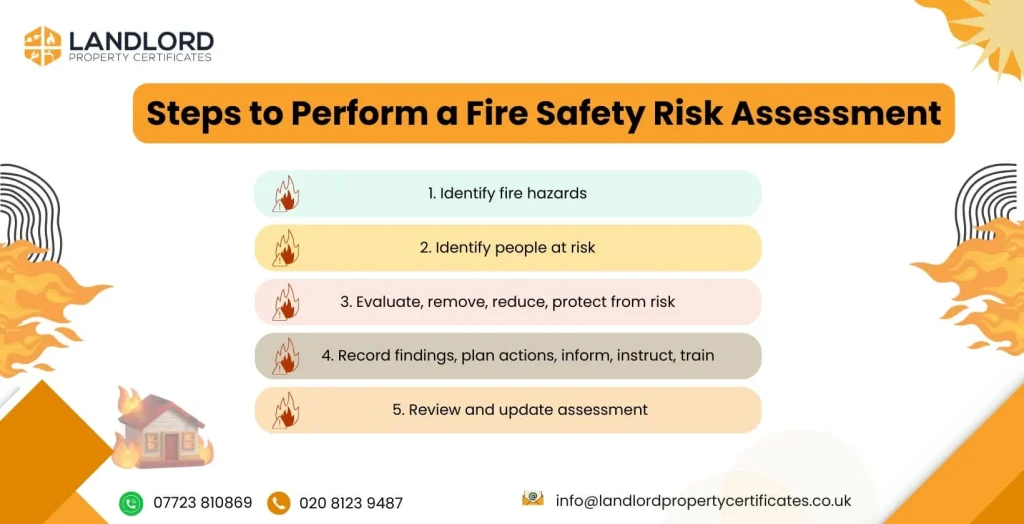
Here are the five steps to perform a fire safety risk assessment are listed below.
- Identify fire hazards
- Identify people at risk
- Evaluate, remove, reduce, protect from risk
- Record findings, plan actions, inform, instruct, and train
- Review and update the assessment
1. Identify fire hazards
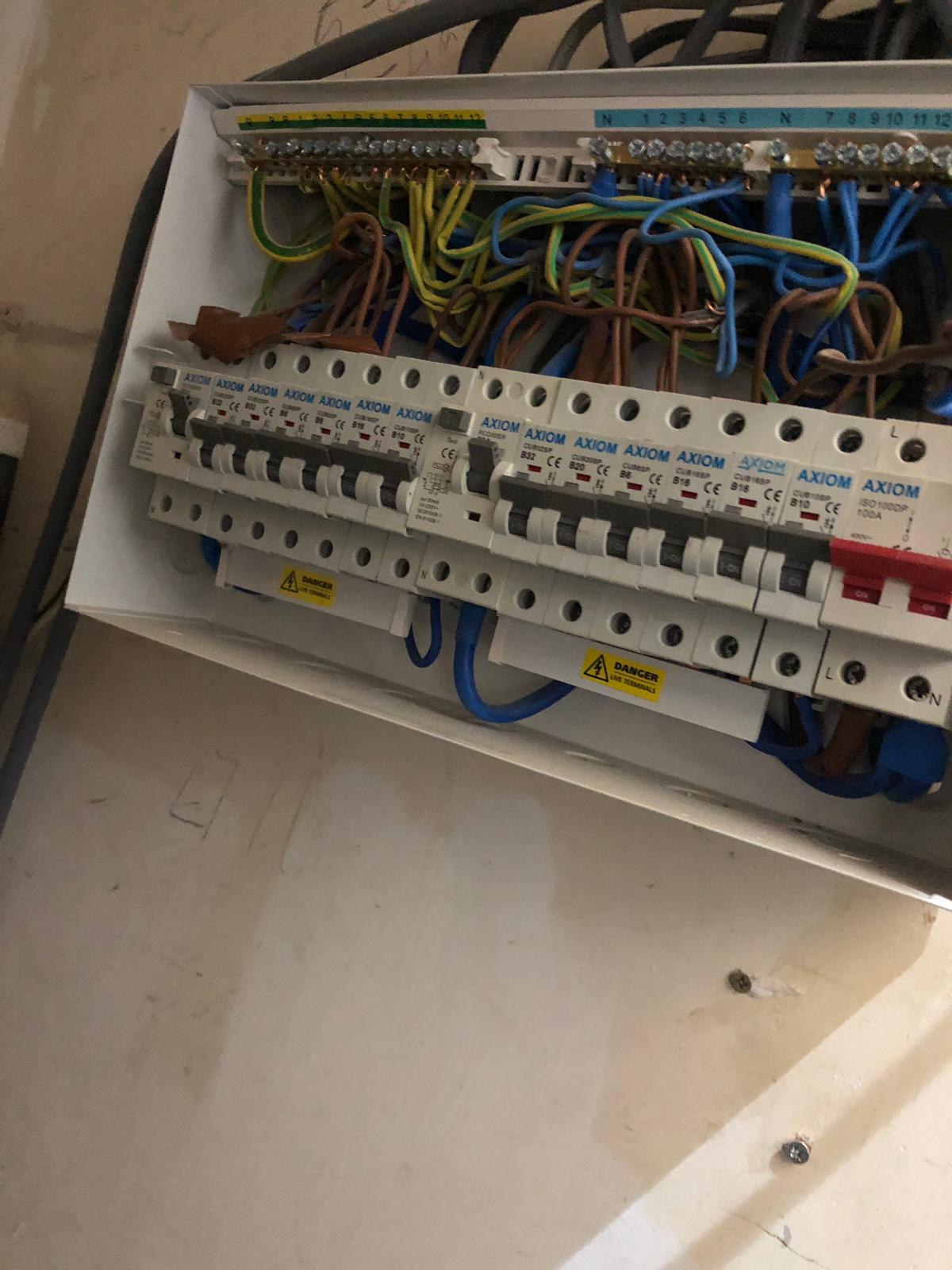
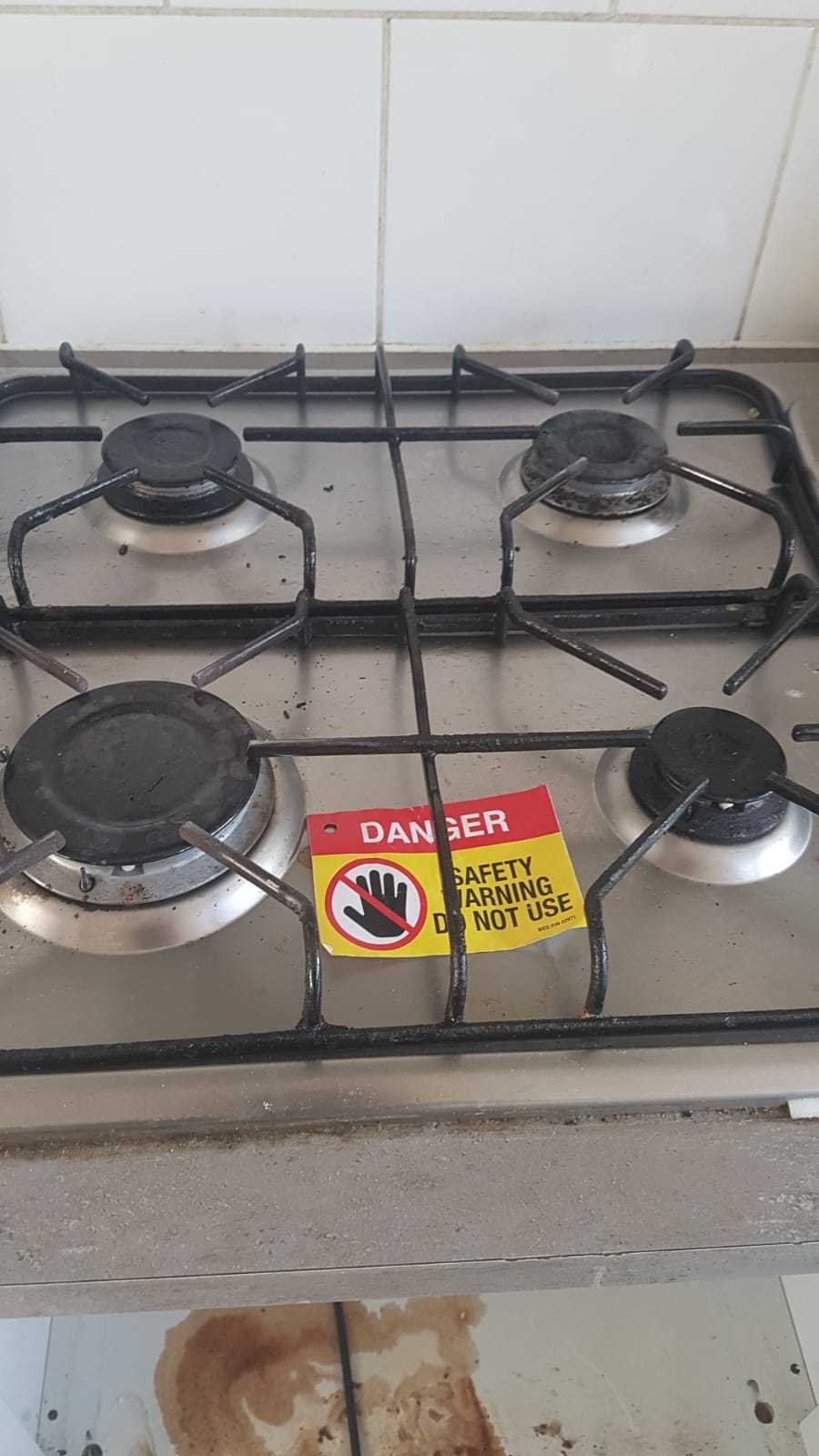
The first step of fire risk assessment is to identify all fire hazards (electrical sparks and fumes spread), their nature,e and problems with them. Identification of fire hazards is carried out by walking through the building and looking at the sources of ignition (broken electrics, heaters, cooking equipment, etc., or smoking material), fuel sources (paper, furniture, rubbish, chemicals), and ventilation or oxygen supply. The fire hazards are identified by the concerned individual or a qualified fire risk assessor. Identification of fire hazards includes the detection of overloaded sockets, defective wires, and the presence of flammable objects around the heat source.
2. Identify people at risk
The 2nd step of fire risk assessment is the identification of people at risk, in which the fire risk assessor finds out people who would be affected in case of a fire hazard. The employees in a building, residents, visitors, contractors, and individuals who require additional assistance, such as children, elderly people, disabled occupants, or lone workers, are identified. The individual who is responsible for fire hazards takes into consideration.
3. Evaluate, remove, reduce, protect from risk
The 3rd step of fire risk assessment is evaluation and protection from fire risk, in which the fire risk assessor determines the probability of a fire and the severity of the fire hazard. The fire risk assessors then made strategies to eliminate the fire hazards and protect individuals by offering fire alarms, extinguishers, safe storage, clear escape paths, and fire-resistant doors. This is under the control of the concerned individual on the advice of fire risk assessors. The fire risk assessors fit smoke detectors, keep the exits free, and create a separation of inflammable substances and sources of fire.
4. Record findings, plan actions, inform, instruct, and train
The 4th step of fire risk assessment is to record findings and take action according to these findings. In this step, all the information that was found during the fire risk assessment is documented. A fire emergency plan has been made, and the occupants or staff have been made aware and trained for fire hazard incidents. This fire risk report has been left to the person in charge. This report is necessary for maintaining a written fire risk assessment, placing fire action notices, and conducting fire drills.
5. Review and update the assessment
The 5th step of fire risk assessment is the review and update of the assessment. In this step, the fire risk assessment is reviewed, and changes are made when there are changes in the building. The landlord keeps it up-to-date, and it’s one of the main responsibilities of a landlord. It includes the change of the fire risk assessment with renovations, installation of new fire safety equipment, or a change of the layout.
What are the 4 types of fire risk assessment?
The four types of fire risk assessment are listed below.
- Type 1 Fire Risk Assessment: Type 1 Fire Risk Assessment is a non-invasive survey of the common fireplaces of a building. It is a visual examination, but does not include the opening of walls, ceilings, and floors. Fire risk assessor inspects fire alarms, escape routes, fire doors, emergency lighting, and general fire security arrangements. Type 1 fire risk assessment is applied to typical residential blocks and commercial buildings.
- Type 2 Fire Risk Assessment: Type 2 Fire Risk Assessment is a non-invasive inspection of common fire areas, as well as individual parts of the fire tools. It involves in-room inspections of flats, office or room interior layouts, or activities that influence fire safety. Type 2 Fire Risk Assessment is appropriate in buildings like HMO buildings or mixed-use premises.
- Type 3 Fire Risk Assessment: Type 3 Fire Risk Assessment is an intrusive examination of the common fire areas in a building and the escape doors in the fire hazard area. It is the opening up of some of the building areas, like ceilings, walls,s or service risers, as part of the inspection of concealed fire risks, and fire-stopping systems. Type 3 Fire Risk Assessment is applied in cases of fears regarding the quality of construction or fire propagation.
- Type 4 Fire Risk Assessment: The Type 4 Fire Risk Assessment is a fully intrusive evaluation of an individual fire unit in a building. It involves a thorough examination of structural components, compartments, ts and hidden areas within the building. The Type 4 Fire Risk Assessment is the most extensive one and is implemented in buildings that are at high risk of fire safety issues.
Who is responsible for making a fire risk assessment?
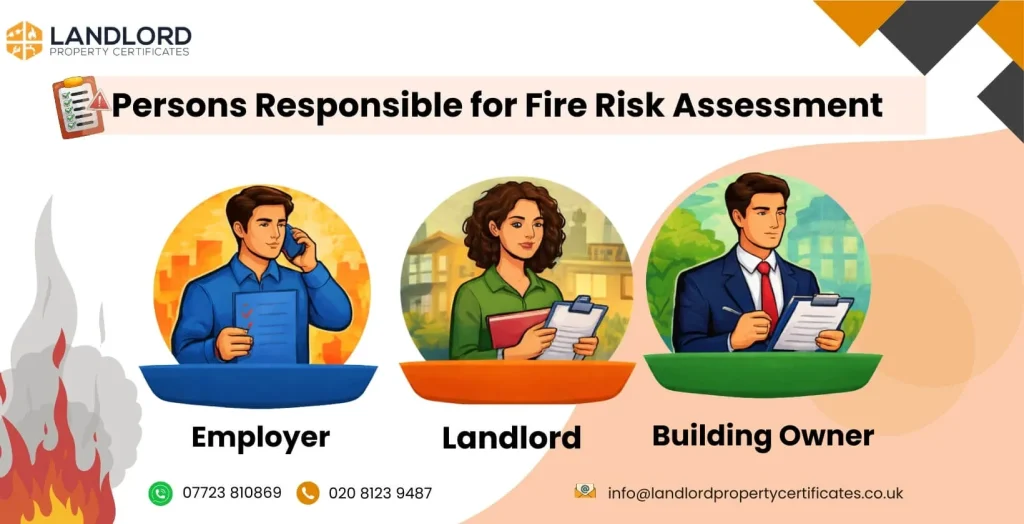
The responsible person for fire risk assessment is the employer, the landlord, the building owner, or a managing agent who exercises control over the premises is responsible for firework assessment. The legal individual charged with the duty of fire risk assessment, ensuring that a fire risk assessment is performed under the Regulatory Reform (Fire Safety) Order of 2005, is in London.
Anyone with fire risk assessment skills, training, and experience can technically assess according to the UK fire safety law. A Responsible Person can do a fire risk assessment in London for small, low-risk companies with the help of fire risk assessment templates provided by the UK government. The high fire risk building needs a professional fire risk assessor for a complete inspection and to avoid any fire hazard.
What qualifications are necessary to conduct a fire risk assessment report?
Fire risk assessors need NEBOSH (National Examination Board in Occupational Safety and Health), IFA (International Fire Association), and FPE (Fire Protection Engineering) Fire Safety training and certificates to conduct a fire risk assessment report.
A fire risk assessor has to know about fire regulations, building plans, fire risks, and the way they evaluate risks and the emergency action required. The fire risk assessor has to know how to determine the fire hazards, propose safety precautions, and compose a concise report. The Landlord Property Certificates have trained fire risk assessors with all the requirements necessary for fire risk assessment.
Can I do a fire risk assessment by myself?
Yes, you can do a fire risk assessment if you have fire safety knowledge and training about fire risk assessment. You have to gain knowledge on fire hazards, assessment of risks, emergency operations, and appropriate fire safety legislation to perform a fire risk assessment.
On low fire risk structures, such as offices or shops, the assessment can be done by a responsible individual with appropriate guidance. The high fire risk structures need a professional fire risk assessor for a complete and certified assessment.
Can you get a fire risk assessment online for free?
Yes, you can get a fire risk assessment online for free with the help of fire risk assessment templates and advice on the web. Online fire risk assessment resources assist you in basic guidance, laws, and methods of fire risk assessment to perform in low-risk buildings. The professional fire risk assessment report in respect of commercial, multi-occupancy, or high-risk buildings is not free and is conducted by a qualified fire risk assessor in accordance with legal regulations.
Who Needs a Fire Risk Assessment Report in the UK?
A Fire Risk Assessment (FRA) report is necessary for all domestic and commercial premises in the UK under the Regulatory Reform (Fire Safety) Order of 2005.
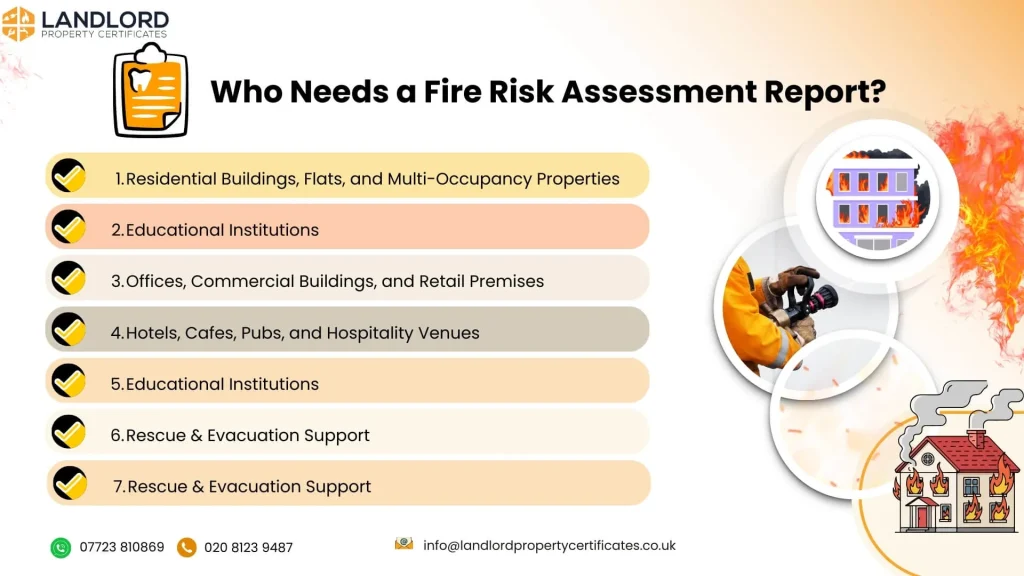
Here are the following premises that need a Fire Risk Assessment Report in the UK.
- Residential Buildings, Flats, and Multi-Occupancy Properties: Residential areas need FRA to find ignition and electric sparks in their buildings. Fire risk assessment in residential buildings includes the monitoring of staircases, lifts, corridors, entrance halls, shared kitchens, of residential blocks and HMOs. FRAs make sure that residents, visitors, and maintenance staff are secure, escape routes are clear, fire doors and fire alarms are operational,l and flammable materials are stored safely.
- Educational Institutions: Educational institutions need fire risk assessment to find electrical sparks in classrooms, staffrooms, ms and chemical fire hazards in labs. Headteachers, principals, or governing bodies are responsible for fire risk assessment in classrooms, labs, corridors, and staffing spaces. FRAs aid in securing students, teachers, staff, and visitors against electrical accidents, combustible substances, overpopulation, and chemical storage. FRAs make sure that the evacuation plans are clear.
- Offices, Commercial Buildings, and Retail Premises: The offices and commercial buildings need FRA to find ignition in the kitchen and electrical maintenance. The employers, building owners, and managers are responsible for fire risk assessment in the offices, meeting rooms, storage rooms, kitchen areas, staff areas, and customer areas. FRAs manage the risks of electrical equipment, cooking appliances, storing paper, and congested areas to protect employees, clients, and their visitors from fire hazards.
- Hotels, Cafes, Pubs, and Hospitality Venues: The hotels and dining areas need a fire risk assessment to find ignition in the kitchen and an electric spark in the building. The owners or managers of hotels, hostels, restaurants, kitchens, and dining areas are responsible for conducting fire risk assessments. FRAs provide fire risk safety against cooking risks, smoking zones, inflammable materials, overcrowding, and the process of evacuation during emergency changes of both guests and employees.
- Hospitals and Healthcare Facilities: Healthcare centres need fire risk assessment to find fire risk in wards, treatment rooms, operating theatres, corridors, and patient rooms. FRAs mitigate the risk of patients, staff, visitors, and medical equipment. FRAs ensure the presence of fire alarms, evacuation, and firefighting equipment.
- Public Buildings and entertainment Venues: Public buildings need FRA to find ignition and fire-causing items (cigratees and lighters). Managers of libraries, museums, theatres, and community centres conduct FRAs. Fire risk assessor identifies the fire hazards in high occupancy places, the safety of the evacuation routes, the staff, a nd the people during an occasion or a meeting.
- Factories, Warehouses, and Industrial Sites: Factories and industrial sites need FRA to inspect the production floors, stores, Chemicals, machinery rooms, and loading docks. FRAs eliminate fire hazards of inflammable, heavy construction, hot procedures, and complicated plans, and make sure that the fire-fighting gear and emergency plans are available.
When is a fire risk assessment required?
Here are the conditions when a fire risk assessment is required in the UK according to the UK Fire Safety Law 2005.
- In all non-domestic premises in the UK
- In workplaces with chemicals and fire
- In the buildings with universal access to fire
- In residential apartments, having common areas
- Before the occupancy of a new building
- Following a fire or a near-miss incident
- In the case of fire safety law
When is a fire risk assessment not required?
Here are the conditions when a fire risk assessment is not required in the UK according to the UK Fire Safety Law 2005.
- Single residential house with a single family in the UK
- Within personal apartments or flats
- Housing with no employees and owner-occupied
- The domestic buildings with no shared common facilities
- Writing-room and premises not accessible to work or the public
Is a fire risk assessment required by law for landlords?
Yes, a fire risk assessment is required by law for landlords. The responsibility of fire risk assessment falls on the landlord or managing agent under the Regulatory Reform (Fire Safety) Order 2005.
The landlords are responsible for fire risk assessment of their property, including hallways, staircases, lifts, and entrance halls in the flats or the multi-occupancy buildings. The tenants do not have a legal responsibility to conduct a fire risk assessment, but the tenants must take safety precautions and report any risks.
How much time does a fire risk assessment take?
The fire risk assessment takes 4 hours to 10 days for the complete assessment process. The fire risk assessment takes 4-5 hours for small offices, shops,s or low-risk premises and 10-12 hours for medium-sized buildings such as schools, home care facilities, or a small residential block.
The fire risk assessment requires 7-10 days for detailed inspection of concealed areas, structural components, and high-risk or complex buildings like hospitals, hotels, factories, es or multi-occupancy flats. The duration of the fire risk assessment depends on the area, fire risk, and complexity.
How much does a fire risk assessment cost?
The fire risk assessment costs between £150 and £2000 in the UK. Expansive or complicated premises, such as hotels, warehouses, schools,s or hospitals, cost £800-£2,000 for a fire risk assessment. Medium-sized buildings, such as large commercial premises, restaurants, or mid-sized residential blocks, cost £400-£900 for a fire risk assessment.
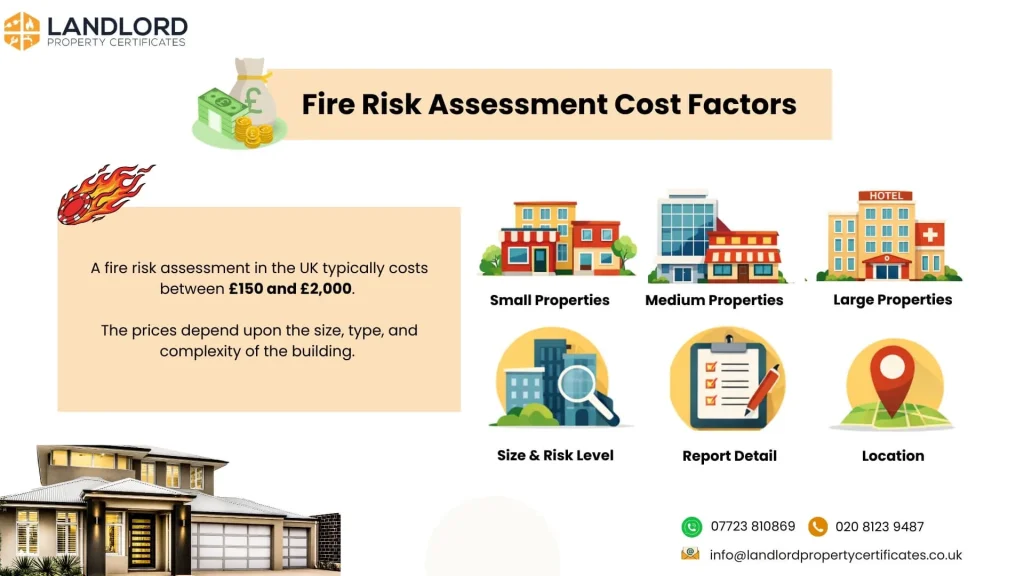
Small or low-risk properties, such as small offices, shops, or even flats, cost between £150 and 500 for a fire risk assessment. The FRA costs vary based on the building size and plan, occupancy and use, complexity or hazardous material complexity, detail of the report, qualification of the assessors,r and location. In Gloucester, the fire risk assessment cost is £200 to £750.
How often should fire risk assessments be reviewed in the UK?
Fire risk assessment in the UK is reviewed at least once a year to keep it up to date. The fire risk assessment report is revised as soon as there are material changes in the building, including renovations, new equipment, an increase or decrease in staff or visitors,s or after a fire incident. Periodic reviews ensure all the fire hazards are identified, the hazards are kept under management, and emergency procedures are still appropriate to occupants.
Are fire risk assessments required annually?
Yes, fire risk assessments are required annually in the UK. The UK fire safety law does not require an annual fire risk assessment deadline, but the assessment is periodically checked to maintain the fire safety measures. The premises are checked annually to monitor fire hazards, escape routes, alarms, and emergency procedures. The fire risk assessment report is revised in case of building renovations, equipment additions, higher occupancy, or a fire event.
What is the expiry date of a fire risk assessment report?
The UK law does not specify an expiry date for a fire risk assessment report. The building itself, the purpose it is used for, the number of people using it, and the fire safety measures do not change its validity. The fire risk assessment report is revisited regularly, like once a year, ar and in case of renovation, new equipment, or layout changes. The report is considered outdated when there are some changes in the building, but the report is not updated.
Is a fire validation report the same as a fire risk assessment?
No, a fire validation report is not the same as a fire risk assessment. A fire risk assessment (FRA) is a legal inspection of a building to outline the presence of fire risk, evaluate the risk to human life, and provide recommendations to mitigate any fire hazard. Fire risk assessment is mandated by the Regulatory Reform (Fire Safety) Order of 2005.
A fire validation report is concerned with testing and inspection of the fire safety systems, such as alarms, sprinklers, fire doors, or emergency lighting, to ensure that the systems are up to the design standards and are functional. The role of an FRA is to identify and control risks, but the fire validation report is to confirm the functionality and standards of fire safety systems.
Is cladding part of the fire risk assessment report?
Yes, cladding is part of a fire risk assessment report according to the UK Fire Safety Act 2021. The fire risk assessment observes external materials such as cladding, insulation,n and facade systems for combustible or improperly installed cladding. FRA recognises hazards associated with cladding, assesses the risk of it affecting the safety of occupants, and prescribes control measures in the form of an inspection, replacement, or fire safety enhancement.
The FRA does not substitute the structural or material testing, but it identifies cladding as a potential fire hazard.