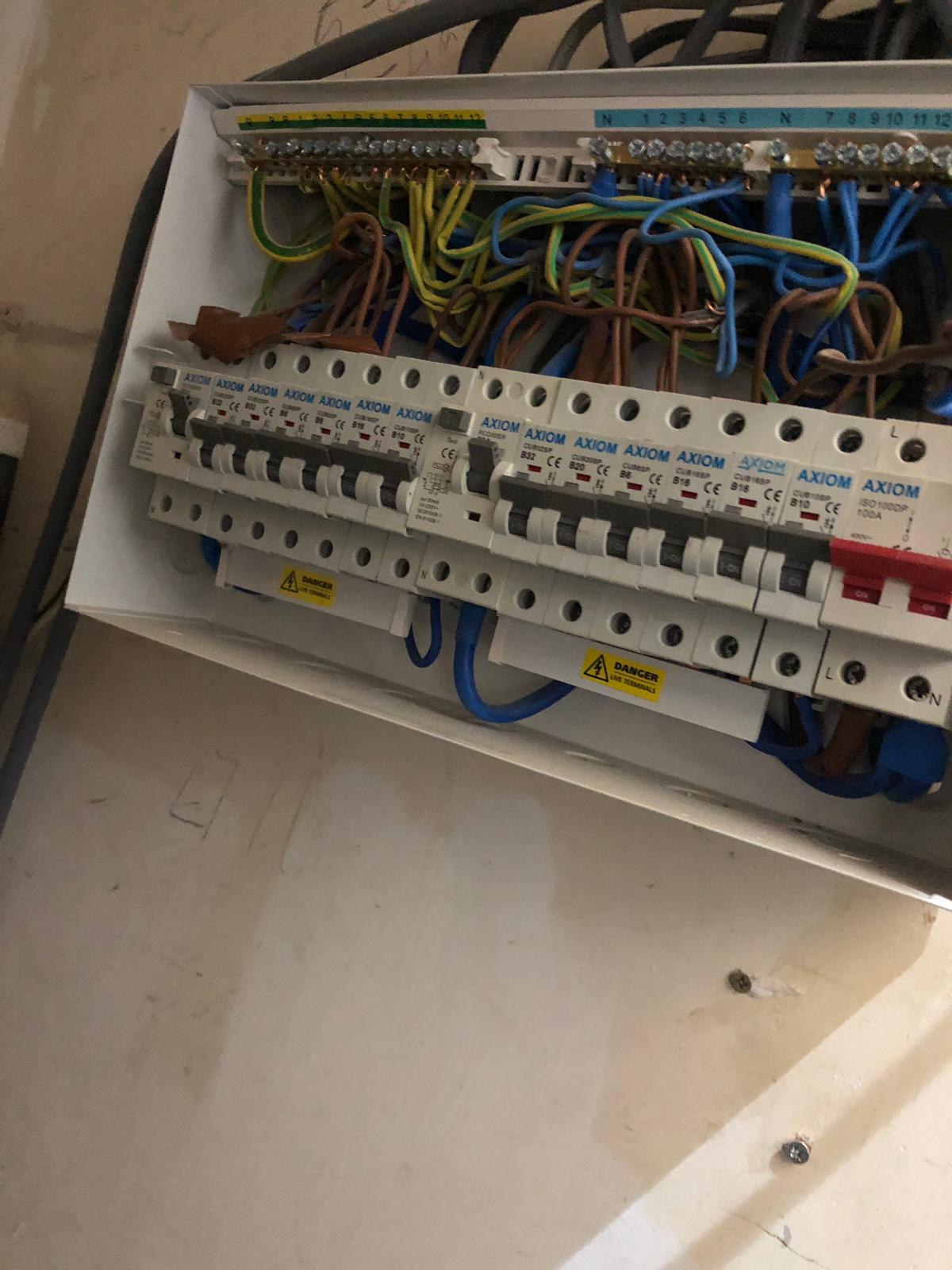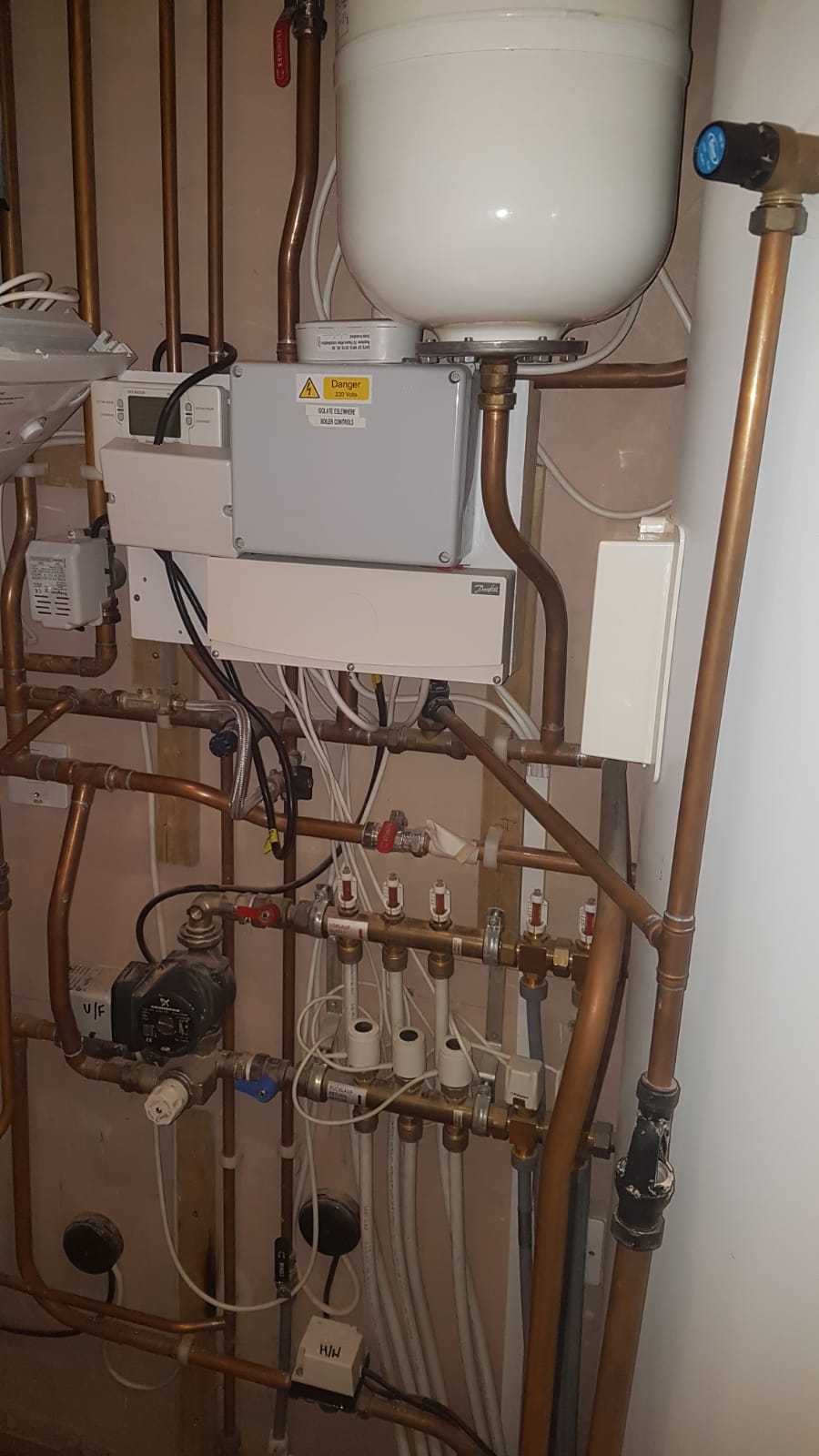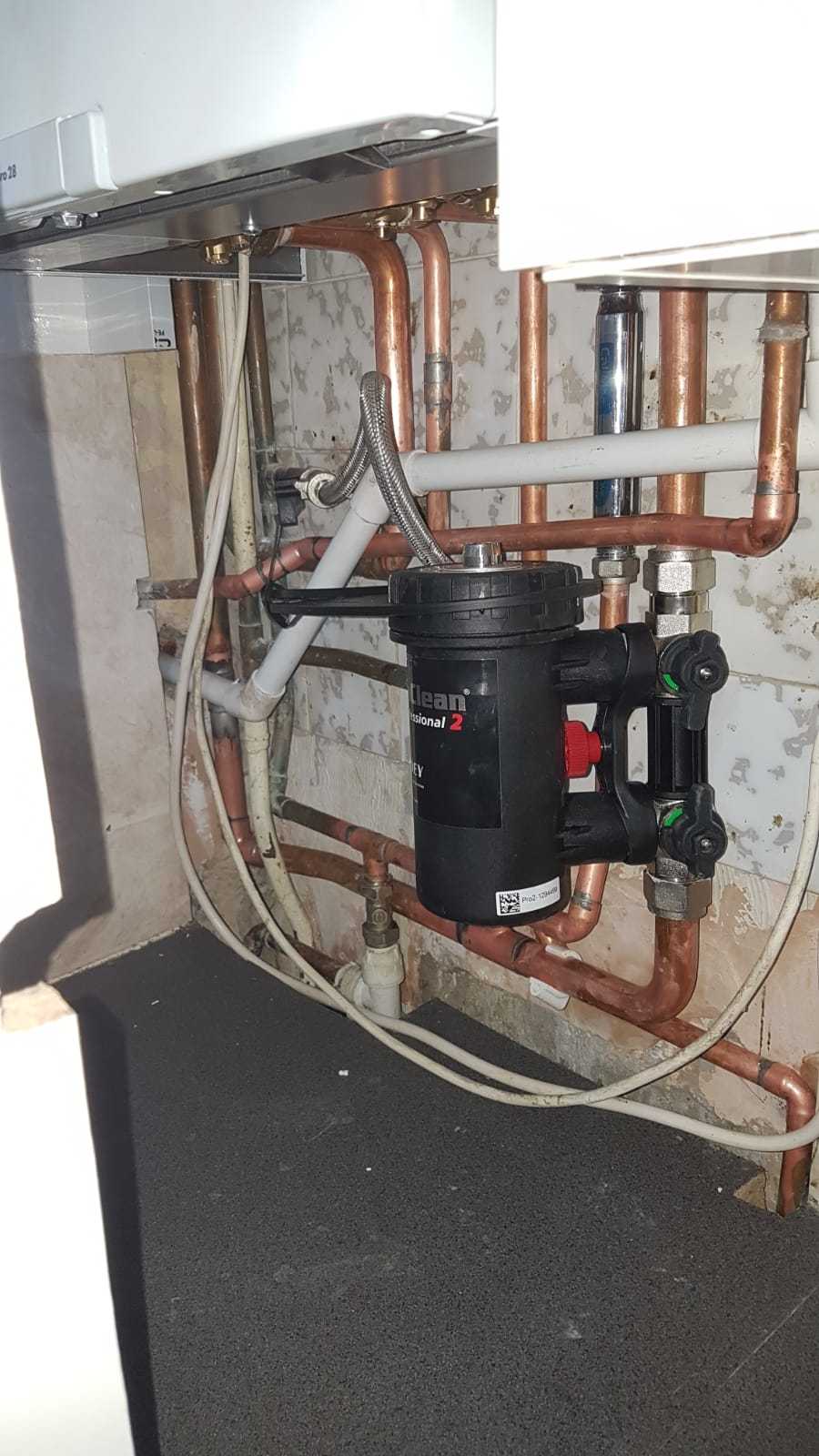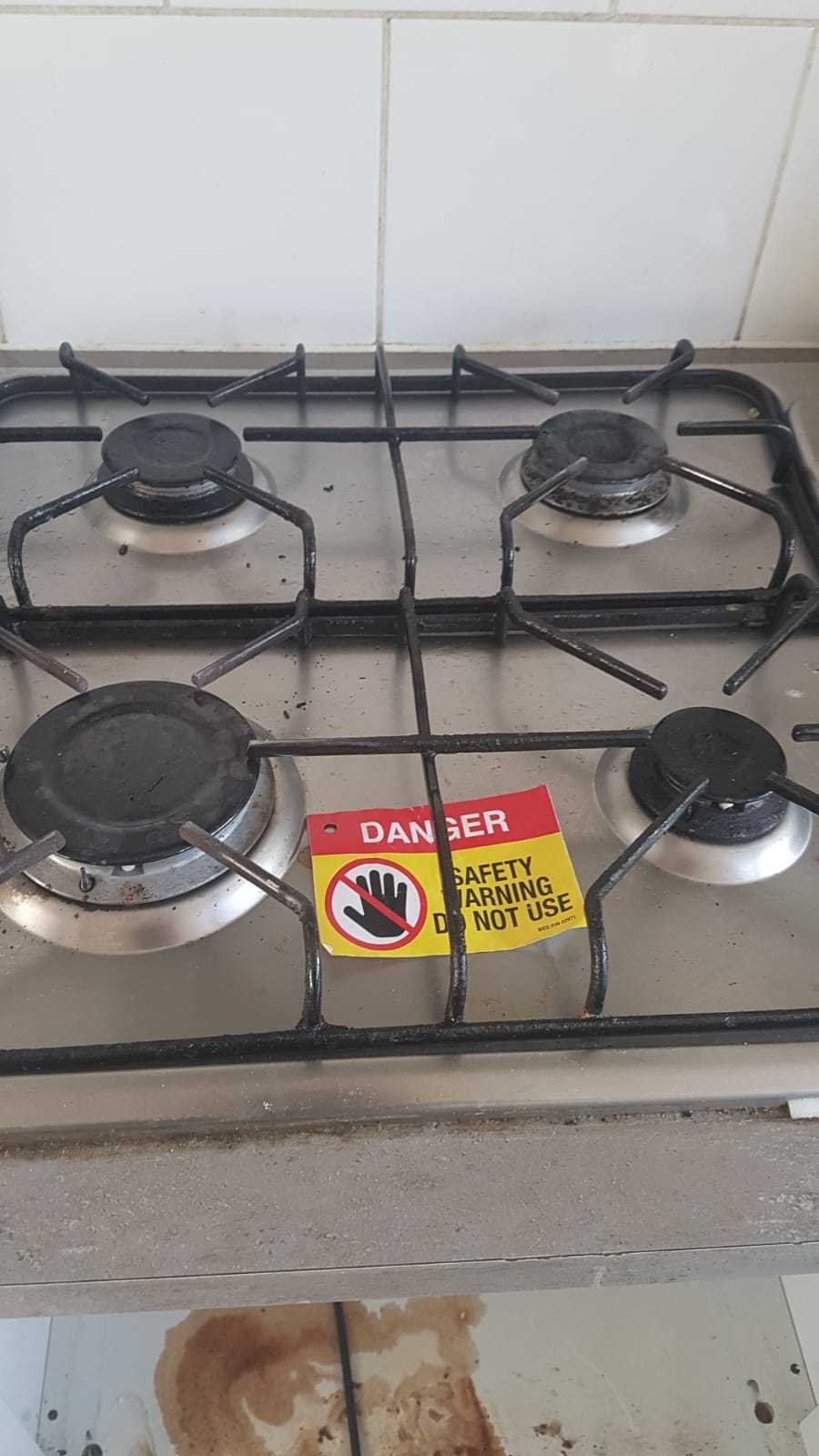
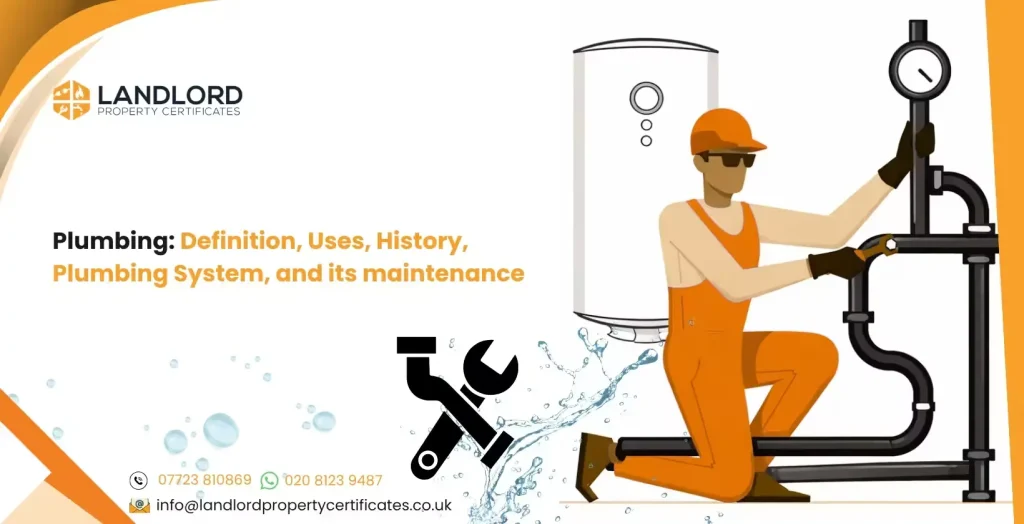
Plumbing is the installation of pipes, valves, fittings, tanks, and fixtures. Plumbing enables water to flow into a building and wastewater to exit it without causing harm (peeling paint and electric damage). It is primarily used to provide a flow of clean water and eliminate wastewater in a hygienic way. Plumbing is one of the most crucial services in residential and commercial buildings, as it delivers drinking water, supports cooking, bathing, washing, and sanitation, and supports heating systems and drainage.
The first plumbing systems were invented in the ancient Indus Valley Civilisation (2600–2500 BCE) in the cities of Mohenjo-daro. It had covered drains and wastewater canals, household water pipes, indicating that well-structured sanitation in the area existed about 4,500 years ago. Ancient Minoan civilisation also had similar early water systems in which water was transported to buildings in underground clay pipes.
A modern plumbing system contains 2 networks: the water supply system and the drainage system. The water supply system supplies drinkable water in pipes and storage tanks. The drainage system carries wastewater in the form of traps, vents, and sewer lines.
The plumbing system is maintained regularly to prevent leaks, corrosion, clogged drains, or pressure problems decrease efficiency and destroy building structures. Plumbing maintenance includes joint inspection, drain inspection, inspection of valves, replacement of damaged fittings, and inspection of water heaters or water tanks. Technical maintenance is carried out by professional plumbers since they are aware of pressure systems, drainage design, and pipe repair. Simple maintenance, like cleaning the strainers of the sinks, is carried out by the occupants.
In residential properties, the landlord has the responsibility to undertake major plumbing repairs like broken pipes, sewer defects, or the replacement of fittings, as they require building infrastructure. The tenants are expected to prevent misuse, blockage, and report faults immediately, but in the case that damages are caused by negligence of the tenants, the repair costs are charged to the tenants. Proactive plumbing care increases water use, minimises microbial pollution, and decreases repair costs of both residential and institutional buildings in the long run, according to Bilal, M. et al., A review of premise plumbing systems: from design and key performance domains to challenges and future research pathways for full-scale integration, published in 2026.
What is plumbing?
Plumbing is the system by which water is provided, distributed, and evacuated throughout a building through a network of interconnected pipes, valves, and fixtures, tanks, and drainage lines. It is associated with installation and repairs of drinking, cooking, bathing, sanitation,n and heating water supply systems, waste water disposal systems that transport used water to sewers or treatment areas safely. A plumbing system circulates clean water under pressure through supply pipes to taps, sinks, toilets, and other fixtures.
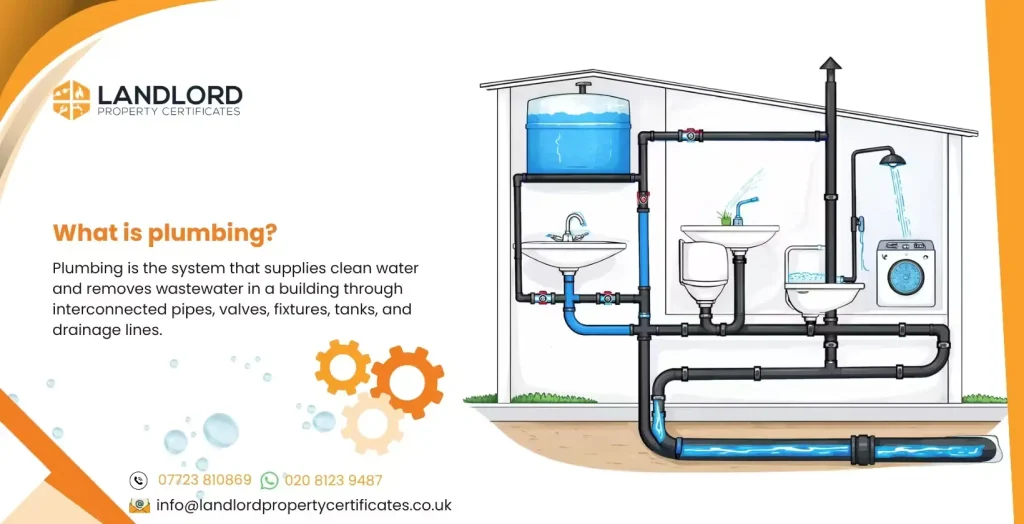
Wastewater is carried through drainage pipes using gravity, ensuring that it does not stagnate or cause contamination. Plumbing also involves vents and traps that keep the pressure in check and prevent any sewer gases from entering the premises. The Plumbing is performed by a plumber, a trained technician who installs, repairs, and maintains these systems to maintain a safe water flow and effective drainage. Properly designed plumbing has a direct positive effect on indoor hygiene, water saving, and health outcomes of the population, according to Liang, Z. et al., Building water quality deterioration during water supply restoration after interruption: influences of premise plumbing configuration, published in 2023.
What is the purpose of plumbing?
The purpose of plumbing is to provide clean water to where it is required safely and to collect and remove wastewater in a proper way that does not lead to contamination and hazardous health effects. It facilitates the daily practices of drinking, cooking, bathing, cleaning,g and sanitation by ensuring a controlled supply of water within structures. Plumbing also ensures the safety of indoor settings by diverting sewage and dirty water away from the living areas through drainage systems, which helps to avoid foul odours, moisture damage, and prevent disease. In contemporary constructions, plumbing also helps to save water, control temperatures, and prevent fire hazards since it is intertwined with heating systems, water storage tanks, and emergency water supply lines. An efficient plumbing system impacts the health, comfort, and hygiene of the population, according to He, H. et al., Building plumbing influences the microdiversity and community assembly of the drinking water microbiome, published in 2025.
What are the uses of plumbing?
The uses of plumbing are listed below.
- Residential Homes
- Commercial Buildings
- Industrial Facilities
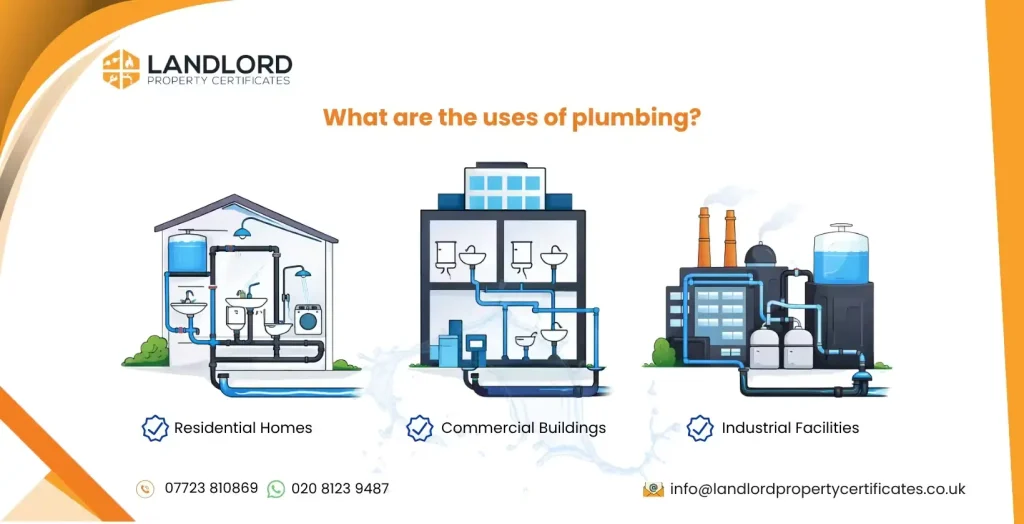
- Residential Homes: Residential Homes are applied in residential houses to provide clean drinking, cooking, bathing, laundering clothes, and toilet use water, as well as to dispose of wastewater safely through drainage. It is a linking of household fittings like taps, sinks, showers, toilets, washing machines, and water heaters. As an example, a kitchen plumbing system that supplies water to make food and wash dishes, and a bathroom plumbing system that supplies a shower, a wash basin, and a toilet flushing. A plumbed house also assists in keeping things clean and avoiding water spills, which ruin walls or floors.
- Commercial Buildings: Plumbing in commercial buildings includes offices, schools, hotels, restaurants, and hospitals in washrooms, kitchens, drinking water, fire sprinkler systems, and heating systems. In a hotel, plumbing serves the guest rooms, laundry facilities, es and kitchens, whereas in a hospital, it serves sterilisation rooms, labs, and critical care units, where water supply is needed at all times. Commercial space requires proper plumbing in the areas to ensure comfort, safety, and cleanliness.
- Industrial Facilities: Plumbing in industrial areas serves not just sanitation purposes, but also production and technical purposes. Machines, equipment, and the processing of materials, as well as waste liquids, require water in factories. It includes food industries that use plumbing to wash food materials and clean processing lines. Textile industries use water to dye and rinse clothes, and the chemical industries use water-resistant corrosion plumbing to transfer liquids. Plumbing in industries has to endure high pressure, high temperature, and chemicals.
What is the history of plumbing?
The term plumbing originates from the Latin term plumbum, or lead, since the earliest Roman water pipes were composed of sheets of lead that were cut into tubes. The first recorded evidence of plumbing is found in 4000 BCE in ancient Mesopotamian civilisation, where wastewater was removed using clay sewer pipes in places like Nippur. One of the earliest known organised urban plumbing systems emerged in the Indus Valley Civilisation around 2700 BCE, in Mohenjo-daro.
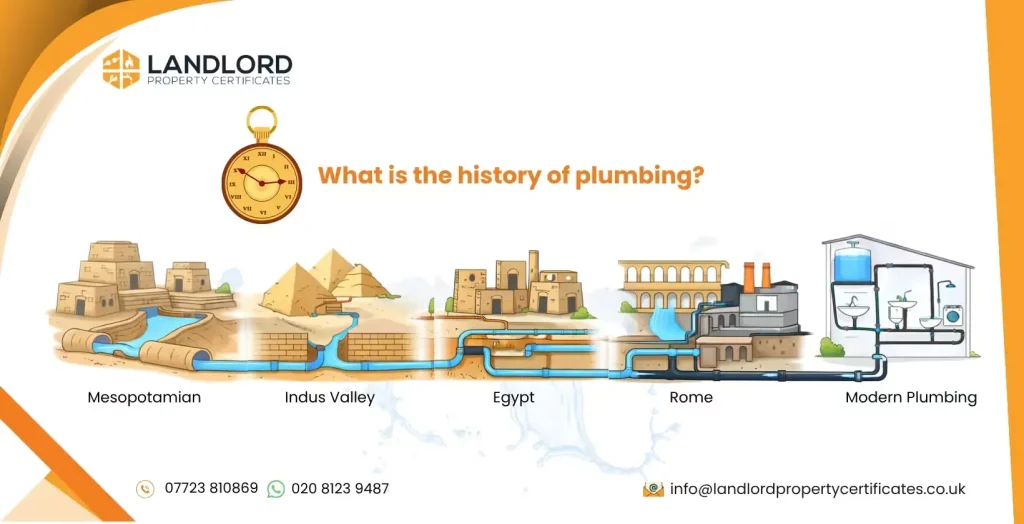
The organisation of drains and sewage was covered in brick, and drains were laid to carry wastewater into the streets and the bathing areas of houses. In 2400 BCE, copper pipes were used in the 7-pyramid complex of the Pyramid of Sahure to dispose of water. In 1600 BCE, the Minoan civilisation used terracotta pipes and flushing systems in palaces on Crete. One of the most significant improvements was made in 312 BCE when the Aqua Appia, the first aqueduct in Rome, started to supply Rome with water. Plumbing became a key component of urban life during the Roman period (1st century BCE to 4th century CE) with aqueducts, the presence of public baths, and underground sewers like Cloaca Maxima. In the 19th century, modern plumbing grew in sanitation reforms, which connected clean water systems to the prevention of disease.
What is a plumbing system?
The plumbing system is the entire system of pipes, fittings, tanks, fixtures, valves, and controls that supplies clean water in a building and removes waste water in a safe manner. It is set up in a way that it contains running potable water, but makes sure that used water and sewage are transported off without pollution. A plumbing system has the main composition of water supply pipes, drainage pipes, fixtures, valves, traps, vents, and storage units. Water supply pipes carry clean water (under pressure) to taps, showers, toilets, and appliances through a main source or storage tank. The wastewater is removed by gravity using drainage pipes, which transport it to either sewer lines or septic systems. Direct water use fixtures comprise sinks, washbasins, toilets, bathtubs, and showers. Valves are used to control the flow of water and enable the isolation of parts of the system when performing repairs.
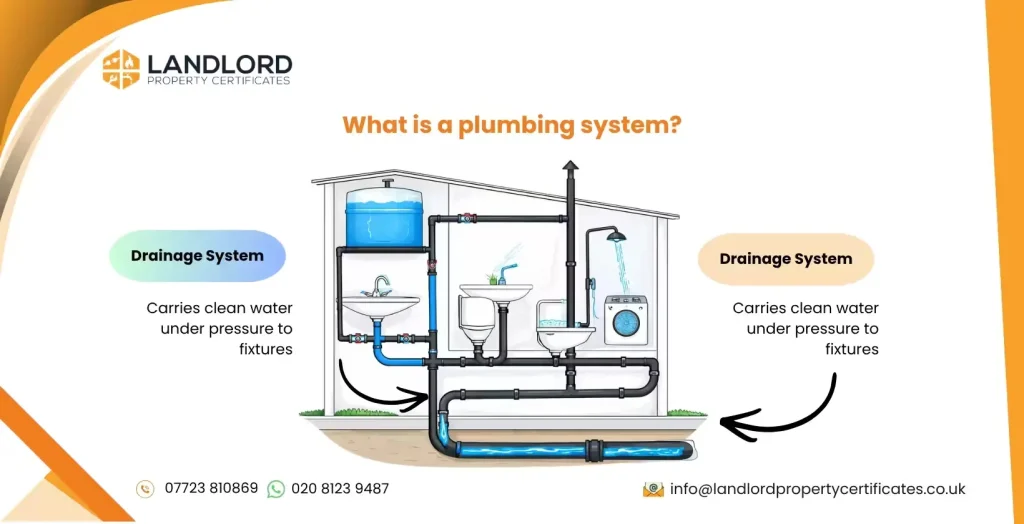
Traps are curved pipe sections that are installed beneath the fixtures to trap the water and stop sewer gases from finding their way into the inside areas. The vents stabilise the air pressure and enhance the effectiveness of the drains. Storage tanks and pumps are useful in ensuring the water supply where pressure is low or the supply is intermittent. A plumbing system operates by the use of pressure in supply lines and gravity in drainage lines, where clean water is supplied through inlets and wastewater is outflow through different lines. Its purpose is to assist in sanitation, hygiene, comfort,t and safe use of water in residential homes, commercial buildings, and industries. The plumbing directly influences the quality of water and the prevention of diseases; the plumbing is one of the most significant systems in the new infrastructure, according to Zhang et al. A review of premise plumbing systems: from design and key performance domains to challenges and future research pathways for full-scale integration, published in 2026.
How does a house plumbing system look?
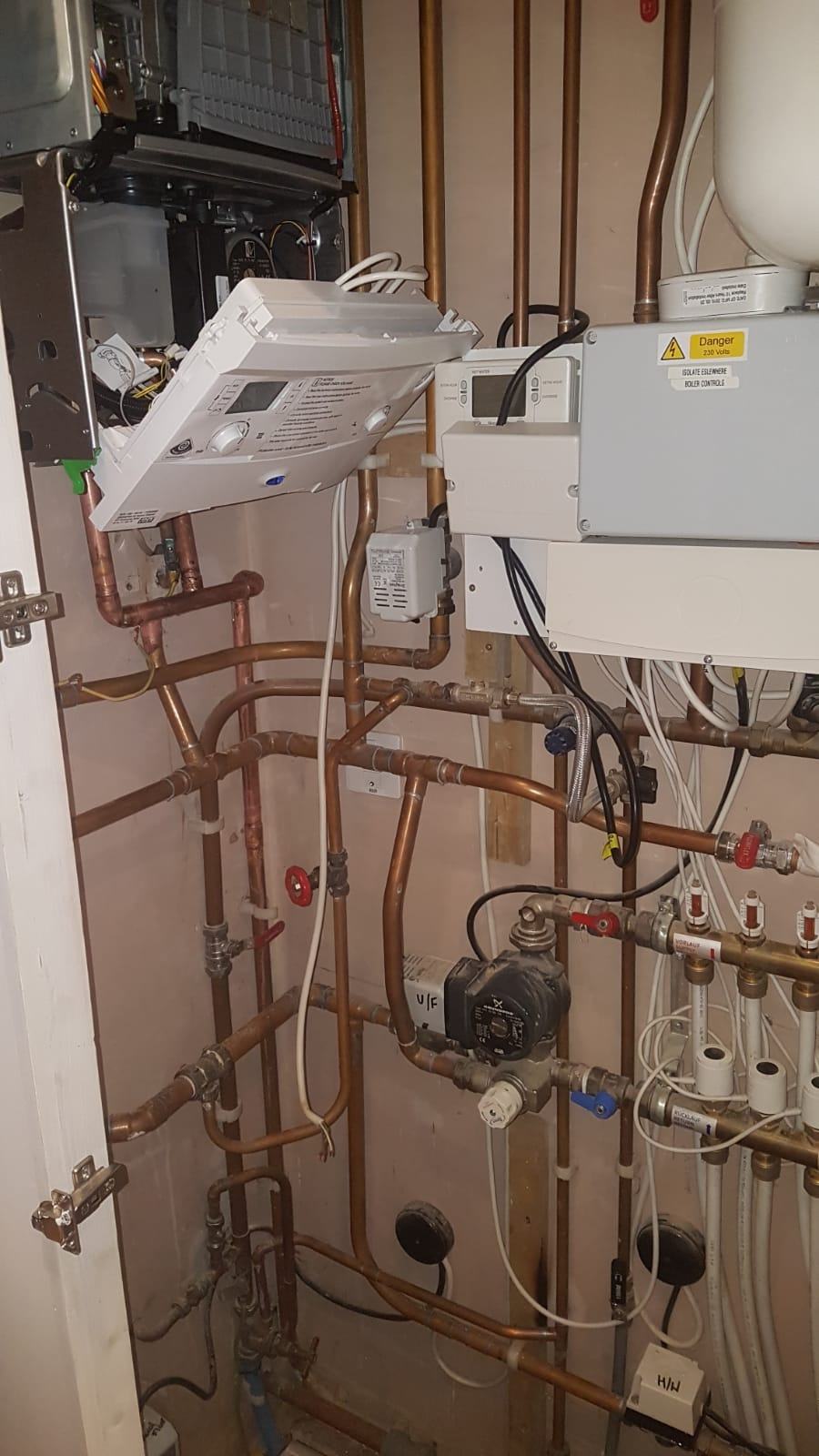
A house plumbing system looks like a networked system of concealed pipes behind walls, beneath floors. The system is overhead, with one group of smaller pipes carrying clean water from the main supply to fixtures such as sinks, showers, toilets, washing machines, and water heaters. A second group of larger pipes transports wastewater away using gravity. The common plumbing layout involves cold water entering the house through a main service line. Some of the water flows directly to fixtures, while some enters the water heater, supplying hot water through separate pipes.
U-shaped traps are installed below each of the fixtures to stop the sewer gas. The vertical vent pipes of the roof run upwards to help in holding some water to prevent the gases, to ensure the air pressure, and to allow free flow of the drainage. All wastewater pipes are attached to a main drain line, which leads outside to a sewer or septic system. The entire picture of house plumbing is two systems operating in unity, one supplying clean water and the other, the sewage system, removing waste in a safe and sanitary way.
How to maintain home plumbing systems?
The methods to maintain home plumbing systems are listed below.
- Inspect fixtures and supply lines for leaks
- Test the water pressure with a pressure gauge
- Descalcify faucet aerators and showerheads
- Flush drains with a baking soda solution
- Drain the water heater tank sediment annually
- Examine the toilet flapper and fill valves
- Insulate exposed pipe runs and joints
- Exercise the main shut-off valves biannually
- Inspect fixtures and supply lines for leaks: Inspecting faucets, taps, toilets, under-sink pipes, flexible connections, and visible joints involves checking whether water is dripping. Even the slightest leakage seems insignificant because dripping drip by drip undermines the fittings and leads to higher water usage. Check the areas behind toilets, below wash basins, and around the washing machine connections, as these areas break first due to the daily pressure variations during leak inspection. Leakages that go undetected develop into structural water damage when left untreated over a long period. Take the case of a slow leak beneath a kitchen sink, which initially causes mild swelling in the cabinets, but after a few weeks, provides fungus and destruction of wooden surfaces.
- Test water pressure with a pressure gauge: Water pressure testing is the measurement of the strength of the water entering the pipes of the consumer, using a gauge on an outside tap or service line. Normal residential pressure is at a steady state to allow the functioning of fixtures without excessive strain on joints. The pipes, seals, and appliance valves are put under constant strain when the pressure is excessive. In case of excessively low pressure, then the delivery of water is inefficient, and it is a sign of some blockage or accumulation of sediments. When the flow of a shower is suddenly aggressive or noisy, this usually indicates that there is high pressure, which reduces the life of a given fitting. Investigations into the performance of premise plumbing have identified unstable pressure as one of the factors that cause fatigue and frequency of maintenance in pipes.
- Descale faucet aerators and showerheads: Descaling is the elimination of mineral deposits that accumulate at the outlet openings as the hard water evaporates and leaves behind calcium or magnesium deposits. These deposits are slowly built up by aerators and showerheads and constrict openings and uniformity of flow. Cleaning is done by dipping pieces that are removed in a weak acidic solution, such as diluted vinegar. This maintenance increases water flow and avoids the pressure imbalance among fixtures. A shower sprays unevenly on one side and not at all on the other; this is due to mineral scaling. Mineral deposition changes hydraulic efficiency and leads to stagnation in the small outlets of fixtures.
- Flush drains with a baking soda solution: Drain flushing is a preventive cleaning of sink and floor drains before they become fully blocked. A weak solution of baking soda, which is then added to warm water, assists in softening the grease film, soap deposits, and early organic deposits along domestic drain lines. This technique is less violent than harsh chemical cleaners, which cause damage to the interiors of the pipes over time. The slow drain in a bathroom basin after brushing teeth or taking a shower is improved with repeated gentle flushing since the initial deposits are flushed away before hard plugging occurs. Preventive drain cleaning also assists in keeping the drainage flowing smoothly and minimises the development of odour within the drainage systems of the homes.
- Drain water heater tank sediment annually: Water heater sediment drainage is the removal of mineral particles, which accumulate in the bottom of storage tanks throughout heating processes. In the tough water areas, the calcium and suspended materials build up slowly and decrease the heating performance. Sediment also causes local overheating of heating elements and reduces the life of heaters. When hot water becomes noisy when heating or takes more time to warm up, it is due to the presence of sediment in the tank. Annual draining restores thermal effectiveness and lessens the danger of internal corrosion. The need to remove sediment is always highlighted by maintenance literature to extend the life of domestic heaters.
- Examine toilet flapper and fill valves: Examine toilet flapper and fill valves, including opening the tank in the toilet and ensuring that the rubber flapper closes correctly after flushing. It ensures that the fill valve does not allow water past the appropriate level. A damaged flapper (one that has holes through which the water leaks constantly, without making a sound) keeps the bowl taking in water, and the fill valve keeps refilling the bowl. These issues are overlooked since there is no external leakage in the toilet. As an example, the short refill sounds in a span of a few minutes, although the toilet has not been used. This type of internal leakage elevates the monthly water consumption and influences pressure stability in adjacent plumbing lines.
- Insulate exposed pipe runs and joints: Pipe insulation is the process of wrapping bare pipes, such as those in a roof, garage, basement, or exterior wall, with an insulating substance to decrease heat transfer. Insulation reduces the chance of freezing in cold weather and the chances of condensation in hot weather, as well as corrosion of pipe surfaces due to moisture. In hot-water pipes, insulation also minimises heat loss during the transportation between the heater and tap. Hot-water pipes that are insulated present warm water more quickly and minimise unwarranted wastage of water as they wait to get hot. Building plumbing research has associated insulating pipes with energy efficiency and pipe system life.
- Exercise main shut-off valves biannually: It is advisable to open and close the main shut-off valve at least twice annually, to avoid stiffness, mineral locking, or seizure. A valve that has never been touched in years breaks just at a time when emergency isolation is required by a leakage in the pipes. It is best to turn it to ensure that the inside works well. In a bursting pipe occurring suddenly in a washing machine, an operative shut-off valve enables water to be isolated immediately and minimises damage. Modern plumbing systems recommend that maintenance programs strongly recommend periodic movement of the valves since inactive valves tend to break down in case of emergency usage.
Who can maintain home plumbing systems?
In the UK, an approved and qualified (Level 2 or 3 NVQ/SVQ Diploma in Plumbing and Heating) domestic plumber is allowed to maintain a home plumbing system. The plumber has to be registered under the WaterSafe Register or an approved contractor scheme as allowed under the Water Supply (Water Fittings) Regulations 1999. The law of the UK does not specify that any minor repair must necessarily be performed by a single licensed trade person. The UK law makes it clear that any individual performing plumbing work must ensure that all fittings, pipework, and installations are in accordance with legal requirements as stipulated by law on water safety. The UK authorities highly advise using an officially qualified and approved plumber. Qualified plumbers understand backflow prevention and contamination control, the standard of materials to be used, and the legal requirements for notifying regulated plumbing work. Homeowners are also secured by approved plumbers to issue compliance certificates, which works against water suppliers who may inspect the installation at a later date.
A qualified approved home plumber is responsible for the safety of drinking water, pressure regulation, and safeguarding against contamination. Any improper maintenance by a non-trained individual results in unseen cross connections, ineffective sealing, or improper use of materials that result in polluted water finding its way into the clean supply. Homeowners are legally liable in UK water law in case of waste, misuse, or contamination caused by plumbing work, making the selection of an approved plumber a way to minimise legal and technical risk. Changing a kitchen tap seems easy, but if the incorrect backflow protection is not used, the contaminated water reverts to the supply line when the pressure fluctuates. Approved contractors are also trained on water regulations and insured against liability, and this implies that once errors are identified, they are rectified through a responsible system.
Before choosing a plumber for home plumbing maintenance, ensure they have a recognised NVQ Level 2 (or equivalent) qualification in plumbing and are listed on the WaterSafe register or an approved contractor list. The plumber has to be familiar with the Water Supply (Water Fittings) Regulations 1999, as most plumbing failures occur due to the fitting being correctly installed in mechanical terms, but wrong in legal terms. A qualified licensed plumber in London has public liability cover and issues a work completion or compliance certificate once maintenance is done. This provides homeowners with written evidence that the work complies with UK law, the Parliament Landlord and Tenant Act 1985.
Does the landlord have to fix all the plumbing issues by law?
Yes, under Section 11 of the Landlord and Tenant Act 1985, it is a legal obligation of the landlord to maintain the main plumbing system in repair in rented houses in England, including London.
The legal obligation includes supply pipes, drains, sinks, toilets, bath, sanitary installations, and the hot water system. This implies that any leaks, broken internal pipes, faulty toilets, or broken taps connected to the water system are the landlord’s responsibility.
It also includes defects in drainage attributed to age or wear, and breakdown of the hot water delivery are the responsibility of the landlord. Defects in drainage attributed to age or wear, and breakdown of the hot water delivery form part of the fixed structure and essential services of the house. This law does not necessarily apply to all plumbing issues in all cases. The landlord is entitled to have the cost of repairing the damage reimbursed by the tenant when the damage is evident due to the tenant’s misuse.
The tenant is liable if a sink or toilet is blocked by oil, wipes, food remnants, or other inappropriate materials, as this is user-caused damage, not normal plumbing wear.
Plumbing is not a distinct landlord certificate as mandated by UK law. Unlike legally required documents such as a Gas Safety Certificate, an Electrical Installation Condition Report, or an Energy Performance Certificate, no official plumbing certificate exists for standard residential rentals.
Plumbing is controlled by repair requirements and water safety adherence. Under building regulations, or by a certified contractor, compliance is verified in the event of major plumbing installation work, but a separate landlord certificate is not required when it comes to routine plumbing maintenance.
The house plumbing maintenance is shared depending on the nature of the work. The landlord takes care of the main plumbing system, whereas the tenant is in charge of the daily careful use.
Internal water pipes, drainage lines, toilet flushing mechanisms, fixed sanitary fittings, and hot water systems are maintained by the landlord. They are permanent components of the dwelling and are directly related to the minimum standards of habitability under the Homes (Fitness for Human Habitation) Act 2018.
A house on rent with no safe water, sanitation, or proper drainage is regarded legally as not fit to reside in. The tenant reports leaks promptly, does not create blockages, cleans strainers and visible outlets, and uses fixtures in a manner that does not cause damage. The tenant bears some responsibility if a leaky tap is not reported for several months and it damages cabinets or flooring, as the landlord was not notified in time.
Legally, when an unseen pipe within a wall starts to leak, the landlord has an obligation to fix it, since it is an installation of water and sanitation. UK law stipulates that the installation of water and sanitation, as well as having all landlord certificates in London, is a landlord’s repair obligation.
The tenant must bear the cost if a toilet is blocked due to the discharge of unsuitable materials, as the fault was caused by misuse, according to the Homes (Fitness for Human Habitation) Act 2018.