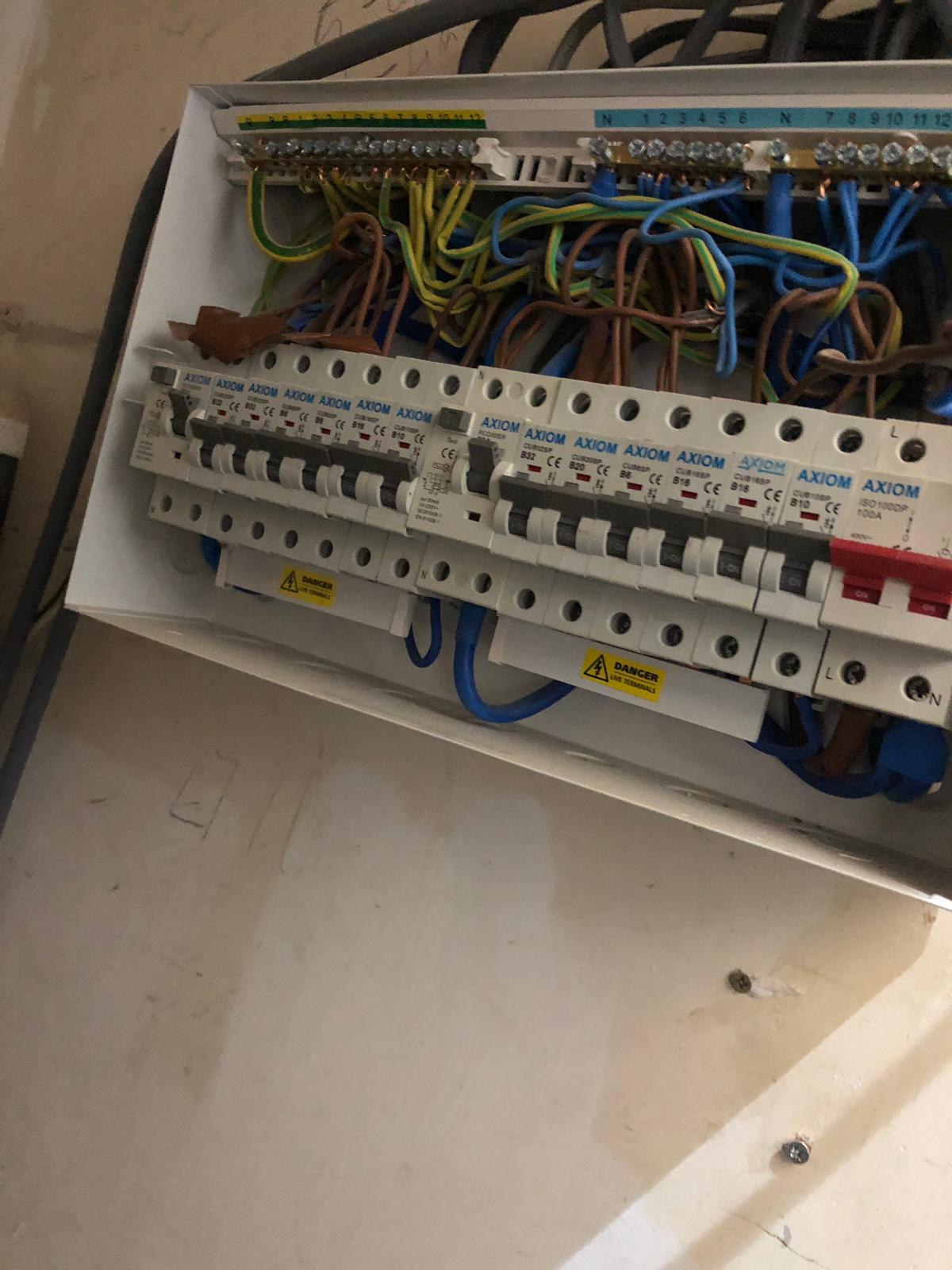

EICR regulations are legal requirements set under the Electrical Safety Standards in the Private Rented Sector (England) Regulations 2020. Electrical Safety Standards in the Private Rented Sector (England) Regulations 2020 came into force on 1st June 2020. EICR regulations mandate that a qualified professional inspect all fixed installations in rental properties at least every 5 years. The purpose of inspection is to identify faults and safety risks, and to prevent electrical shocks and fires.
EICR regulations require landlords to ensure that electrical installations are safe from start to finish throughout tenancy. EICR regulations require inspections and testing of installations at least every 5 years. The landlord obtains a valid Electrical Installation Condition Report (EICR) and, if required, completes remedial work within 28 days.
EICR regulations aim to protect tenants from electric shock, fire, and personal injury. The standards hold landlords legally accountable for electrical safety compliance while reducing the risks posed by faulty wiring and outdated installations.
EICR regulation applies to private landlords in England, property managers, and letting agents. The regulations apply to properties such as long-term residential lets, private rented residential properties, houses, flats, Assured shorthold tenancies (ASTs), and HMOs (Houses in Multiple Occupation). Properties exempted from EICR regulations include short-term holiday lets, lodgers, care homes, student halls of residence, and hospitals.
Landlords must conduct an EICR every 5 years, or as recommended by a qualified technician. The landlord must keep a valid EICR report stating that the property is in a safe and satisfactory electrical condition. EICR regulations require landlords to understand EICR fault codes (C1, C2, C3, F1) and complete repairs within 28 days. The landlord must provide the EICR report to new tenants (before moving in), existing/ prospective tenants (within 28 days), and the local authority (within 7 days if requested). EICR regulations apply to fixed wiring and installations, but not to portable electrical appliances.
What are the EICR regulations for landlords regarding electrical installations in England?
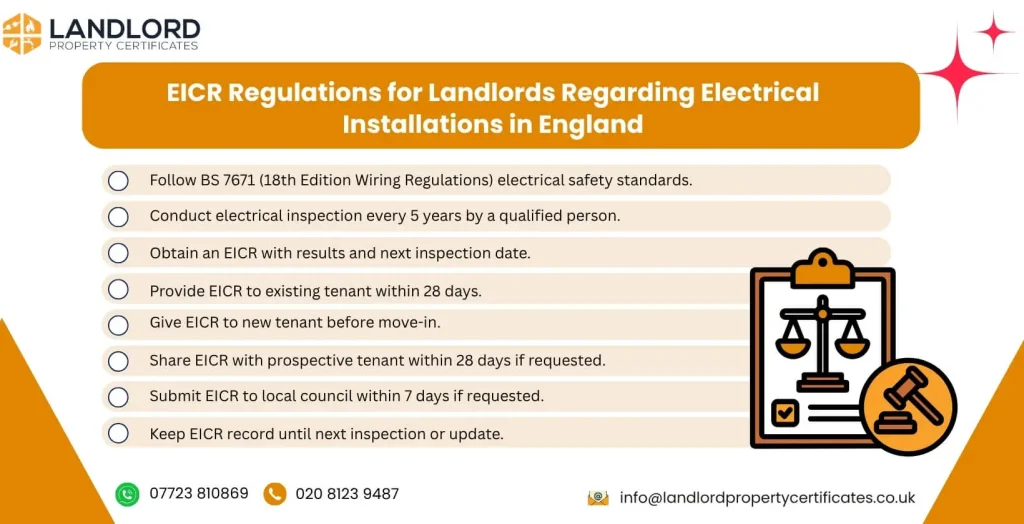
The 10 EICR regulations for landlords regarding electrical installations in England are listed below.
- Comply with electrical safety standards set out in the 18th Edition Wiring Regulations, published as British Standard 7671.
- Arrange inspection and testing of electrical installations by a qualified, competent person at least every 5 years.
- Obtain an EICR from the inspector stating the results and the date for the next inspection. (Social landlords providing electrical equipment must also confirm that equipment checks are current.)
- Provide a copy of the EICR to the existing tenant within 28 days of the inspection and test.
- Supply a copy of the EICR to any new tenant before they occupy the premises.
- Issue a copy of the EICR to any prospective tenant within 28 days of receiving their request.
- Submit a copy of the EICR to the local council within 7 days of receiving their request.
- Retain a copy of the EICR until the next inspection is due or completed, unless superseded by a more recent report.
- Hand the EICR to the inspector and tester who will carry out the next inspection, before they begin their work.
- Complete any remedial or investigative work identified in the EICR within 28 days (or sooner if specified), then supply the tenant and local council with the report and written confirmation from the qualified person who carried out the works, within 28 days of completion.
1. Comply with the 18th edition wiring regulations (BS 7671)
The landlord must comply with the 18th edition wiring regulations, British Standard BS 7671. The 18th is the most recent edition of BS. It was published on July 2, 2018, by the Institution of Engineering and Technology (IET) and the British Standards Institution (BSI).
BS 7671 was amended with A2 in 2022 and with A4 in April 2022. The 18th Edition of BS 7671:2018+A4:2026 applies to all new installations, additions, and alterations. BS 7671 defines installation standards, safe design, inspection, and testing requirements.
The landlord must ensure that installations are protected against electrical shock and that safety devices, such as RCDs, are installed. The 18th Edition of BS 7671 aims to maintain the safety of electrical installations while protecting both lives and property from risk of fire and accidents.
2. Arrange for electrical inspection and testing every 5 years
Landlords of the private rented sector must arrange electrical inspection and testing every 5 years or according to the previous report under the Electrical Safety Standards in the Private Rented Sector (England) Regulations 2020. Landlords must ensure that all fixed electrical installations are inspected and tested at least every 5 years or according to the previous certificate. This is commonly done through an Electrical Installation Condition Report (EICR). The 5-year rule is a maximum interval; landlords schedule more frequent inspections, like every 3 years, rs for older and high-usage properties. A qualified and competent electrician registered with a recognised body (NICEIC, NAPIT) performs an electrical inspection. A qualified technician checks the condition of the wiring, tests the consumer unit, and inspects sockets, switches, and circuits. The purpose of the inspection is to identify damage, wear, and outdated components. An electrician follows BS 7671 (18th Edition Wiring Regulations) during inspection.
3. Obtain an electrical installation condition report (EICR).
The landlord obtains an EICR report from an electrician. This report provides the results of the current inspection and sets the date for the next inspection. Remedial work within 28 days is required under the regulation if electrical installations are unsafe. This report confirms whether the installation is safe or unsafe. The 5-year clock for the next inspection date is based on the last EICR date. The next inspection date is mentioned in the report. The 5-year inspection rule helps landlords prevent electrical fires and shocks while maintaining property value. The landlord must arrange for a qualified electrician to carry out an EICR every 5 years to ensure compliance with legal safety standards.
4. Provide the EICR to existing tenants within 28 days
Landlords are legally required to provide the EICR to existing tenants within 28 days, under the Electrical Safety Standards in the Private Rented Sector (England) Regulations 2020. The landlord can deliver the EICR to tenants via email (PDF format) and a printed hard copy. This requirement ensures that tenants are aware of the current electrical safety conditions and any associated risks. Landlords must keep tenants informed of any repairs required when EICR reports are unsatisfactory. Tenants are aware of the current electrical condition and take precautionary measures to avoid injury or electrical hazards.
5. Supply the EICR to new tenants before occupation
Landlords are legally required to provide a valid Electrical Installation Condition Report (EICR) to new tenants before they move into the property. The tenant must receive a valid EICR report before the start of tenancy. The landlord must provide this report before handing over the tenancy. The landlord is noncompliant if the tenant moves in without receiving a valid EICR. This EICR regulation protects new tenants who deserve a safe electrical system in the new place while knowing all past issues and risks. A landlord cannot legally rent out a property in England until they provide a valid EICR. A valid EICR demonstrates that installations are safe and that all necessary repairs have been carried out.
6. Issue the EICR to prospective tenants within 28 days of request
Landlords are legally required to issue the EICR to prospective tenants within 28 days of request under the EICR Regulations 2020. A prospective tenant requests an EICR to verify that the property has a safe electrical installation before signing a tenancy agreement. This regulation ensures transparency before renting out a space. A landlord must provide a copy of a valid EICR to a prospective tenant only when requested, within 28 days.
7. Submit the EICR to the local council within 7 days of the request
Electrical Safety Standards in the Private Rented Sector (England) Regulations 2020 require landlords to provide a copy of the Electrical Installation Condition Report (EICR) to the local authority within 7 days if requested. Local councils request the EICR for investigating tenant complaints, checking landlord compliance, property safety inspection, and monitoring high-risk properties. The landlord must keep and provide a valid and up-to-date EICR to the council and respond within 7 days. Local councils enforce electrical safety standards, and these regulations help them protect tenants from electrical hazards and identify unsafe properties.
8. Retain the EICR until the next inspection is completed
Landlords are legally required to retain the EICR until the next inspection is completed under the 2020 EICR regulations. Landlords need to retain a formal record of the EICR for at least five years because a new inspection will happen after 5 years. Retaining the EICR ensures that a landlord can provide a copy of the report to tenants (existing, new, prospective) and local authorities, if requested. The previous EICR report is archived for reporting when a new EICR is issued after the next EICR. The latest EICR becomes the active legal record that the property’s electrical installation is safe for use. Landlords find it hard to rent out a property and face legal enforcement issues if a proper record of a recent EICR is not kept. Retaining a valid EICR report is not optional but a continuous compliance requirement to ensure property safety for tenants.
9. Provide the EICR to the next inspector before they begin
Landlords are legally required to provide the EICR to the new inspector before they begin under the Electrical Safety Standards in the Private Rented Sector (England) Regulations 2020. This report helps electrical engineers understand the history of all electrical installations, previous issues, and recommendations. An EICR report helps a new inspector plan a better and more accurate inspection of the property. Electrical engineers keep proper track of past C1, C2, and C3 observations and recheck completed and pending remedial work. The quality and reliability of new reports improve by providing the old ones. The new inspector uses the old EICR report to review previous circuit conditions, test results, upgrades, and risks from the last inspection. A new inspection takes a long time and becomes less accurate if the landlord fails to provide a previous EICR report. It increases the risks of noncompliance and an incomplete electrical safety assessment.
10. Complete remedial works within 28 days and confirm in writing
Landlords must complete remedial work within 28 days and confirm in writing under the EICR Regulations 2020. An unsatisfactory EICR report includes fault codes such as CI (danger present), C2 (potentially dangerous), and F1 (further investigation required). The landlord must start immediate action for C1 and urgent repair for C2. Remedial work involves replacing faulty wiring, fixing exposed electrical components, installing RCD protection, and upgrading outdated units. The landlord must fix issues and obtain written confirmation from a qualified technician that all electrical installations are safe and that remedial work has been completed. The landlord provides written confirmation of remedial work to existing tenants and the local council (if requested). This regulation ensures that all immediate electrical risks are eliminated as quickly as possible. The EICR regulations mandate landlords to maintain safety standards while protecting tenants from electrical hazards.
What are the EICR regulations for landlords regarding electrical equipment in England?
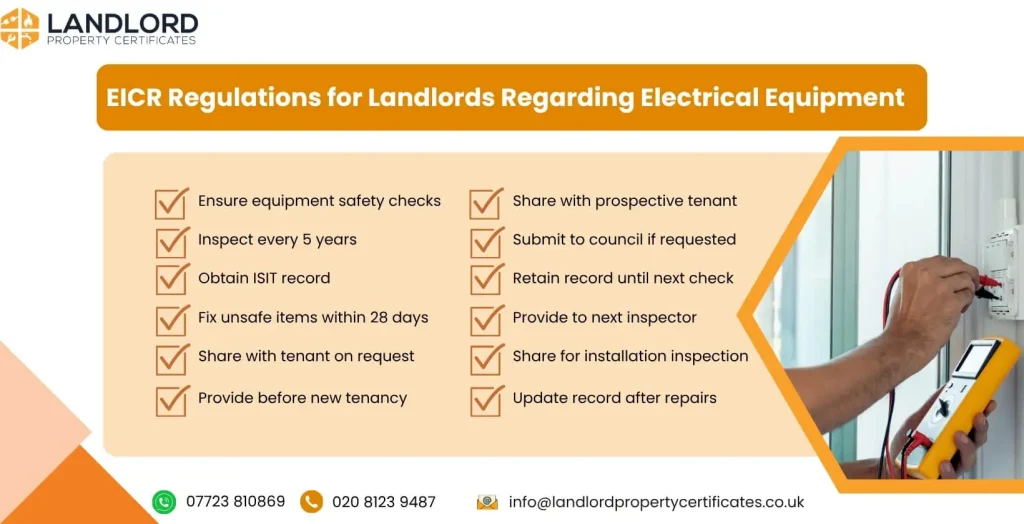
Listed below are the EICR regulations for landlords regarding electrical equipment in England.
- Inspect all landlord-provided electrical equipment through visual inspection, testing, or both, as the qualified person considers necessary to confirm it is safe for continued use.
- Arrange checks on all landlord-provided electrical equipment at least every 5 years.
- Obtain an ISIT record from the person conducting the check, stating results and, where equipment is safe, the date for the next check.
- Act immediately where the record shows equipment is unsafe, inform the tenant, and replace or make the equipment safe within 28 days. If unoccupied, resolve this before the tenancy begins.
- Provide a copy of the ISIT record to the existing tenant within 28 days of receiving a written request.
- Supply a copy of the ISIT record to a new tenant before they occupy the premises.
- Issue a copy of the ISIT record to any prospective tenant within 28 days of receiving a written request.
- Submit equipment identification information and the ISIT record to the local council within 7 days of receiving a written request.
- Retain the ISIT record until the next check is due or completed, unless superseded by a more recent record.
- Hand the ISIT record to the person undertaking the next equipment check or any remedial work.
- Provide equipment identification information and the ISIT record to the person conducting the next electrical installation inspection.
- Obtain a new ISIT record following any remedial work or equipment replacement.
1. Inspect landlord-provided equipment for safe continued use
The landlord must inspect landlord-provided equipment for safe continued use, according to the Electrical Safety Standards in the Private and Social Rented Sector regulations 2020. The regulation applies to private sector landlords and social landlords from 1st November 2025 in England. This regulation covers electrical equipment that the landlord supplies as part of the tenancy ( cookers, fridges, microwaves).
2. Arrange electrical equipment checks every 5 years
A landlord must arrange electrical equipment checks every 5 years. The landlord must hire a qualified person to arrange checks for every piece of electrical equipment they provide. The purpose of this check is to ensure that equipment is safe for continued use. A check must be done for equipment, regardless of equipment age.
3. Obtain an in-service inspection and testing (ISIT) record
The landlord must obtain an in-service inspection from a qualified electrician and a testing (ISIT)record. An electrician provides the record of the check, which is also known as the Inservice Inspection and Testing (ISIT) record. The record must clearly state the equipment, whether the equipment is safe for continued use, and a recommended date for the next check. This record sets the audit trail for all the inspections and provides tenants with peace of mind that the equipment is safe for use.
4. Act immediately on unsafe equipment and resolve it within 28 days
Landlords must act immediately on unsafe equipment and resolve it within 28 days, according to the Electrical Safety Standards in the Private and Social Rented Sector (England) Regulations 2020. The landlord must either replace the equipment or make it safe if the record shows it is unsafe for continued use. The replacement or issue resolution must be done within 28 days after the check. The landlord must ensure that the equipment is safe for use before the tenancy begins.
5. Provide the ISIT record to existing tenants within 28 days of a written request
The landlord must provide the ISIT record to existing tenants within 28 days of a written request. This record contains important information such as details of equipment tested, test results, recommended actions, the date of inspection, and the qualification of the inspector. The ISIT record provides equipment safety information to the tenants. Tenants have the right to know how safe the electrical equipment in the home is. The ISIT record provides transparency into the condition of electrical equipment at the rented property. The landlord faces potential penalties, enforcement actions by the local authority, and legal disputes with tenants if they fail to provide the record within 28 days.
6. Supply the ISIT record to new tenants before occupation
The landlord must supply the ISIT record to new tenants before occupation to ensure tenant safety. The record helps the tenant understand that there are no safety risks. Failure to provide the record leads to non-compliance with regulations, penalties, and legal implications due to electrical hazards.
7. Issue the ISIT record to prospective tenants within 28 days of a written request
Landlords must issue the ISIT record to prospective tenants within 28 days of a written request. Prospective tenants request the ISIT record to check whether the equipment is safe for use in the home. The landlord must provide the record within 28 days of a written request. Failure to provide the ISIT record leads to damage to the landlord’s reputation and legal consequences, such as a fine.
8. Submit equipment information and ISIT record to the local council within 7 days
Landlord must submit equipment information and ISIT record to the local council within 7 days, according to the Electrical Safety Standards in the Private Rented Sector (England) Regulations 2020. The local council requests information and records to monitor compliance with electrical safety regulations, enforce any improvements, or ensure tenant safety. Failure to submit required information and records on time results in fines of up to £30,000. The local council may issue an improvement or remedial notice for equipment if the landlord does not take recommended actions.
9. Retain the ISIT record until the next check is completed
The landlord must retain the ISIT record until the next check is completed. The purpose of retaining all the records is to use the records as proof of compliance with the Electrical Safety Standards in the Private Rented Sector (England) Regulations 2020. The landlord creates an audit trail of inspections that have been completed over time on all equipment. The landlord needs to retain the record until the next inspection. The old inspection record replaces the new ISIT record. Failure to retain the ISIT record leads to non-compliance with regulations and penalties from local authorities. Landlords find it challenging to demonstrate compliance if a tenant or local authority requests the record.
10. Hand the ISIT record to the person conducting the next equipment check
The landlord must hand the ISIT record to the person conducting the next equipment check. The inspector gets historical data on the electrical equipment in the property. The inspector saves time during equipment checks by focusing on previously identified issues and preventing repeated checks. The new inspector builds on previous findings and avoids incomplete inspection. The electrical safety of the entire property will be continuously monitored. The next inspector will not be fully informed about previous issues or action taken if the landlord does not provide the ISIT record. The landlord is in breach of the regulation because the record is required to maintain continuity of checks.
11. Provide the ISIT record to the next electrical installation inspector
The landlord must provide the ISIT record to the next electrical installation inspection, as per the Electrical Safety Standards in the Private Rented Sector (England) Regulations 2020. The purpose of handing over the ISIT record for the next inspection is to ensure a comprehensive inspection of the property’s electrical system and equipment. The regulation mandates that the landlord perform regular checks on the electrical equipment. The ISIT record is proof of regular inspection. Landlord meet their obligations under the law while maintaining transparency through this provision. Checks of electrical installations become less thorough when the landlord is unable to provide the ISIT record to the next inspector. The local councils impose a fine because the landlord is failing to comply with electrical safety regulations.
12. Obtain a new ISIT record after remedial work or replacement
Landlords must obtain a new ISIT record after remedial work or replacement, under the Electrical Safety Standards in the Private Rented Sector (England) Regulations 2020. Landlords are required to obtain a new ISIT record after remedial work or replacement of electrical equipment or components in a rented property. A new ISIT record confirms that the issue has been resolved and that the electrical equipment is safe to use. The new record includes details on equipment (type, model, location), test results, the inspection date, and recommendations. A new ISIT record is a mandatory requirement under the Electrical Safety Standards 2020. This new record acts as proof that required repairs and replacement work have been carried out. New records ensure that there is no gap in safety checks. Landlords face consequences like tenant safety risks, non-compliance, insurance issues, and penalties if they do not obtain a new ISIT record.
What are the EICR regulations for landlords in England regarding remedial work for electrical installations or equipment?
The 3 EICR regulations for landlords in England regarding remedial work for electrical installations or equipment
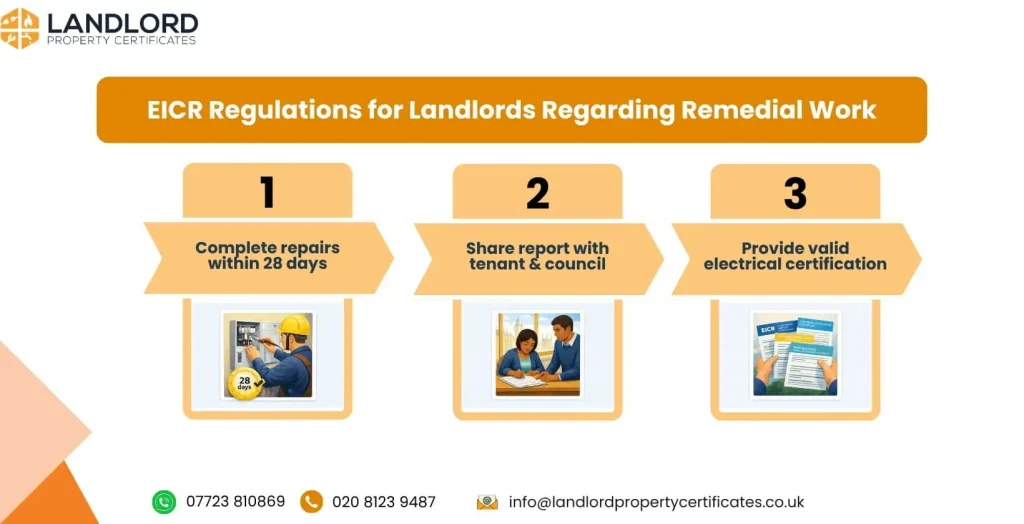
- Complete any remedial or further investigative work identified in the EICR or ISIT record within 28 days, or sooner if a shorter period is specified in the report.
- Provide the tenant and local council with the report/record and written confirmation that the work has been completed, within 28 days of completion.
- Ensure written confirmation takes an acceptable form, a satisfactory EICR, an Electrical Installation Certificate (EIC), a Minor Electrical Installation Works Certificate (MEIWC), or other appropriate electrical certification.
1. Complete remedial or investigative work within 28 days of the report
The landlords must complete any required remedial work within 28 days, or any shorter period if reports indicate that remedial work or further investigation is required. The landlords are unable to complete remedial work within this timeline, sometimes due to practical constraints, like the fact that remedial work is complex or specialist in nature. The landlord can not comply with the timeline when the work depends on a third party, like a supplier. Tenant-specific circumstances could be a reason for not completing work. The landlord needs to make a reasonable adjustment in the remedial plan because the purpose is to comply with work safety and appropriateness. The landlord is not in breach of duty if the landlord shows that they have taken all the reasonable steps. The landlord must keep a complete record of all communication and arrangements with tenants, workers, and suppliers. The local council may require the landlord to provide legal proof of practical constraints.
2. Supply the report and written confirmation to the tenant and council within 28 days of completion
The landlord must supply the report and written confirmation to the tenant and council within 28 days of completion. A qualified electrician fixes issues and provides written confirmation that the installation now meets the required safety standards (BS 7671 – 18th Edition). This confirmation ensures that the property is safe for continued use and free of electrical risks. This written confirmation of remedial action ensures full closure of safety issues and transparency with tenants.
3. Confirm works using an acceptable electrical certificate or documentation
A landlord must confirm that remedial work has been completed using an acceptable electrical certificate or documentation. An Electrical Installation Certificate (EIC), a Minor Electrical Installation Works Certificate (MEIWC), or other appropriate electrical certification is an acceptable form of written confirmation under the law.
The Minor Electrical Installation Works Certificate (MEIWC) verifies that any specification alteration does not compromise the overall system. MEIWC is issued for low-risk intervention to the electrical system.
An Electrical Installation Certificate (EIC) confirms that system-level work has been completed. EIC verifies that new or altered circuits meet full installation standards. An updated EICR or Formal Written Confirmation provides a reference to the original inspection findings. This confirmation verifies that the identified risks have been resolved and that the installation status is satisfactory.
This documentation is acceptable only if issued by a competent person and references the work carried out. The document must be properly dated, signed, and attributed. The local council verifies that all remedial work has been done while staying compliant with BS 7671 requirements through this document.
What are the consequences of not complying with EICR regulations?
The 5 consequences of not complying with EICR regulations are listed below.
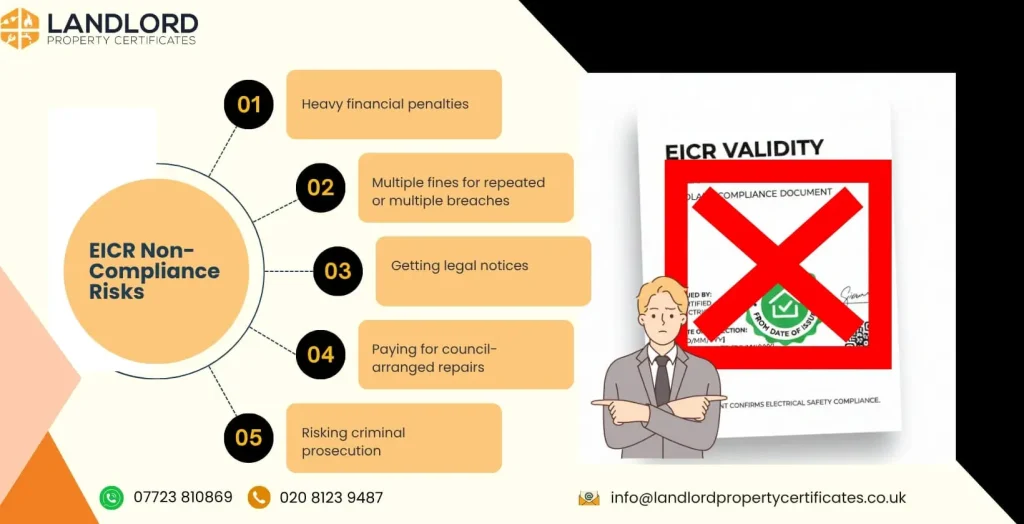
- Penalties: Local councils may impose a financial penalty of up to £40,000 on landlords who breach specified duties under the regulations. According to the Housing and Planning Act 2016, local councils impose a civil penalty of up to £30,000 as an alternative to prosecution for a range of offences under the Housing Act 2004. The penalty is up to £40,000 for more serious offences or repeat breaches. Penalties can reach up to £7,000 for many breaches that do not qualify as a full offence. Civil penalties were established on 6 April 2017. Civil penalties under the Housing and Planning Act apply to offences committed before 1 May 2026. Civil penalties under the Renter’s Rights Act 2025 and other housing legislation apply to all offences committed from 1 May 2026. The regulation applies where a landlord or property agent has breached a banning order under the Housing and Planning Act 2016. Civil penalties are appealable to the First-Tier Tribunal (Property Chamber). Civil Penalties are financial penalties imposed by local housing authorities on individuals or groups for housing offences.
- Multiple or Repeat Penalties: A landlord who fails in multiple duties faces multiple penalties. Repeat noncompliance within 5 years turns a breach into a serious offence, and the council issues a penalty notice of up to £40,000. Local councils in England are authorised to issue separate penalties for each breach or offence.
- Legal Notice: The local council has the authority to issue improvement or remedial notices so that the landlord completes the required electrical safety works themselves within the specified timeline.
- Council Commissioned Repair: Council arranges electrical safety repair work and bills the landlord for the cost if the landlord fails to act upon the improvement/remedial notice. According to recent legislative changes (effective from 1 May 2026) in the Renters’ Rights Act 2025, local councils must enforce landlord duties and act proactively, even without any complaint. Recent changes strengthen penalties and enforcement.
- Criminal prosecution risks: Council pursues criminal prosecution, including or instead of civil penalties, when safety breaches cause severe harm or persistent noncompliance. Landlords face criminal prosecution risks if the same breach continues after a penalty is imposed.
The landlord is not breaking the law if tenants do not allow the landlord to access the premises. According to the Electrical Safety at Work 2020 regulation, the duties of landlords are specified. But a landlord is not in breach of specified duties if they show proof that they have taken all the steps to comply with the relevant duty. The landlord can not force entry because access to the property depends on the tenant’s cooperation. Landlords are required to provide proof of access to the tenant, such as messages, emails, and calls. These documents will serve as evidence to demonstrate that the landlord has taken all reasonable steps.