Portable appliance testing involves visual inspection and electrical testing of appliances in a property to ensure they are safe to use. PAT stands for Portable Appliance Testing. PAT is required to ensure the safety of electrical appliances and reduce the risk of electrical shocks and fires. PAT testing provides documented proof that all reasonable steps have been taken to ensure equipment is safe and fit for its purpose. PAT testing is performed by a competent person, who could be a qualified electrician, a landlord, or an employer with the required skills, knowledge, and training for PAT testing.
PAT testing is mandated by law in the UK, but employers and landlords conduct it to remain compliant with the Health & Safety at Work Act 1974 and the Electricity at Work Regulations 1989. These laws require landlords and employers to ensure that all electrical appliances are safe for tenants and employees to use and to prevent the risk of fire and electric shock. The Housing (Scotland) Act 2014 makes PAT testing of portable appliances mandatory for private landlords in Scotland.
The PAT testing process involves a visual inspection of all appliances and continues with various electrical tests, such as functional load test, insulation resistance, and earth continuity. The process determines whether an appliance is safe for use or not. PAT testing frequency for small equipment should be 2 years, while large equipment requires a minimum of 4 years.
The Institution of Engineering and Technology IET Code of Practice (55th Edition) recommends a risk-based approach for defining the test frequency. An appliance with a high risk must be tested more frequently. Test intervals must be based on how likely an appliance is to develop a fault and how serious the consequences will be if an appliance is faulty.
What is portable appliance testing?
Portable appliance testing is a systematic process of inspecting and testing electrical appliances to ensure they are safe for common use. Health and safety laws require landlords and employers to ensure that all electrical equipment is free of hazards.
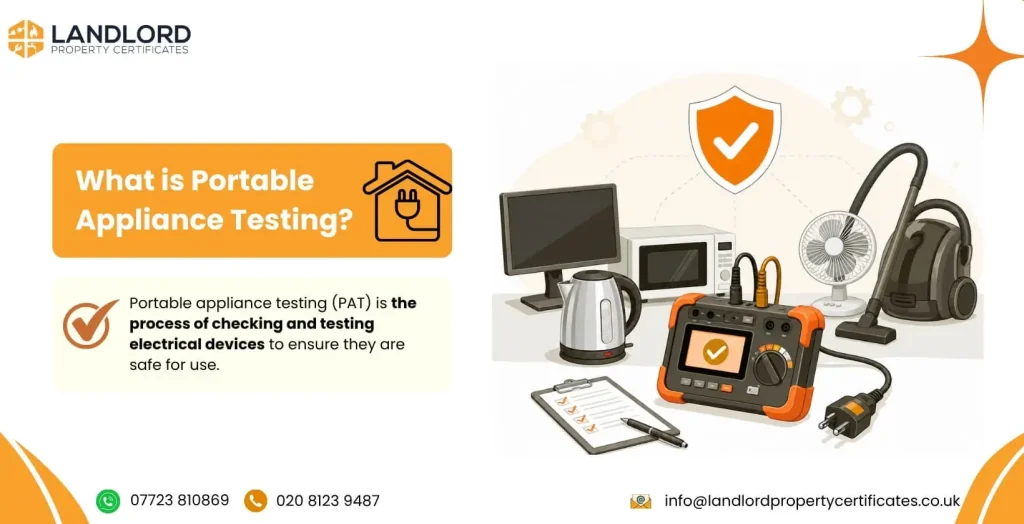
A complete PAT test comprises a visual inspection of all portable appliances (coffee maker, fridge, oven) and a thorough examination with specialized PAT testing equipment. A PAT tester is a competent person who analyses earth continuity, lead polarity, and insulation resistance of all portable appliances during testing. Every item is labelled as “passed” or “failed” after a PAT test.
PAT testing involves testing all portable electrical equipment in a property to ensure that all appliances are functioning properly. A landlord must conduct regular PAT testing of equipment, especially before handing over the property to a new tenant, to prevent electrical accidents and maintain tenant safety.
PAT Testing aims to prevent electric shocks, fires, and equipment failure. Tools used for PAT testing include a PAT tester device, a label printer, an inspection checklist, and a multimeter.
An appliance fails the PAT test if there is high leakage current, poor insulation, or cable damage. An appliance passes the test if electrical readings are within safe limits and there is no visible damage.
What does PAT testing stand for?
PAT stands for Portable Appliance Testing. A portable appliance is any device that has a plug or plugs into a power socket. Portable is a term derived from the Latin “Portare”, which means to carry. Portable means an item capable of being moved or carried easily. Appliance is a word derived from the Latin word “Applicare”, which means to attach. An appliance is any device or piece of equipment created for a specific function. Testing is derived from the old French word “tester,” which means to test and try. Testing refers to the act of assessing the function or safety of something.
The term Portable is confusing because PAT testing applies to some fixed appliances as well. What is the history of PAT testing in the UK?
Early appliance testing began in the 1960s in the government building and estate as part of planned maintenance schemes. Employers started taking responsibility for the health and safety of employees, including electrical safety management, with the introduction of the Health and Safety Act 1974. PAT practices began to formalize during the 198s when the use of electrical appliances grew in homes and workplaces.
The Electricity at Work Regulations 1989 came into force on 1 April 1990, and the regulations require proper maintenance of all electrical systems and equipment to prevent danger and injury. This regulation did not create any legal obligations for PAT testing, but employers consider PAT testing as a practical way to comply with the 1989 regulations. The first formal recommended procedure for PAT came into light in 1994 with the publication of HSE Guidance Note HS(G)107 on in‑service inspection and testing of electrical equipment, and the release of the Code of Practice for Visual Inspection and Electrical Testing by the Institution of Electrical Engineers (IEE). The IET code of practice for in-service inspection and testing of equipment was published. This new code updates the procedures and highlights the recommended practices. The IET released the 5th Edition Code of Practice in 2020 and introduced the term ’Electrical Equipment Testing (EET). EET is regarded as a more accurate description of what was traditionally called PAT.
How does portable appliance testing work?
Portable Appliance Testing works by visually inspecting appliances and then electrically testing them via PAT testing equipment. The process of PAT testing includes different electrical tests such as earth continuity, insulation resistance, and leakage current. A PAT tester labels applications as either “pass” or “fail” based on the results. A certificate of PAT testing is issued to maintain a record for future reference.
PAT test is executed to ensure that all appliances are safe to use in a property. PAT testing is important in the UK because of the use of low-cost appliances at work and in household areas. Fires and electrical shock incidents related to these appliances in the past have increased the need for PAT testing. Around 53.4% of all accidental dwelling fires in England are caused by electrical hazards, while 25.9% of electrical dwelling fires are caused by faulty appliances. More than 45 percent of domestic fires are caused by cookers and ovens, 13% of which are caused by grills and toasters, while 10 percent of cases are due to hot plates. White goods caused 1140 fires in England in 2024.
A qualified PAT tester or electrician conducts the PAT testing to check the quality of appliances and any health or safety-related issues. A label with a pass or fail is attached to the device if an inspection is done with calibrated tools. Property residents and workers must not use a device that failed the test unless repair or replacement has been done. Regular PAT testing helps landlords and employers to prevent accidental fires caused by faulty appliances or poor-quality equipment.
PAT testing helps landlords stay compliant with safety standards while improving tenant safety and lowering insurance risks.
Is PAT a type of landlord certificate?
Yes, PAT is a type of landlord certificates in London that verifies that electrical appliances have been inspected and tested thoroughly. An electrical appliance with a pass PAT result is safe to use. This certificate is proof that the landlord has taken all the required measures to provide safe appliances for regular use by tenants.
Who performs portable appliance testing?
PAT testing can be carried out by a competent person, not necessarily a qualified electrician. In London, PAT testing is commonly performed by trained in-house staff, property managers, facilities management companies, electrical contractors, or specialist PAT testing providers.
UK law does not require a specific PAT testing licence or fixed qualification. The Health and Safety Executive states that electrical equipment must be maintained in a safe condition, but the law does not specify who must test it, how often it must be tested, or whether testing must happen annually. A competent person must have enough knowledge, training, experience, and test equipment to inspect appliances, use PAT testing equipment correctly, and understand the results.
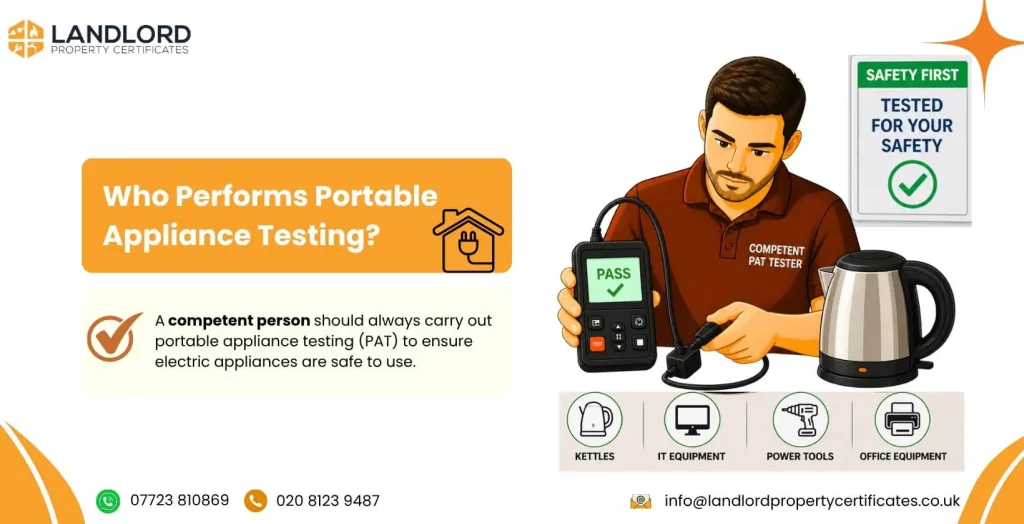
A landlord, employer, or staff member may carry out basic visual checks if they are trained to spot damage, loose plugs, exposed wires, burn marks, cracked casings, or unsafe leads.
Formal inspection and electrical testing need more skill because some faults cannot be found by sight alone. A PAT tester does not need to be an electrician, but many landlords and businesses use trained contractors because they provide appliance records, pass/fail labels, and a PAT testing report or certificate for compliance evidence.
City & Guilds 2377-77 is a recognised Level 3 qualification for in-service inspection and testing of electrical equipment, and it is based on the IET Code of Practice, but it is a competence route rather than a universal legal requirement.
What does a PAT testing certificate look like?
A PAT testing certificate looks like an official report document that provides test results, test details, appliance details, name, and contract details of a client and the company/service providers. This document provides appliance details like unique ID, reference number, description (kettle, oven), location, make, and model of the appliance.
Test details include the date of the test, test results (pass or fail), and type of test performed (earth continuity, visual inspection, insulation resistance). A PAT testing certificate includes the next recommended date for inspection alongside compliance statements like the test is conducted by following safety regulations, such as the Electricity at Work Regulations 1989 and the Health and Safety at Work Act 1974.
How to perform portable appliance testing?
Portable appliance testing is performed by recording all the appliance inventory, classifying each appliance, inspecting the appliance visually, and then conducting a test according to the class of each appliance. A PAT tester runs different tests (earth continuity, function load, wire polarity) to ensure that appliances are safe and free from current leakage. PAT testers affix a pass or fail label to each appliance and document all the tests and results for compliance.
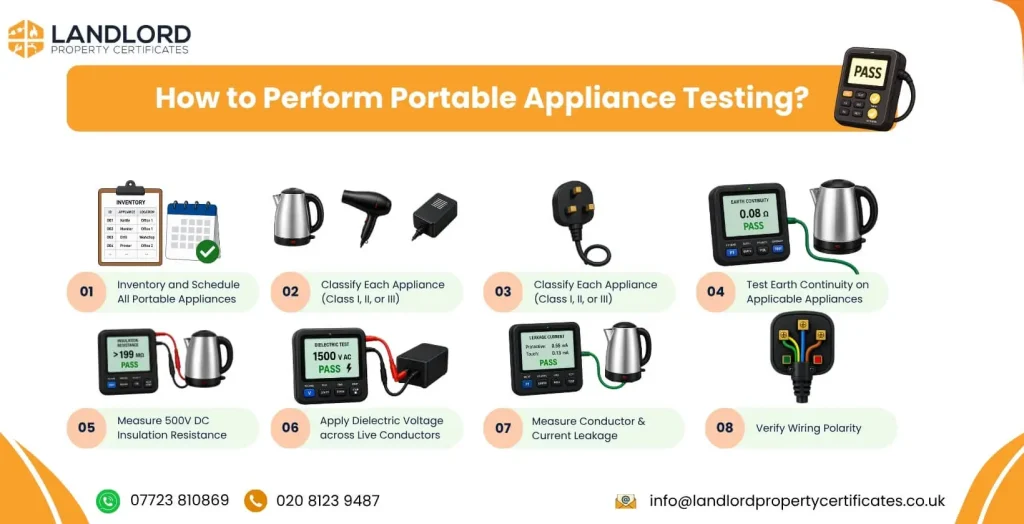
Listed below are 11 steps to perform potable appliance testing.
1. Inventory and Schedule All Portable Appliances
Inventory and schedule all portable electrical appliances in a facility. Give each item a unique identification number based on location, type, or usage level. Create a testing schedule based on frequency of use and risk factor. Appliances with high risk and regular use should be tested more often than appliances that are not used regularly. A PAT tester continues with the classification of each appliance after the inventory and scheduling process is completed.
2. Classify Each Appliance (Class I, II, or III)
The PAT tester classifies each appliance based on construction and level of protection. Class I appliances use an earth connection for safety, Class II appliances have double insulation, and therefore Class II does not rely on an earth connection. Class II appliances operate on low voltage. Classification of each appliance is a must because specific electrical tests need to be performed based on the class.
3. Perform Visual Inspection of Plug, Cable, and Casing
APATt tester performs a visual inspection of the plug, cable, and appliances. This inspection is done to locate visible signs like burn marks, loose connections, frayed wires, cuts, or cracked casing. Visual inspection allows a PAT tester to identify faults without any need for advanced testing procedures. PAT tester continues with the electrical test after performing a visual inspection
4. Test Earth Continuity on applicable appliances
The PAT tester tests earth continuity on class I appliances to check that the protective earth connection is stable and intact. These tests measure the resistance between the earth pin of the plug and the metal body of the appliance. A low resistance reading ensures that the risk of electric shock is low because fault current safely passes to earth.
5. Measure 500V DC Insulation Resistance
The PAT tester measures the insulation resistance of an appliance by applying a 500V DC voltage between live conductors and earth. This insulation resistance test checks how effectively an appliance’s insulation prevents current leakage. A low value suggests potential safety risks, while a high resistance value indicates good insulation.
6. Apply Dielectric Strength Voltage across the Live conductors
The PAT tester applies a dielectric strength voltage across the live conductor to check whether the insulation withstands electric stress or not. The standard insulation testing may not detect hidden weaknesses, but the dielectric strength voltage helps the PAT tester identify these issues. An appliance can operate safely under surge conditions if it passes dielectric strength voltage testing.
7. Measure Protective Conductor and Touch Current Leakage
The PAT tester measures protective conductor and touch current leakage to ensure that an appliance does not pose a serious shock hazard. Protective conductor current refers to leakage flowing across the earth conductor. A touch current refers to the current that could pass through a person upon touching an appliance. The PAT tester checks both the protective conductor and touch current leakage to ensure that there is no excessive leakage or a fault, which leads to a shock hazard.
8. Verify Wiring Polarity
A PAT tester verifies wiring polarity to eliminate the risk of electric shock. A polarity check ensures that live, neutral, and earth wires are correctly connected to the cable and plug. An incorrect polarity connection is dangerous because it is a condition where some parts of appliances remain live even when you switch them off.
9. Run Functional Load Test
The PAT tester runs a functional load test to ensure that appliances are functioning as intended. Testers measure the current (amperage) and power consumption (wattage) to see whether it is within the expected ranges. The appliance is safe to use when readings are within the expected range and unsafe to use if readings do not fall within the expected range. A PAT tester verifies the normal functioning and safety of an appliance by running a functional load test.
10. Affix Pass/Fail PAT Compliance Label
The PAT tester starts attaching a clearly visible label, such as red or green, to the appliance, indicating whether it passes or fails a test. The green label indicates that the appliance is safe to use, while the red label indicates that it is not safe to use. The label includes the test date, next due date, and test results P/F. Landlords must remove failed items from service to prevent regular use by tenants.
11. Record and Archive Results in PAT Register
The PAT testers document all the test results in a PAT register or digital system. This record includes all the main details like appliance ID, measured values, testing date, test results, and technician info. The PAT tester issues a PAT testing certificate to the landlord. Proper documentation is required to stay compliant with support audit and safety regulations.
Is PAT testing a legal requirement for landlords in the UK?
PAT testing is not a universal legal requirement for landlords in England, Wales, or Northern Ireland, but landlords must ensure that any electrical appliance they supply is safe for tenant use. PAT testing is the common way to show that kettles, microwaves, fridges, washing machines, lamps, extension leads, and other plug-in appliances have been inspected and tested.
In Scotland, the rules are stricter because the electrical safety inspection for private rented homes includes a Portable Appliance Test on appliances supplied by the landlord. Scottish short-term lets must also meet safety standards under the licensing system.

Landlords in London should not treat PAT testing as optional when they provide furnished accommodation, HMOs, serviced apartments, or managed rental properties. HMO licence conditions can require PAT records; for example, Lewisham Council requires landlord-provided portable appliances to be PAT tested every 12 months, with records kept for at least five years.
An EICR checks fixed electrics such as wiring, sockets, and consumer units, while PAT testing checks portable plug-in appliances. Landlords who need appliance records for tenant safety, HMO licensing, insurance, or council inspections can book Portable appliance testing services in London to keep supplied appliances checked, labelled, and documented.
How frequently should PAT testing be conducted?
There is no recommended PAT testing frequency by the Health and Safety Executive (HSE), but landlords must perform PAT tests before a new tenant occupies the property. PAT testing frequency for small appliances is every two years, and four years for large appliances like washing machines. The frequency of PAT testing is determined by 3 factors: the electrical class of the appliance, the risk level of the working environment, and the category of the appliance.
HSE devices landlords to determine PAT frequency based on 5 factors such as manufacturer’s guidelines, usage, maintenance history, impact of repair, potential for equipment misuse, and age of equipment.
The Institution of Engineering and Technology IET Code of Practice (55th Edition) recommends a risk-based approach for defining the test frequency. An appliance with a high risk of failure must be tested more frequently. Test intervals must be based on how likely an appliance is to develop a fault and how serious the consequences will be if an appliance is faulty.
What qualifications are required to perform PAT testing in the UK?
There is no legally required qualification to perform PAT testing in the UK. The test must be carried out by a competent person, meaning someone with enough technical knowledge, practical training, experience, and ability to inspect appliances, use PAT testing equipment, and understand the results. UK law does not say that a PAT tester must be a qualified electrician or hold a specific licence. The legal duty is to keep electrical equipment safe, while PAT testing is one method used to prove that supplied appliances have been checked.
Formal training is not mandatory, but it is the common route to proving competence. A PAT course teaches appliance classes such as Class I, Class II, and Class III, visual inspection, electrical risk identification, test-equipment use, result interpretation, and record keeping. City & Guilds 2377-77, the Level 3 Award in the In-Service Inspection and Testing of Electrical Equipment, is a recognised qualification for people responsible for inspection and testing; City & Guilds lists it as replacing the older 2377-22/32 route. The IET Code of Practice is also widely used because it guides duty holders, testers, facilities managers, and maintenance staff on managing in-service inspection and testing of electrical equipment.
Which appliances require PAT testing in the UK?
Appliances that require PAT Testing include microwaves, stereos, radios, toasters, sandwich makers, extensions, vacuum cleaners, lamps, portable lighting, fridges, freezers, kettles, and washing machines.
The 7 types of appliances that need PAT testing are listed below.
- Fixed appliances (cooker, AC)
- Stationary appliances (Fridge, washing machine)
- IT appliances (server rack equipment, computer)
- Moveable appliances (space heater, floor fan)
- Portable appliances (Kettle, toaster)
- Cables and chargers (mobile phone charger, laptop power cable)
- Handheld appliances (hair dryer, electric drill)
Landlords always wonder what needs PAT testing. Any electrical items with an electrical plug and the capability of moving require PAT testing. Large appliances like fridges and freezers are fixed but need PAT testing. Some items are affixed to a surface and connected through a plug socket; they must be tested.
Which appliances are exempt from PAT testing in the UK?
New appliances, fixed installations (ceiling lights, built-in ovens), permanently wired equipment, and equipment that operates under extra-low voltages of 50V AC or less are exempt from PAT testing in the UK. Power supplies feeding low-voltage systems require PAT testing if they operate at the mains voltage.
What is the cost of PAT testing in the UK?
The average PAT testing cost in the UK is around £1 to £3 per item. Some service providers charge an initial fee of £10 to £ 30, others charge £40 to £60 hourly.
Does the PAT testing certificate expire?
No, A PAT testing certificate does not technically expire. A PAT test certificate remains valid until the risk assessment period has expired or the appliance is no longer safe to use. PAT tester performs 30 tests in 1 hour. How long a PAT test lasts depends on the ease of access to the electrical appliances or whether it’s possible to unplug or not use the appliance.