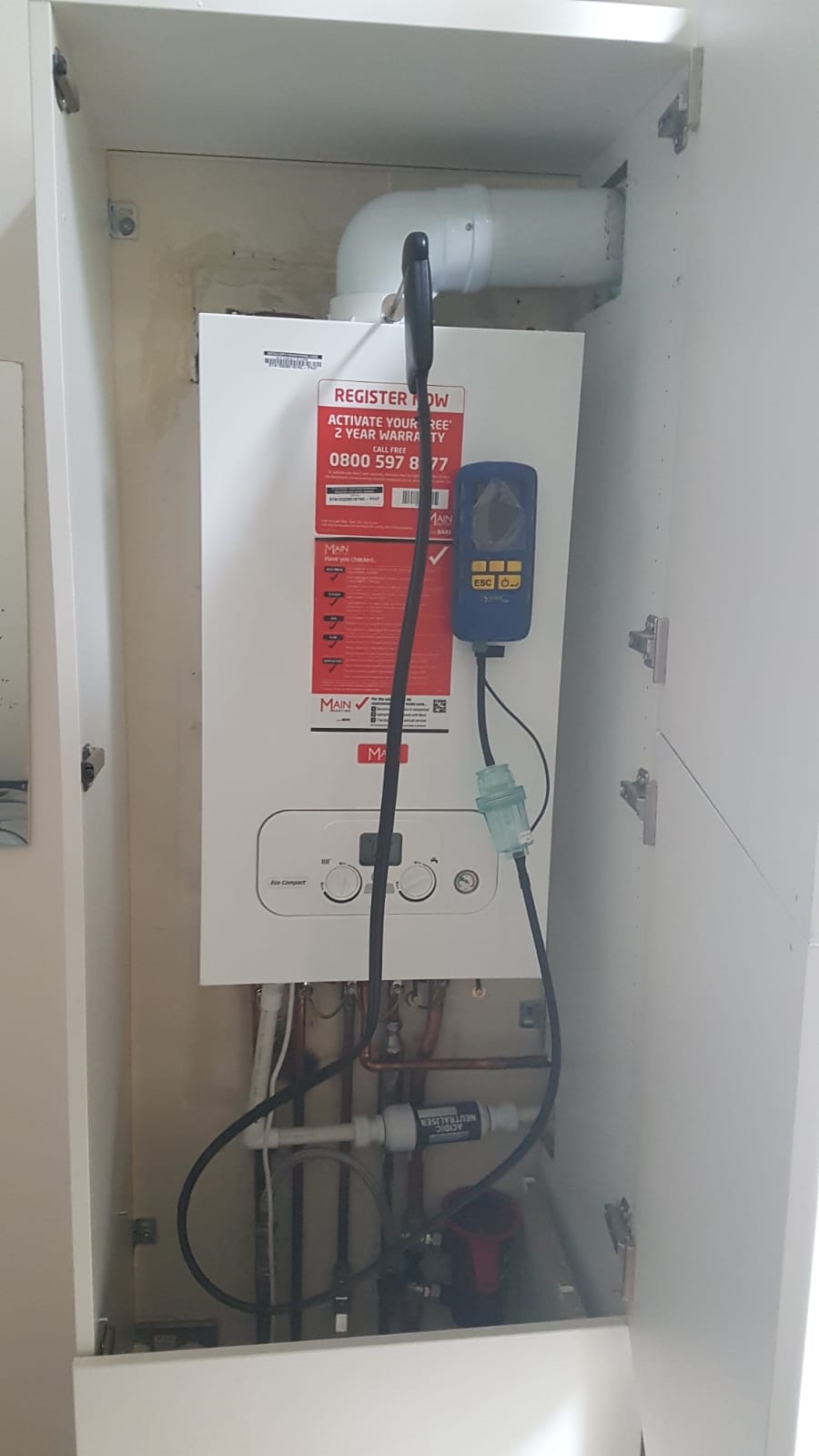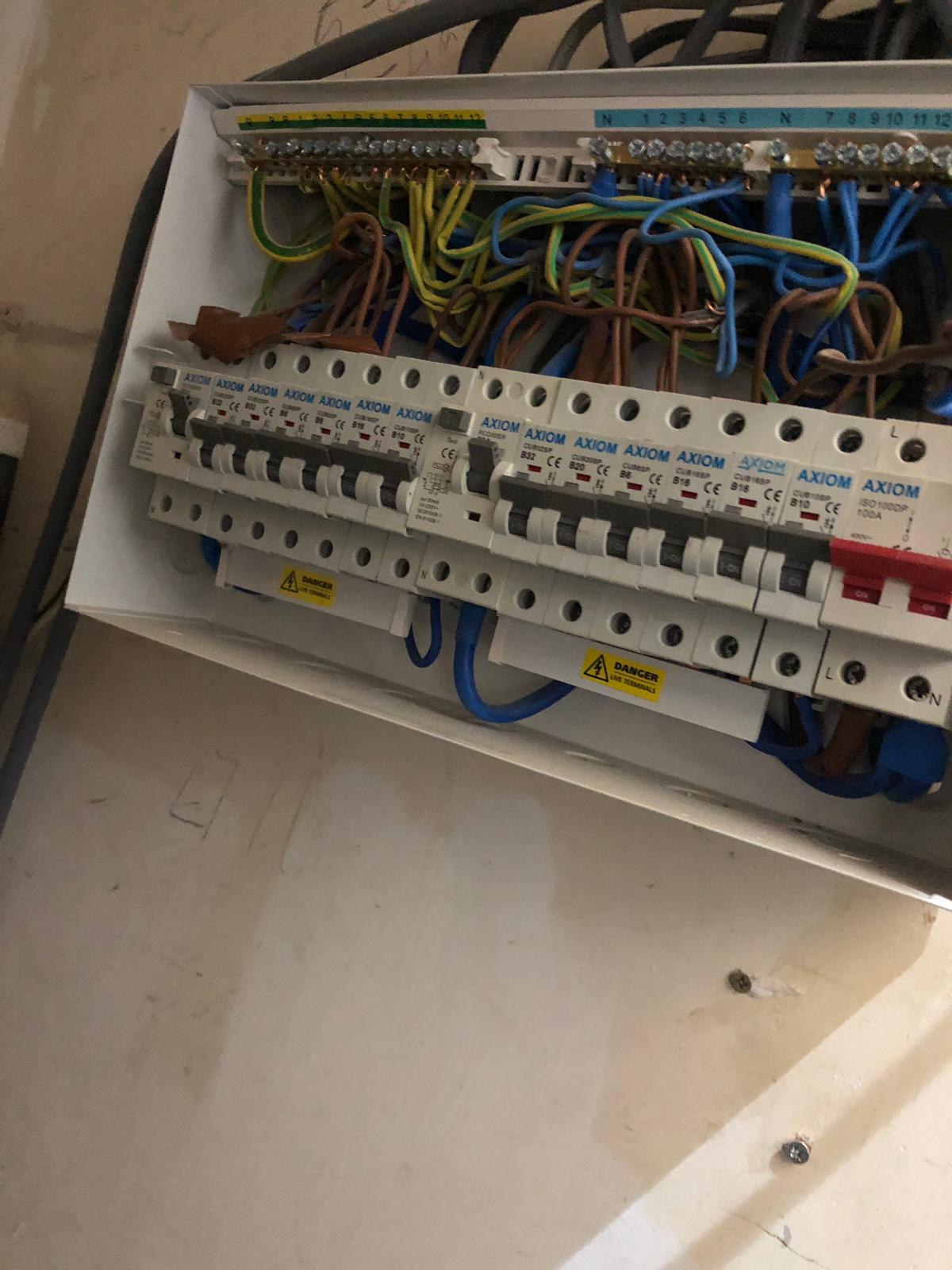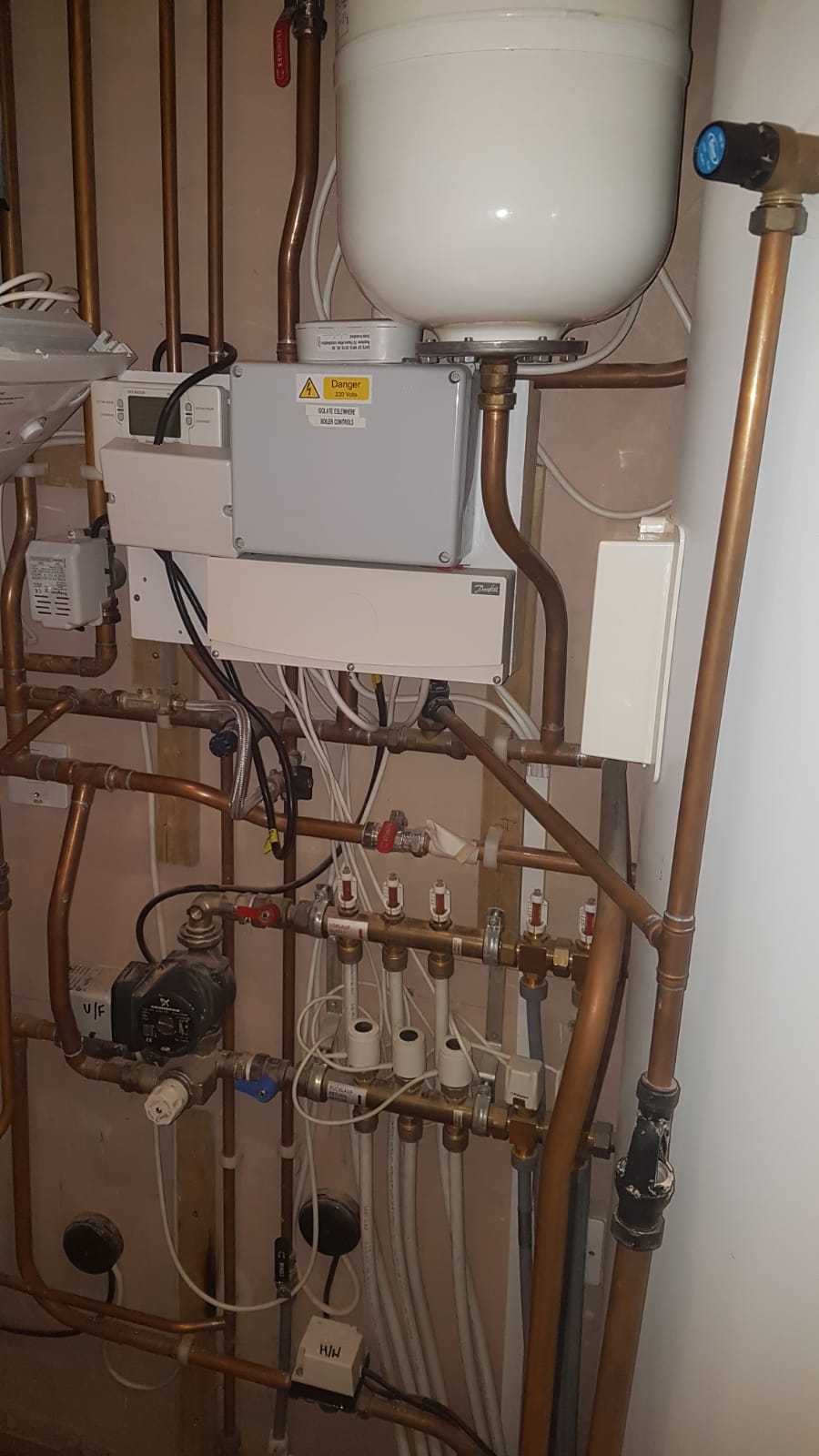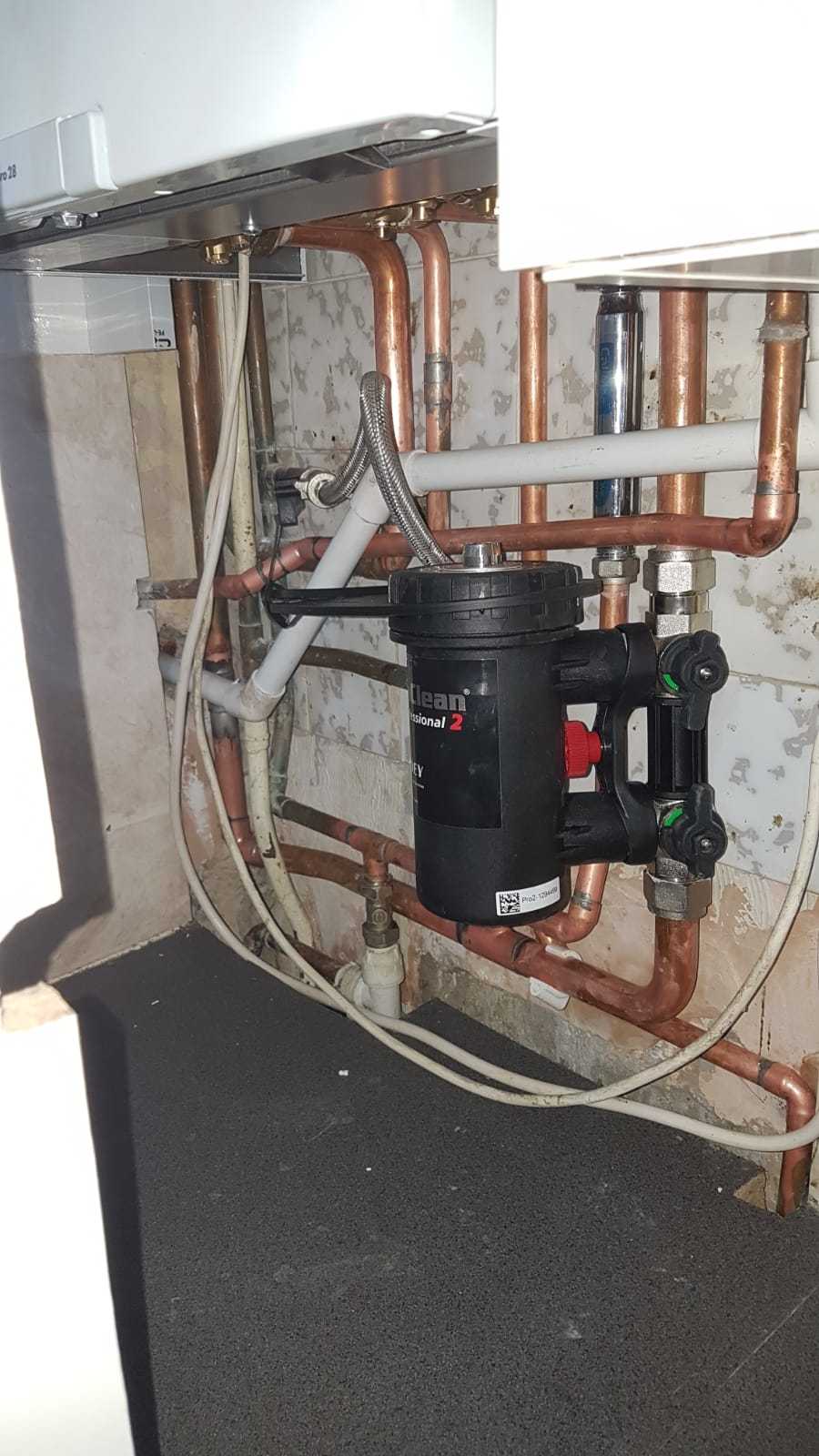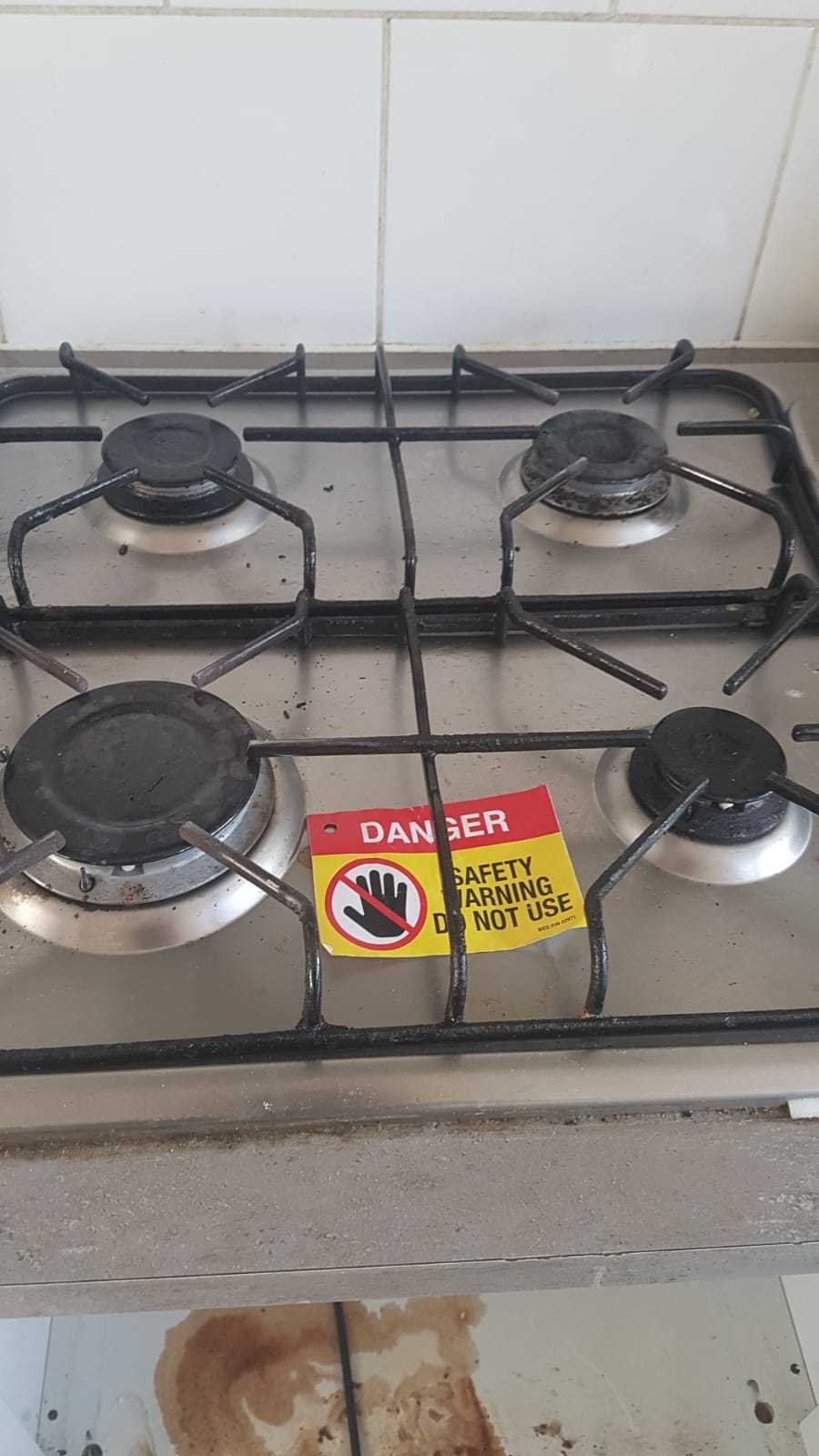

A Landlord Gas Safety Certificate is a document that ensures a Gas Safe-registered engineer has inspected all gas appliances, flues, and pipework supplied by the landlord. Landlords are required to have annual gas safety certificates under the Gas Safety (Installation and Use) Regulations 1998, which came into effect on 31st October 1998. The landlord must retain a gas safety certificate for at least 2 years. The landlord is responsible for providing a gas safety certificate to tenants before they move in, or within 28 days of the gas inspection.
The Landlord Gas Safety Certificate applies to private landlords, housing associations, local authorities, and landlords of hostels, short-term holiday lets, and properties under short-term leases (for less than 7 years).
Gas safety regulations in the UK prevent gas leaks, fire, explosions, and carbon monoxide poisoning, and protect tenants’ health and property. These regulations provide a clear legal framework to ensure gas safety standards in rented homes. Violations of these rules lead to criminal prosecution, fines (unlimited), and imprisonment (2 years) according to the Health and Safety at Work Act 1974.
Tenants are obligated to provide access for annual gas inspections and maintenance, and to promptly report suspected gas faults or safety issues, as required by law in 1998. Landlords are responsible for taking legal action if tenants are repeatedly denied access to their rooms. Community discussion and legal advice consistently indicate that it is the landlord’s responsibility to arrange and pay for the gas safety check, not the tenant’s.
Listed below are the 23 Gas Safety Certificate Obligations for Landlords in the UK.
- Landlords must arrange a gas safety check every 12 months for each landlord-provided gas appliance and flue.
- Gas checks, servicing, repairs, installations, and maintenance must be done by a Gas Safe registered engineer.
- Landlords must cover fixed, portable, LPG, and communal gas appliances supplied for tenant use.
- Existing tenants must receive the Gas Safety Record within 28 days, and new tenants must receive it before moving in.
- Landlords must keep gas safety records for at least 2 years.
- Gas pipework, appliances, chimneys, flues, and ventilation must be kept safe and working.
- Unsafe gas appliances must not be used until defects are repaired and the appliance is made safe.
- Accessible installation pipework should be visually inspected and tightness-tested where reasonably practicable.
- Pipework should be checked before re-letting, where inspection or testing is recommended.
- Gas appliances left by previous tenants must be removed or checked before new tenants use them.
- Landlords must take reasonable steps to access the property and keep evidence of access attempts.
- Landlords cannot transfer legal gas safety duties to tenants through the tenancy agreement.
- In England, carbon monoxide alarms are required in rooms with fixed combustion appliances, except gas cookers.
- Required smoke and carbon monoxide alarms must be tested at the start of each new tenancy.
- Faulty smoke or carbon monoxide alarms must be repaired or replaced once the landlord is informed.
- Carbon monoxide alarms should meet BS EN 50291 or an equivalent approved standard.
- Alarms should be fitted, tested, and replaced according to the manufacturer’s instructions.
- Tenants should be told how to turn off the gas and respond to a gas emergency.
- Inspection hatches are needed where concealed boiler flues cannot otherwise be checked.
- Rented homes must remain fit for human habitation and free from gas-related health risks.
- Landlords must fix defects that could cause injury or property damage.
- Licensed HMO landlords must provide an up-to-date gas safety certificate to the council when required.
- Social landlords must follow Awaab’s Law timescales for emergency hazards and covered health risks.
1. Arrange gas safety checks every 12 months for each landlord-provided gas appliance and flue.
Landlords are responsible for carrying out a safety check of all gas appliances and flues supplied every 12 months (1 year) under the Gas Safety Regulations 1998.
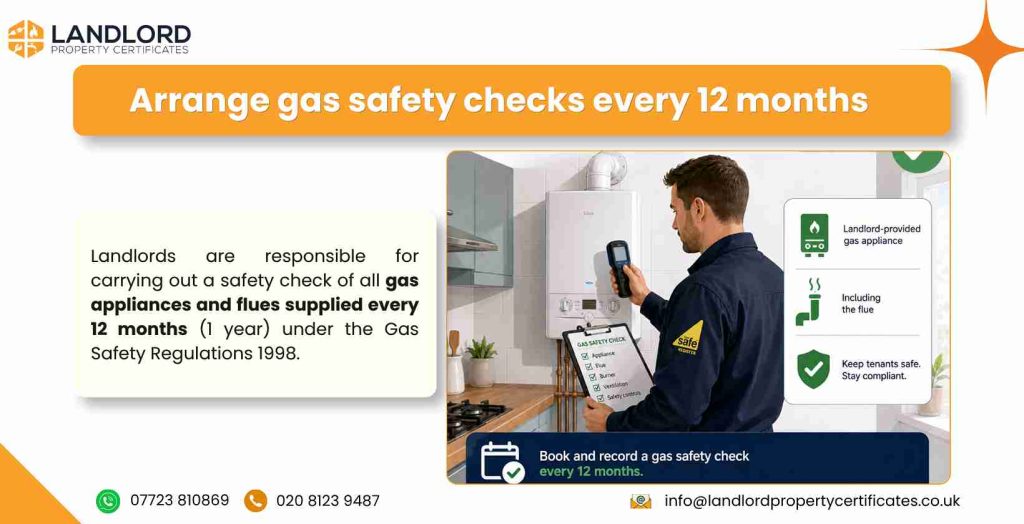
The gas engineer inspects gas tightness, burner pressure, ventilation, combustion performance, flame stability, and flue performance. These inspections detect corrosion, blockage, leaks, or combustion failure before they pose a risk to occupants. The Health and Safety Executive (HSE) has the authority to take legal action against a landlord for failing to provide a valid Gas Safety certificate.
2. Use Gas Safe-registered engineers for gas checks, installations, servicing, maintenance, and repairs.
The Gas Safety (Installation and Use) Regulations 1998 state that hire a Gas Safe-registered engineer to carry out gas inspections.

The official gas safety registration body was changed from CORGI to the Gas Safe Register in 2009. Gas safety registration ensures that an engineer has completed the training (ACS), evaluation, and periodic competency checks for gas work, and has provided a GAS safety certificate in London.
Gas systems pose the threat of gas leaks, fires, explosions, and carbon monoxide (CO) poisoning, and the law does not allow gas work to be undertaken by unregistered persons. A landlord who knowingly brings in an unregistered person to perform gas work is fined (£30,000), imprisoned (2 years), and held liable for any injuries and property damage according to the Health and Safety at Work Act 1974.
3. Check landlord-provided permanent, portable, LPG, and communal gas appliances and flues used by tenants.
Check landlord-provided permanent, portable, LPG, and communal gas appliances and flues used by tenants.

The Gas Safety Regulations 1998 apply not only to domestic boilers but also to all LPG and communal gas appliances provided to tenants by the landlord. These regulations cover the safety of boilers, gas fires, cookers, water heaters (fixed appliances), portable appliances, and LPG installations. Responsibility for the gas safety certificate lies with the person in charge of these installations.
4. Provide the Landlord Gas Safety Record to existing tenants within 28 days and to new tenants before move-in.
Landlords are responsible for providing a copy of the Gas Safety Record within 28 days of the gas inspection and to new tenants before they move in, according to the Gas Safety (Installation and Use) Regulations 1998.

This requirement ensures transparency and enables the tenant to verify that legal gas safety inspections have been completed. The Gas Safety Record includes the inspection date, the engineer’s registration number, and the property address. This certificate also includes the inspected appliances, the inspection findings, and the required remedial action.
5. Keep gas safety records for at least 2 years, or longer when using the 2-month early renewal window.
Landlords are required to keep gas safety records for at least 2 years or longer when using the 2-month early renewal window under Regulation 36(3)(c) 1998.

This record allows the courts, insurers, and tenants to verify that gas installations comply with the law. The amendments in gas safety certificates allow them to be renewed up to two months early, but they don’t change the renewal date, so landlords have to keep records longer (2 years) to prove a continuous history of compliance. An accurate gas safety record contributes to diligence in resolving disagreements or investigating accidents.
6. Maintain gas pipework, appliances, chimneys, flues, and ventilation in safe working condition.
Landlords are responsible for maintaining gas pipework, appliances, chimneys, flues, and ventilation in safe working condition under section 36(2) of the Gas Safety (Installation and Use) Regulations 1998.

Failure to maintain gas components, worn or cracked pipes, poor ventilation, or faulty parts results in gas leaks, inadequate combustion, CO buildup, fire, or explosion. Landlords are responsible for making the necessary repairs as soon as possible if defects in gas installation are found, to ensure the home is safe for tenants.
7. Repair gas safety defects promptly and stop unsafe appliances from being used until made safe.
Landlords are responsible for repairing gas safety defects and stopping the use of unsafe appliances until they are made safe under Regulation 36(2) of the Gas Safety (Installation and Use) Regulations 1998.
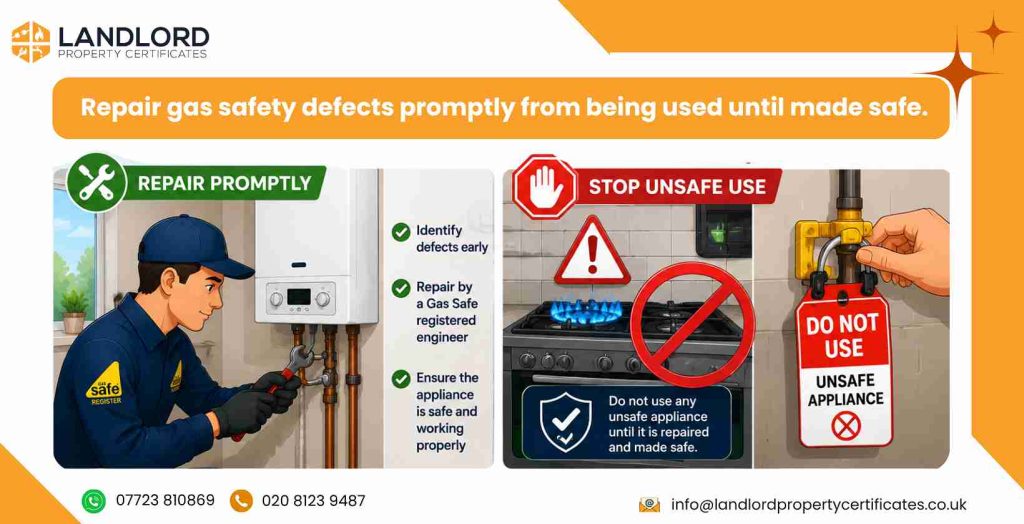
A faulty appliance results in a gas explosion or carbon monoxide poisoning. Failure to fix defects in gas installations results in criminal prosecution (up to 2 years’ imprisonment), civil liability, enforcement notices, and significant monetary penalties (£30,000).
8. Request tightness testing and visual inspection of installation pipework during safety checks where reasonably practicable.
Landlords should ensure a gas-tightness test and visual inspection of accessible installation pipework during the annual gas safety check, according to HSE guidance accompanying Regulation 36.

The gas tightness test identifies gas leakage from the system, and the visual inspection identifies corrosion, physical damage, and inadequate support. These checks identify potential issues that would otherwise go undetected, leading to serious safety risks. Periodic examination is an added safety measure to appliance testing only for gas pipework that continues to be in service for years (more than 2 years).
9. Inspect and test installation pipework for soundness before re-letting where recommended.
HSE and Gas Safe Register guidance advises landlords to have pipework inspected and tested when a new tenant moves in after a property has been vacant. Unoccupied houses suffer from wear and tear, corrosion, damage, vandalism, and unnoticed unauthorized changes.

Testing the soundness of the system before re-letting ensures that the installation is still gas-tight and fit for safe operation. This step minimizes the risk of gas safety issues immediately after the start of the new tenancy and demonstrates a landlord’s proactive response to their duty of care.
10. Remove or safety-check gas appliances left by previous tenants before re-letting.
The landlord is legally responsible for the gas appliances left by the previous tenants, which are still connected and available for use by new tenants.
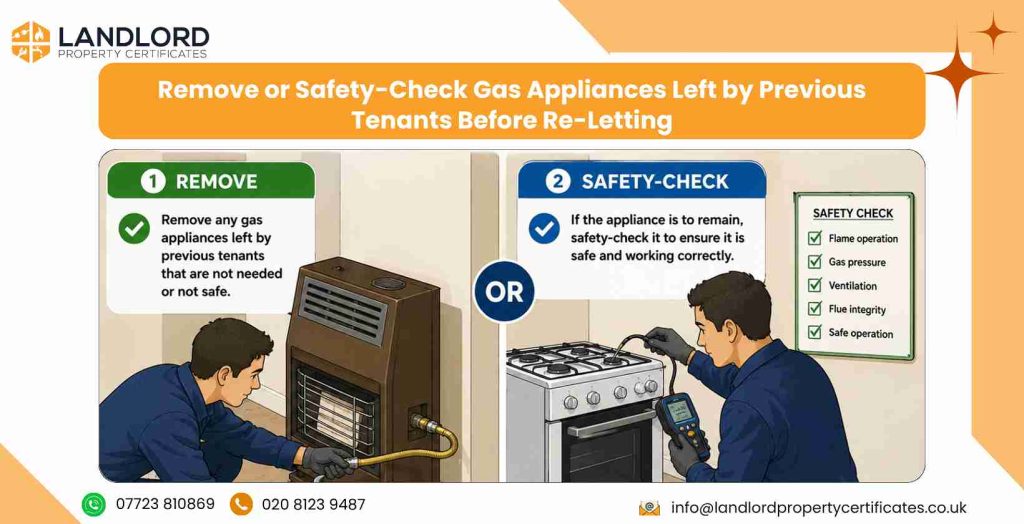
Landlords have to remove old gas appliances themselves or ensure a Gas Safe-registered engineer inspects them before re-letting a property. Appliances with a problematic history may have hidden faults, lack safety devices, or have installation defects.
11. Take reasonable steps to gain access for checks and keep evidence of notices, letters, and appointment attempts.
Landlords are responsible for taking reasonable steps to gain access for checks and for keeping evidence of notices, letters, and appointment attempts, in accordance with HSE guidelines.
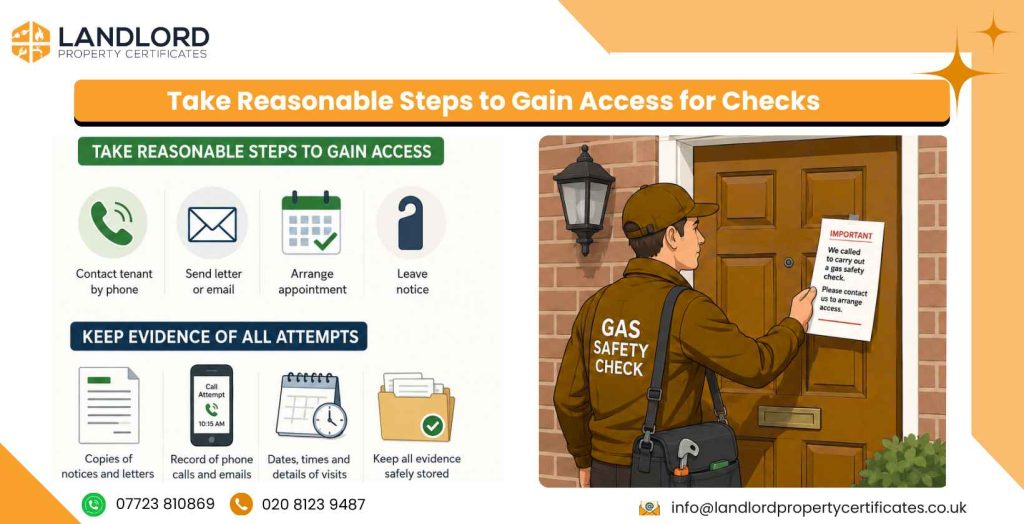
These records are useful in a defense to an enforcement action if the tenant denies access and the landlord has made a reasonable attempt to comply with the legislation. Landlords are not allowed to physically trespass on occupied property to carry out annual gas safety inspections without informing the tenant.
12. Do not transfer legal gas safety duties to tenants through the tenancy agreement.
Gas safety responsibilities rest with the landlord and cannot be delegated to the tenant by contract under the Gas Safety (Installation and Use) Regulations 1998.
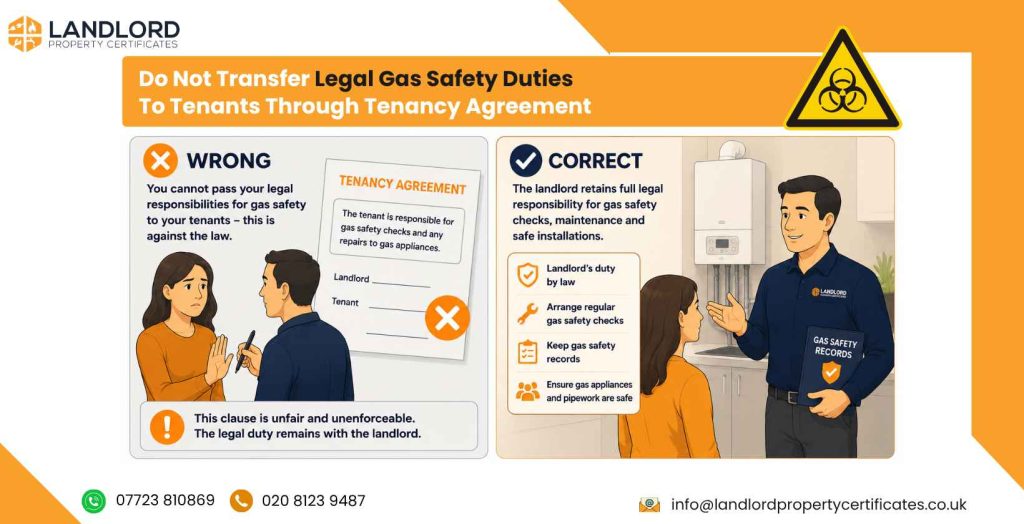
Tenants should not be asked to conduct annual gas safety checks, employ Gas Engineers, maintain landlord-owned gas equipment, or take responsibility for statutory compliance, as this is unlawful under a tenancy agreement. The landlord is still legally responsible for the gas safety certificate to regulators and the courts, even if tenants agree to these conditions.
13. Fit carbon monoxide alarms in rooms containing relevant gas, oil, or solid-fuel appliances under the rules for the relevant UK nation.
Landlords are responsible for fitting a carbon monoxide alarm in any room with a fixed combustion appliance, except gas cookers, according to the UK Regulations October 2022.

These rules were tightened after evidence showed that faulty fuel-burning appliances remain a major cause of accidental carbon monoxide poisoning. Carbon monoxide (CO) is a colorless, odorless, lethal gas that makes people ill or even kills them without warning.
14. Test prescribed smoke and carbon monoxide alarms on each new tenancy start date.
The Smoke and Carbon Monoxide Alarm Regulations (Regulations 2015, Amendment in 2022) require landlords to ensure that all smoke and carbon monoxide alarms are in working order on the first day of each new tenancy.

This requirement intends to ensure that tenants begin their occupancy with fully functional life-safety equipment. Testing CO at the beginning of a tenancy establishes a record that the alarms are operating at the time of the transfer of occupancy. This duty is in addition to landlords’ general obligations under the Housing Act 2004 to minimize risk in residential properties.
15. Repair or replace faulty smoke and carbon monoxide alarms once notified.
The Smoking and Carbon Monoxide Alarm (Amendment) Regulations 2022 require landlords to repair or replace defective alarms.

A faulty alarm eliminates an important safety barrier from fire and CO poisoning. Local authorities enforce and issue remedial notices to compel compliance. The landlord is subject to civil penalties and enforcement action if he fails to comply with the CO law. Alarms that work are part of a landlord’s overall responsibility to ensure a safe place to live.
16. Choose carbon monoxide alarms marked BS EN 50291 with a British or European approval mark, such as Kitemark.
Legislation does not always specify a particular brand, but landlords are strongly advised to install alarms that comply with BS EN 50291, a recognized European and British performance standard for domestic carbon monoxide alarms.

Certification to the Kitemark or equivalent European mark shows that they have been independently tested for reliability, sensitivity, and durability. Certified Alarms provide a way to demonstrate due diligence and avoid products that are not safety-checked, unverified, or of unknown quality.
17. Follow manufacturer instructions for fitting, testing, battery condition, and alarm replacement dates.
Landlords have to ensure that the alarms are fitted and kept in good working order in accordance with the manufacturer’s instructions and British Standard. Correct positioning of alarms is important, as improper placement delays smoke or CO detection.

Manufacturers also indicate how often the alarm should be tested, how the battery should be replaced, how to clean the alarm, and how long the alarm should last. New alarms have sensors that lose functionality over time and must be completely replaced after a certain number of years (typically 10).
18. Tell tenants how to turn off the gas and what to do in a gas emergency.
Informing tenants how to turn off the gas and what to do in a gas emergency is considered good practice guidance from the Health and Safety Executive (HSE) and the Gas Safe Register.
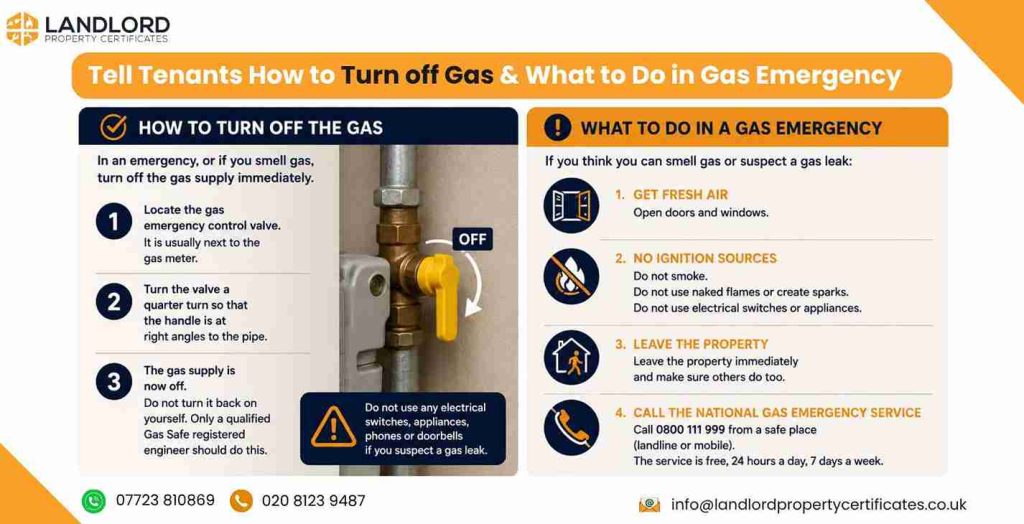
The landlord must provide the location of the emergency control valve (gas shut-off valve) to address situations in which the tenant suspects a gas leak or CO incident. Tenants should be advised to open doors, not to play with electrical switches, not to light candles or other open flames, and to leave their home and contact the National Gas Emergency Service.
19. Install inspection hatches where concealed room-sealed fan-assisted boiler flues cannot otherwise be inspected.
Provide inspection access to concealed flues to prevent flue defects and the consequent escape of dangerous combustion gases, such as CO.

The Gas Safe Register, with support from the Health and Safety Executive (HSE), issued guidance stating that sealed fan-assisted boiler flues should be visually inspected where possible. Inspection hatches should be provided where flue runs through ceilings, walls, boxed-in voids, or r areas where inspection is not possible. The engineer cannot verify the integrity, continuity, and safety of the system without access to the flue system.
20. Keep the rented property fit for human habitation by preventing gas-related health and safety risks.
The Homes (Fitness for Human Habitation) Act 2018, which amended the Landlord and Tenant Act 1985, requires that rented properties be fit for human habitation throughout the tenancy.

The property is deemed unfit if gas-related hazards pose a risk of carbon monoxide poisoning, gas leaks, fire, explosion, or lack of heating and hot water. Tenants can act directly against the landlord if the landlord fails to comply with gas safety regulations.
21. Remedy defects that could cause personal injury or property damage.
Landlords are legally responsible for repairing and maintaining gas installations and for fixing defects that cause injury or damage under Section 11 of the Landlord and Tenant Act 1985.
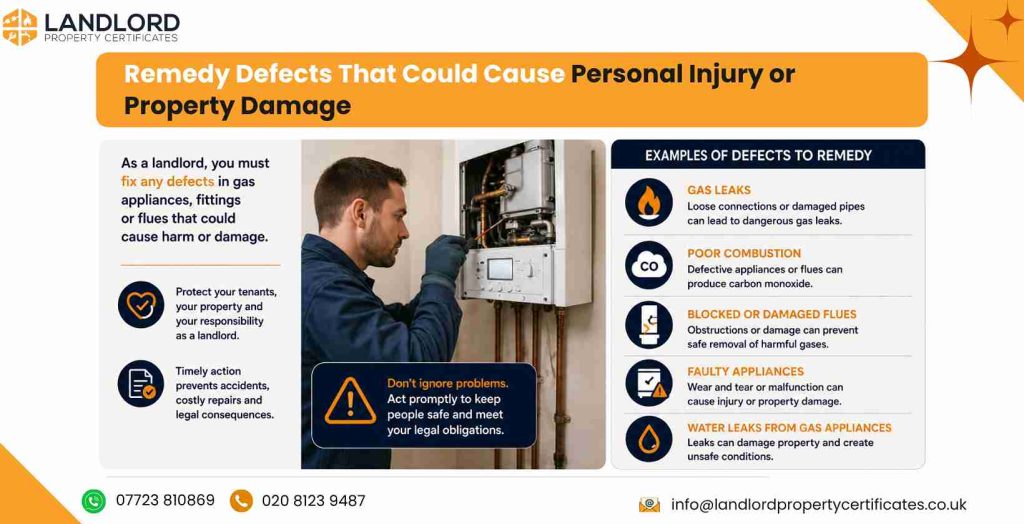
The landlord should be aware of dangerous gas defects and take action to correct them. Landlords face civil claims for damages, criminal actions, insurance issues, and negligence-related injury, death, and property damage suits.
22. Submit an updated gas safety certificate to the council for licensed HMOs.
Landlords of licensed HMOs are required to submit an updated gas safety certificate to the council under the Housing Act 2004.

Licensed HMOs must have a Gas Safety Record, as local authorities routinely ask for an up-to-date one when granting a license and re-licensing. This action allows councils to track compliance with statutory gas safety duties and ensures that multi-occupancy properties meet these requirements. Valid gas certification must be provided; otherwise, license enforcement action and license variation action may be taken against the landlord.
23. Resolve significant or emergency hazards within Awaab’s Law timescales where you are a social landlord.
Awaab’s Law, via the Social Housing (Regulation) Act 2023, introduces new obligations for social landlords, mandating them to investigate and resolve serious health and safety issues within agreed time limits.

The law was drafted in response to the seriousness of damp and mould issues that have caused deaths; its overall aim is to ensure that serious health risks are addressed promptly. Social landlords are expected to act quickly if there is an immediate risk to occupants from gas-related hazards, to investigate, repair, and make safe. Consequences for non-compliance with Awaab’s Law result in action by the housing authority and legal consequences for the landlord/housing provider.
Are landlords legally required to provide a gas safety certificate?
Yes, landlords are legally required to provide a gas safety certificate under Regulation 36(6) of the Gas Safety (Installation and Use) Regulations 1998.
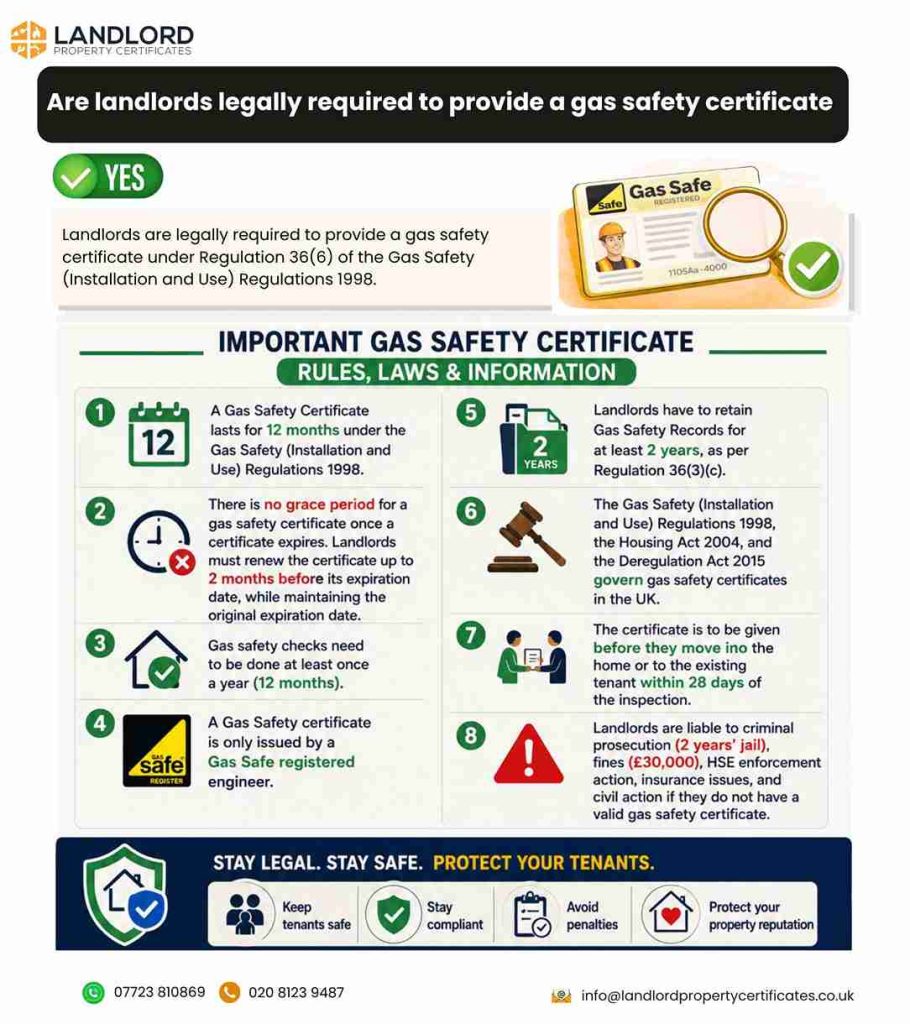
Violation of this regulation results in a fine (unlimited) and imprisonment (2 years). The landlord is responsible for providing an annual gas safety check certificate to existing tenants within 28 days of the check and to new tenants before they move into the property.
As a landlord, you should know about these important Gas safety certificate rules/laws/information.
1. A Gas Safety Certificate lasts for 12 months under the Gas Safety (Installation and Use) Regulations 1998.
2. There is no grace period for a gas safety certificate once a certificate expires. Landlords must renew the certificate up to 2 months before its expiration date, while maintaining the original expiration date.
3. Gas safety checks need to be done at least once a year (12 months).
4. A Gas Safety certificate is only issued by a Gas Safe registered engineer.
5. Landlords have to retain Gas Safety Records for at least 2 years, as per Regulation 36(3)(c).
6. The Gas Safety (Installation and Use) Regulations 1998, the Housing Act 2004, and the Deregulation Act 2015 govern gas safety certificates in the UK.
7. The certificate is to be given before they move into the home or to the existing tenant within 28 days of the inspection.
8. Landlords are liable to criminal prosecution (2 years’ jail), fines (£30,000), HSE enforcement action, insurance issues, and civil action if they do not have a valid gas safety certificate.
Who pays for the gas safety certificate, the landlord or the tenant?
The landlord is responsible for paying for the Gas Safety Certificate, not the tenant. The Gas Safety (Installation and Use) Regulations 1998 require landlords to ensure that gas supplies, appliances, and flues provided for their tenants undergo annual safety checks, and that the landlord pays for them.
The tenant is not responsible for the Gas Safety Certificate cost. Tenants are responsible for reasonable access for inspection, maintenance, and repair in response to requests.
What are the consequences for landlords who fail to follow their legal gas safety obligations?
The consequences for landlords who fail to follow their legal gas safety obligations are listed below.
- Criminal Prosecution: The landlord’s failure to carry out annual Gas Safety Checks, maintain gas installations, and keep Gas Safety Records leads to prosecution (up to 2 years’ imprisonment) and fines (unlimited) by the Health and Safety Executive (HSE) or local authorities.
- Civil Compensation Claims: Landlords are subject to civil compensation claims if a tenant is injured or becomes ill, their property is damaged, or they experience financial loss as a result of unsafe gas installations. This compensation involves medical costs, wages, property damage, and more.
- Damage or loss of life: Landlords are held liable for acts that cause serious harm, such as gas leaks, fires, explosions, or carbon monoxide poisoning, under health and safety legislation, negligence law, and housing law. Investigations and litigation are strict in cases of loss of life.
- Enforcement Notices and Investigations: The HSE or local authorities issue an enforcement notice to landlords if they suspect a breach of gas regulations. There are additional legal penalties for non-compliance with enforcement notices.
- Insurance Problems: Failure to meet gas safety requirements breaks claims for landlords. The insurer refuses to cover the loss if the landlord failed to meet the legal gas safety requirements.
- HMO Licensing Consequences: Multiple Occupation (HMO) properties face difficulty obtaining license renewals and enforcement action by the local authority if they lack a valid Gas Safety certificate.
- Reputational Damage: Gas safety prosecutions and enforcement actions impact a landlord’s professional standing and reduce the ability to attract tenants, obtain insurance, or be a successful landlord.
The landlord is responsible for informing the tenant about their obligations and laws in the UK. A tenant should be given access to relevant information by the landlord, such as the Gas Safety Record, emergency procedures, access arrangements for inspections, and gas defect reporting. Tenants must understand Gas Safety certificate obligations, including providing reasonable access for inspections and promptly reporting issues, to ensure a safe living environment.
Can a tenant sue a landlord for failing to conduct a gas safety check?
Yes, a tenant can sue a landlord for failing to conduct a gas safety check under the Gas Safety (Installation and Use) Regulations 1998 (section 36). A tenant can take legal action against the landlord under the Homes (Fitness for Human Habitation) Act 2018 if the landlord commits negligence, breaches a statutory duty, or creates unsafe housing conditions.
The landlord did not perform their legal safety duties, resulting in the tenant suffering illness (such as carbon monoxide poisoning), injury, or property damage due to poor gas installation.
What are the tenants’ obligations regarding gas safety certificates in the UK?
The tenants’ obligations regarding gas safety certificates in the UK are listed below.
- Tenants have to give landlords reasonable access to do annual gas safety checks.
- Tenants should contact the gas emergency service and inform their landlord if they suspect a gas leak or unsafe gas appliances.
- Tenants should have Gas Safety Records provided by the landlord to keep on hand for future reference.
- Tenants should not engage in self-employment in gas work or hire unqualified people to carry out gas work on gas appliances, gas pipework, or flues.
- Tenants have to follow the landlord’s and Gas Safe engineers’ instructions as well as the manufacturers’ instructions on how to use appliances safely.
- Tenants have to be aware of where the gas shut-off is and what to do in the event of a gas emergency.
- Tenants should use gas appliances responsibly and not in ways that may damage them or render them unsafe.
- Tenants should not block the ventilation openings, air bricks, or flues which are essential for the safe operation of gas appliances.
- Tenants should cooperate with the landlord’s reasonable attempts to fulfill legal gas safety obligations, including arranging annual inspections.
Can a landlord evict a tenant for not following tenant obligations?
Yes, a landlord can evict a tenant for not following the tenant obligations. These obligations include refusing reasonable access required for gas safety checks and inspections, damaging gas appliances or installations, interfering with gas safety equipment, or repeatedly breaking the terms of tenancy.
The Housing Act 1988 allows a landlord to obtain possession for breaches of tenancy.
Eviction of a tenant is not automatic; the landlord must follow a procedure to take possession and serve the correct notice. The landlord can secure a court order to take possession, and the court will decide if eviction is justified.