An EICR is valid for 5 years (for rented properties) in the United Kingdom, or according to the previous report under the Electrical Safety Standards in the Private Rented Sector (England) Regulations 2020. The Housing Act 2004, the Landlord and Tenant Act 1985, the Act 1974, and the Electricity at Work Regulations 1989 govern the validity of EICRs in the UK. Houses in Multiple Occupation (HMOs) and social housing properties have a 5-year EICR validity period. Owner-occupied homes have no legal EICR validity period, but BS 7671 Wiring Regulations suggest an electrical inspection every 10 years.
EICR validity for commercial properties is 5 years, and for industrial premises is 3 years. Sites and temporary structures are regularly inspected (every 7 days) during construction. Health centers, hospitals, and swimming pools have an EICR validity of 1 year. Some electricians suggest a low EICR validity period (1 year) if electrical faults are detected and need to be renewed earlier, according to the Institution of Engineering and Technology (IET) and BS 7671: Requirements for Electrical Installations (18th Edition, Amendment 2), published in 2022.
What is the validity of an EICR certificate in the United Kingdom?
The validity of an EICR certificate for rental properties is 5 years, or according to the previous report, but it can be reduced by a qualified electrician if required. The landlord is legally required to have an electrical installation inspection every 5 years, under the Electrical Safety Standards in the Private Rented Sector (England) Regulations 2020.

The Housing Act 2004 gives local authorities the power to take action if electrical hazards are found in a property. The Landlord and Tenant Act 1985 places a duty on the landlord to ensure that electrical installations are kept in proper repair.
The Electricity at Work Regulations 1989 ensure that the electrical work is safe at construction sites. The 1974 Act places a duty on the employer to ensure that employees and visitors are safe from electrical hazards while at work. The BS 7671 IET Wiring Regulations are not law but a guide on electrical inspection periods (10 years for owner-occupied properties, 5 years for commercial properties, and 3 years for industrial premises). If a landlord obtains an EICR certificate in 2026, then a new one is required in 2031, or according to the previous report, unless the EICR report identifies faults in the electrical installation.
The validity of an EICR certificate in the United Kingdom for different properties is described in the table below.
| Property Type | EICR Validity |
| Residential Properties (General) | 10 years |
| Rental Properties | 5 years |
| Commercial / Industrial Properties | 5 years |
| HMO Properties (Houses in Multiple Occupation) | 5 years |
| Public Buildings | 5 years |
| High-Risk Properties | 1-3 years |
| House with a Swimming Pool | 1 year |
| Owner-Occupied Homes | 10 years |
How long is an EICR valid for residential properties in the UK?
An EICR is valid for 10 years for residential properties in the UK according to BS 7671 (IET Wiring Regulations). Residential properties have less electrical wear and tear than commercial properties. EICR validity is less (3 years) if the electrical installation is old and electrical deterioration is present.
How long is an EICR valid for rental properties in the UK?
The EICR is valid for 5 years in rental properties in the UK under the Electrical Safety Standards in the Private Rented Sector (England) Regulations 2020. Landlords have to inspect electrical installations every five years. This shorter EICR validity for rental properties safeguards tenants and ensures electrical issues are detected and fixed on time.
How long is an EICR valid for commercial/ Industrial properties in the UK?
An EICR is valid for 5 years for commercial/Industrial properties in the UK under BS 7671 and is backed by the Electricity at Work Regulations 1989. Electrical consumption is higher in commercial buildings than in residential buildings, increasing the risk of electrical hazards. Regular electrical inspections ensure that businesses’ electrical systems are safe and compliant with workplace safety regulations.
How long is an EICR valid for HMO properties in the UK?
An EICR is valid for 5 years in a Multiple Occupation (HMO) in the UK under the Housing Act 2004, HMO licensing regulations, and the Electrical Safety Standards Regulations 2020. A greater number of occupants leads to higher electrical demand in HMOs, which carry a high risk of electrical hazards.
How long is an EICR valid for public buildings in the UK?
An EICR is valid for 5 years for public buildings in the UK, in accordance with BS 7671 recommendations and backed by the Health and Safety at Work etc. Act 1974. Regular electrical inspections of public buildings promote a safe environment for the visitors.
How long is an EICR valid for high-risk properties in the UK?
An EICR is valid for 1-3 years for high-risk properties in the UK, in accordance with the recommendations of BS 7671 and the Electricity at Work Regulations 1989. Electrical systems are under greater stress at industrial sites, factories, and in harsh environments, so frequent electrical inspections are required to ensure safety.
How long is an EICR valid for a house with a swimming pool in the UK?
An EICR is valid for 1 year for a house with a swimming pool in the UK, in accordance with BS 7671 recommendations that highlight the electrical risks associated with water. Annual testing of electrical equipment around the pool ensures safety.
How long is an EICR valid for owner-occupied homes in the UK?
An EICR is valid for 10 years for owner-occupied homes in the UK, in accordance with the BS 7671 (IET Wiring Regulations). The longer EICR validity for owner-occupied homes is due to the owner’s presence and upkeep of the property. Homeowners are recommended to have a new EICR report when purchasing or selling a home.
Why is EICR validity set by law in the UK?
The EICR validity is set by law in the UK to ensure that electrical installations remain safe throughout the life of a property. Electrical systems suffer from age, wear and tear, damage, overloading, and neglect. Proper electrical inspections detect electrical issues before they lead to electric shock, fire, injury, or property damage.
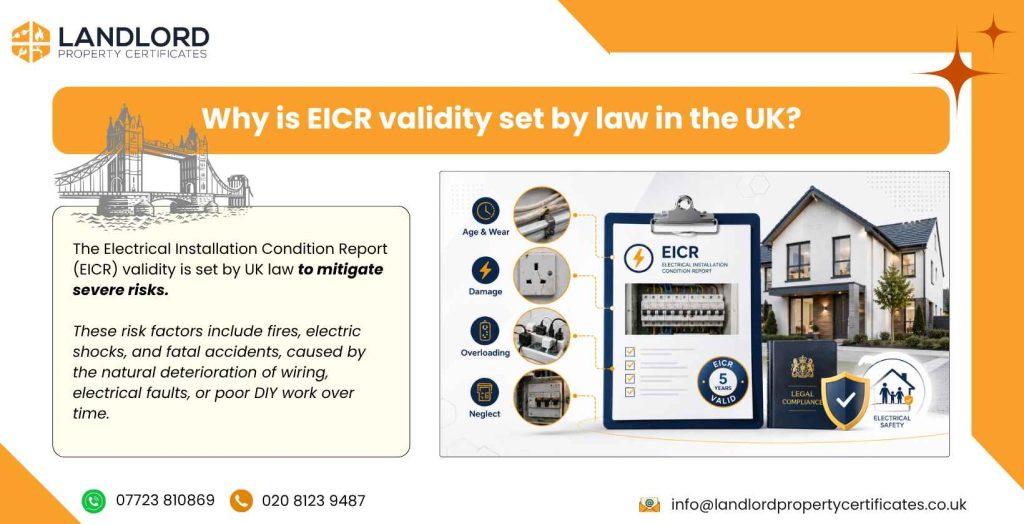
The Electrical Safety Standards in the Private Rented Sector (England) Regulations 2020 require the landlord to ensure electrical installations are tested and inspected every 5 years. This legal requirement safeguards tenants by ensuring the electrical system is inspected by a qualified electrician. The Housing Act 2004 ensures electrical safety by giving local authorities the power to act if there is an electrical hazard. The Landlord and Tenant Act 1985 stipulates that the landlord must maintain electrical installations in good repair and working order.
The Electricity at Work Regulations 1989 state that electrical systems must be in a safe condition during construction. The 1974 Act places a duty on employers to protect employees and visitors from electrical risks while at work. The inspection periods: guidance from BS 7671 (IET Wiring Regulations) suggests 5-year EICR validity for rented properties, 10 years for owner-occupied dwellings, and 1-3 years for high-risk places. A valid EICR gives tenants confidence that the property has been professionally inspected and is safe to live in. A valid EICR helps the landlord comply with legal obligations, limit liability, avoid penalties, and ensure insurance policies remain in force.
What happens if your EICR expires in the UK?
An expired EICR results in legal penalties (£3-4k) for the homeowner in the UK. An out-of-date EICR for rental properties places landlords in breach of the Electrical Safety Standards Regulations 2020. This condition leads to action by local authorities against the landlord, with penalties of up to £3k (old rules) and £4k (new rules). An expired EICR also raises issues for landlords under the Housing Act 2004 and the Landlord and Tenant Act 1985, which require landlords to ensure the property’s electrical safety.
An expired EICR poses insurance risks and leads to letting and renewal delays. An expired EICR poses safety risks to tenants, including electric shock, fire hazards, and damage to appliances from undetected faults. Tenants inform local councils about unsafe electrical conditions so they can take action. An expired EICR results in long-term, expensive repairs, damage to the wiring or equipment, and an electrical fire in a property. The 1974 Act exposes business owners to legal risk for commercial building safety failures if the EICR has expired. An out-of-date EICR removes the formal assurance of electrical safety, adds risk, and has legal, financial, and safety consequences for everyone involved.
Can a tenant move to a property with an expired EICR in the UK?
No, a tenant cannot legally move into a property with an expired EICR in the UK. A landlord requires a valid EICR for tenants to move into a property in accordance with The Electrical Safety Standards in the Private Rented Sector (England) Regulations 2020. A well-maintained property with a good EPC rating but an expired EICR is not considered safe to live in. A landlord ensures that an up-to-date EICR is in place before a new tenant moves in.
Can a tenant move to a property with an unsatisfactory EICR in the UK?
No, a tenant cannot legally move to a property with an unsatisfactory EICR in the UK. An unsatisfactory EICR indicates faults (poor wiring, faulty fuses) in the electrical installation in the form of codes (C2, C2, and F1), which require further investigation. These electrical faults include faulty wiring, poor earth connections, overloaded circuits, missing fuses, or a faulty consumer unit. A property with an unsatisfactory EICR is harmful for tenants to live in. A property with modern facilities and a satisfactory EPC is not considered safe to live in if it has an unsatisfactory EICR. The electrical system is not safe for occupancy until remedial actions have been taken and the electrical installation is found to be satisfactory.
Is there any fine from the UK government for an expired or unsatisfactory EICR?
Yes, there is a fine (£3-4k) from the UK government for an expired or unsatisfactory EICR. Local authorities can impose financial penalties (3K for past rules; 4K for current rules) on landlords for non-compliance with the Electrical Safety Standards in the Private Rented Sector Regulations in England.
The landlord can avoid penalties for having an expired and unsatisfactory EICR by arranging electrical inspections before their EICR comes up for renewal, using a qualified electrician, and providing the EICR to tenants at the appropriate time. The landlord must undertake the remedial work recommended in an unsatisfactory EICR within the required 28-day timeframe after the electrical inspection.
How do you renew an EICR certificate after expiry in the UK?
The steps to renew an EICR certificate after expiry in the UK are listed below.
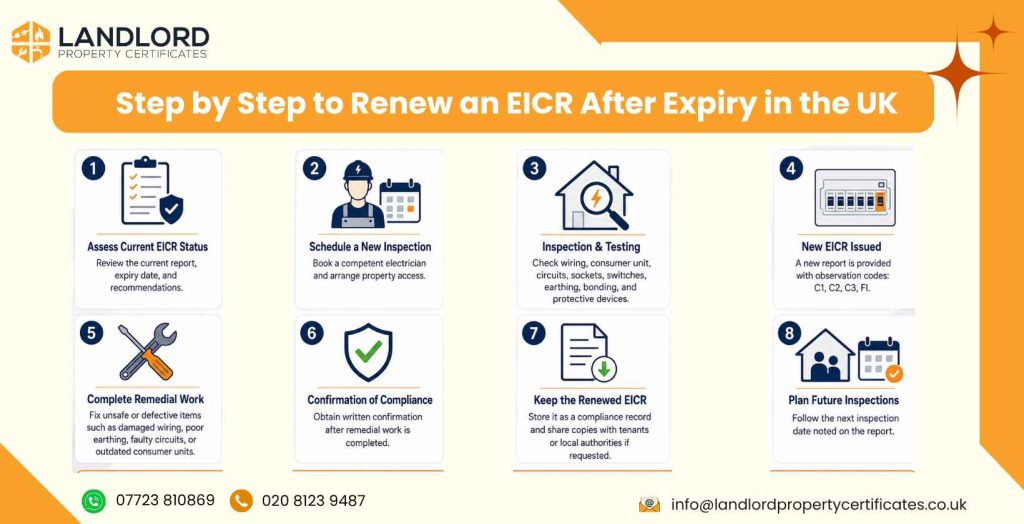
- Access the current EICR status: Review the existing EICR and note its expiry date and recommendations. The EICR is valid for 5 years, or according to the previous report, but EICR validity is recommended for a shorter period if the electrician considers the electrical installations unsatisfactory.
- Schedule a new Electrical Inspection: Schedule a new Electrical Inspection if an EICR has expired or is nearing expiry. Hire a competent electrician and electrical engineer. The electrician schedules a convenient time to get access to the property and conduct an electrical inspection.
- Conduct electrical Inspection and Testing: The electrician inspects the entire fixed electrical installation located on the premises. Electrical inspection includes the wiring system, consumer unit, circuits, sockets, switches, earthing arrangement, bonding conductor, and protective devices in accordance with the latest safety standards.
- Issuance of new EICR: Once the inspection is complete, the electrician provides a new EICR. The EICR includes observation codes (C1, C2, C3, F1) to categorize defects by severity. EICR ensures that the electrical installation is suitable and acceptable for continued use.
- Proceed with remedial work: Proceed with remedial work if dangerous or potentially dangerous defects are identified in the electrical installation. These defects include upgrading circuits and consumer units, earthing, repairing circuits, or replacing damaged wiring and protective devices. These repairs aim to eliminate safety risks and raise the installation to an acceptable standard.
- Get a Confirmation of Compliance: The Electrician is to take a note once the remedial work is done. This record serves as evidence that the identified issues have been corrected and that the electrical work is now safe.
- Renewed EICR: Keep the renewed EICR as the property’s compliance record. Landlords have to provide a copy of the EICR to tenants and to local authorities upon request. EICR provides evidence of continued compliance with electrical safety requirements.
- Plan Future Inspections: The future electrical inspection date is written in the suggestions section of the EICR. Proactive EICR scheduling ensures that electrical inspections are performed regularly, minimizing the risk of compliance action and helping identify electrical safety problems before they become serious hazards.
The property becomes legally non-compliant (rental properties) if the EICR is not renewed, leading to enforcement action by local authorities and potential fines. A non-renewed EICR poses safety hazards due to potential electrical issues, such as insufficient wiring, inadequate earthing, or overloaded circuits.
What is the EICR renewal cost in the UK?
The EICR renewal cost in the UK ranges from £100 to £1,500, depending on the property’s size, type, and complexity. Small residential properties (1-bedroom flats) cost £100-£150 for an EICR renewal. Larger homes (4 bedrooms) cost between £150 and £450 for an EICR renewal. Multiple Occupation (HMO) properties cost between £250 and £550 for an EICR renewal. Commercial buildings (shops and offices) cost £250-£800 for an EICR renewal. Large commercial and industrial premises cost between £800 and £1,500 for EICR renewal, as there are more circuits, distribution boards, and electrical equipment to inspect. EICR renewal cost includes the costs of inspection and report, but remedial work identified during the inspection is added separately to the cost of the EICR certificate.
Is EICR validity the same as EICR frequency in the UK?
No, EICR validity is not the same as EICR frequency in the UK, but both have the same time period. The EICR validity in the UK is the time an EICR remains valid, such as 5 years for rented residential properties. The EICR frequency in the UK is how often electrical inspections need to be conducted, such as every 5 years for rented residential properties. EICR Validity refers to the length of time the EICR report is accepted, but EICR frequency refers to the length of time between EICR inspections.