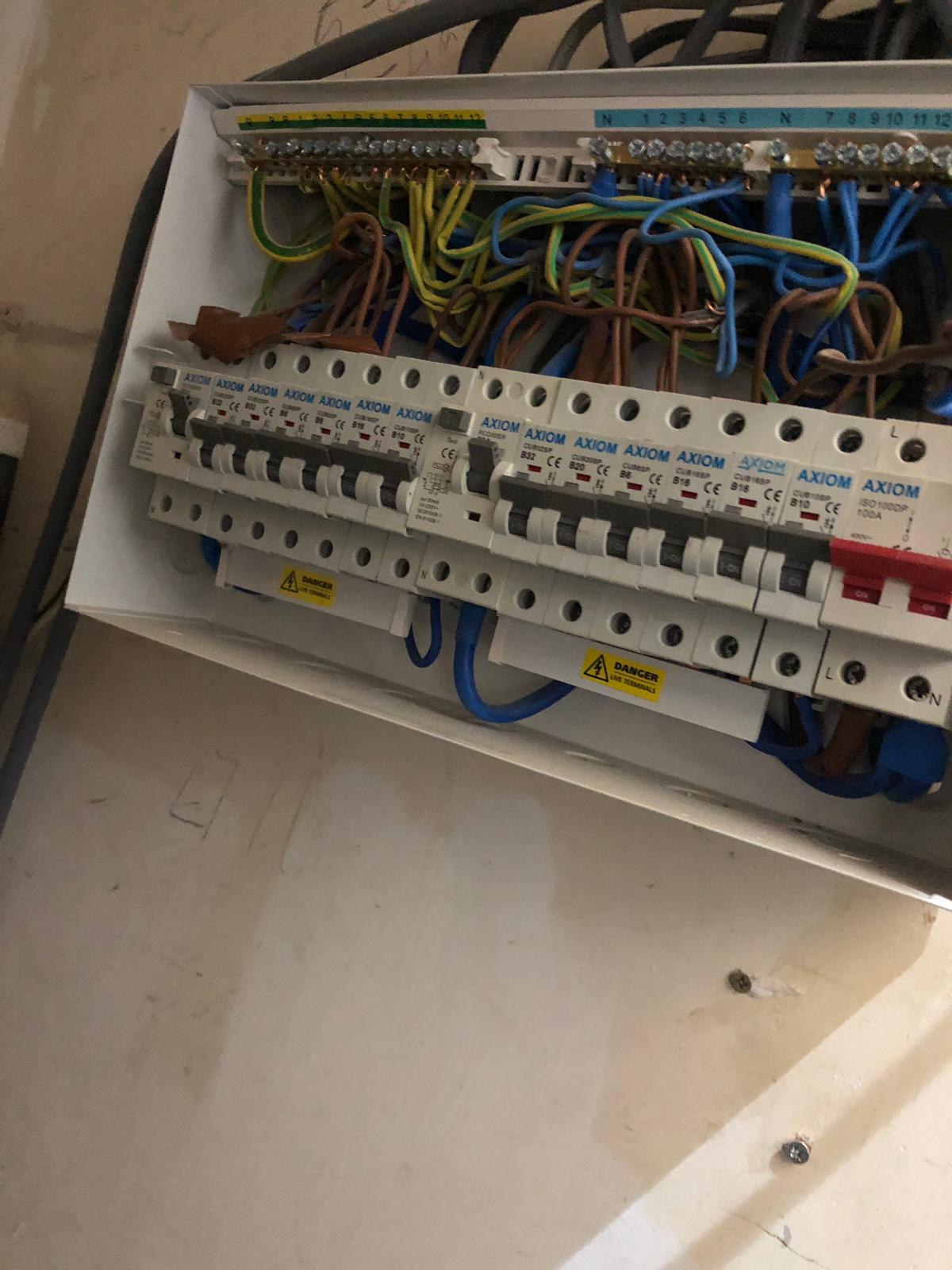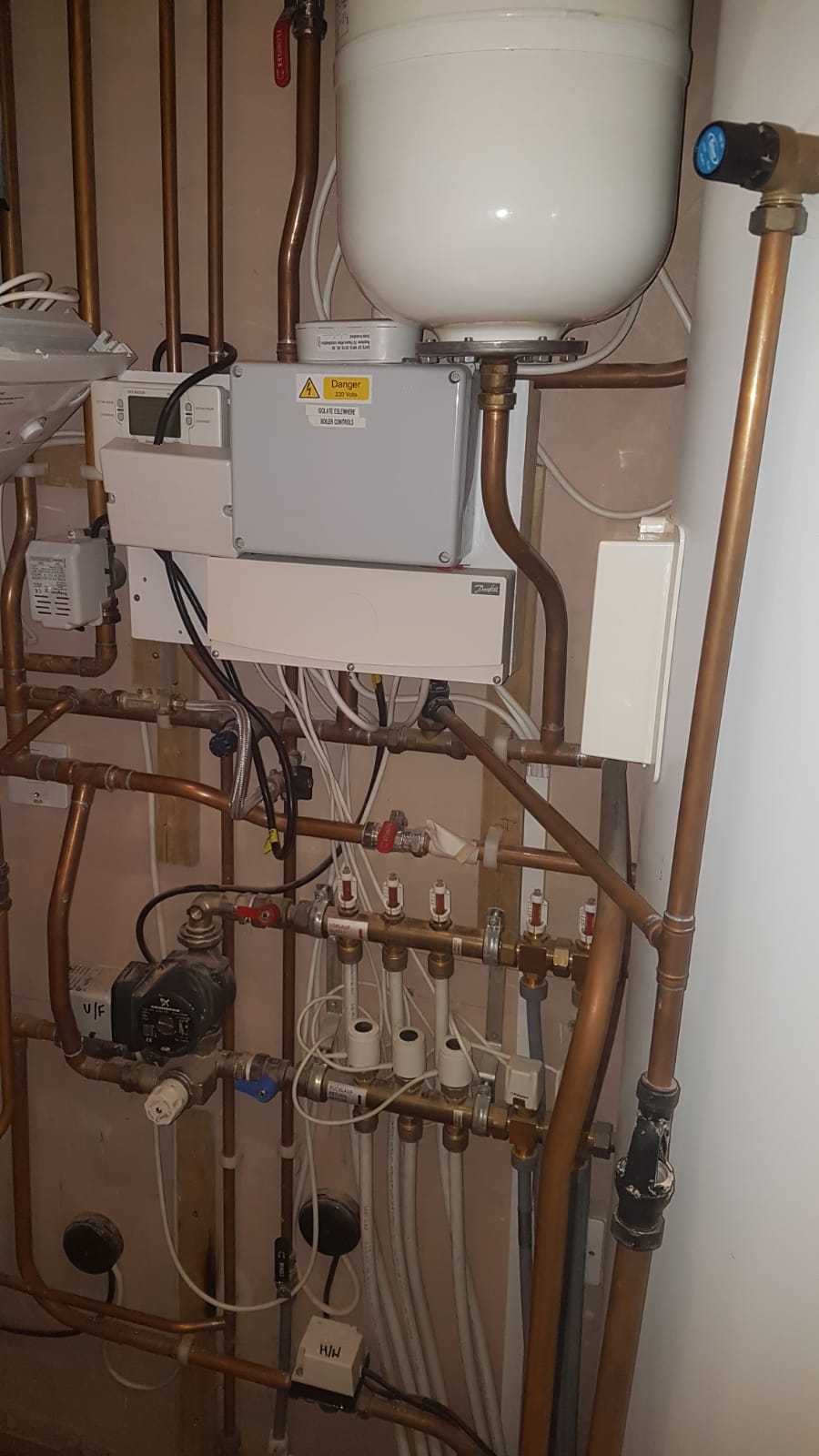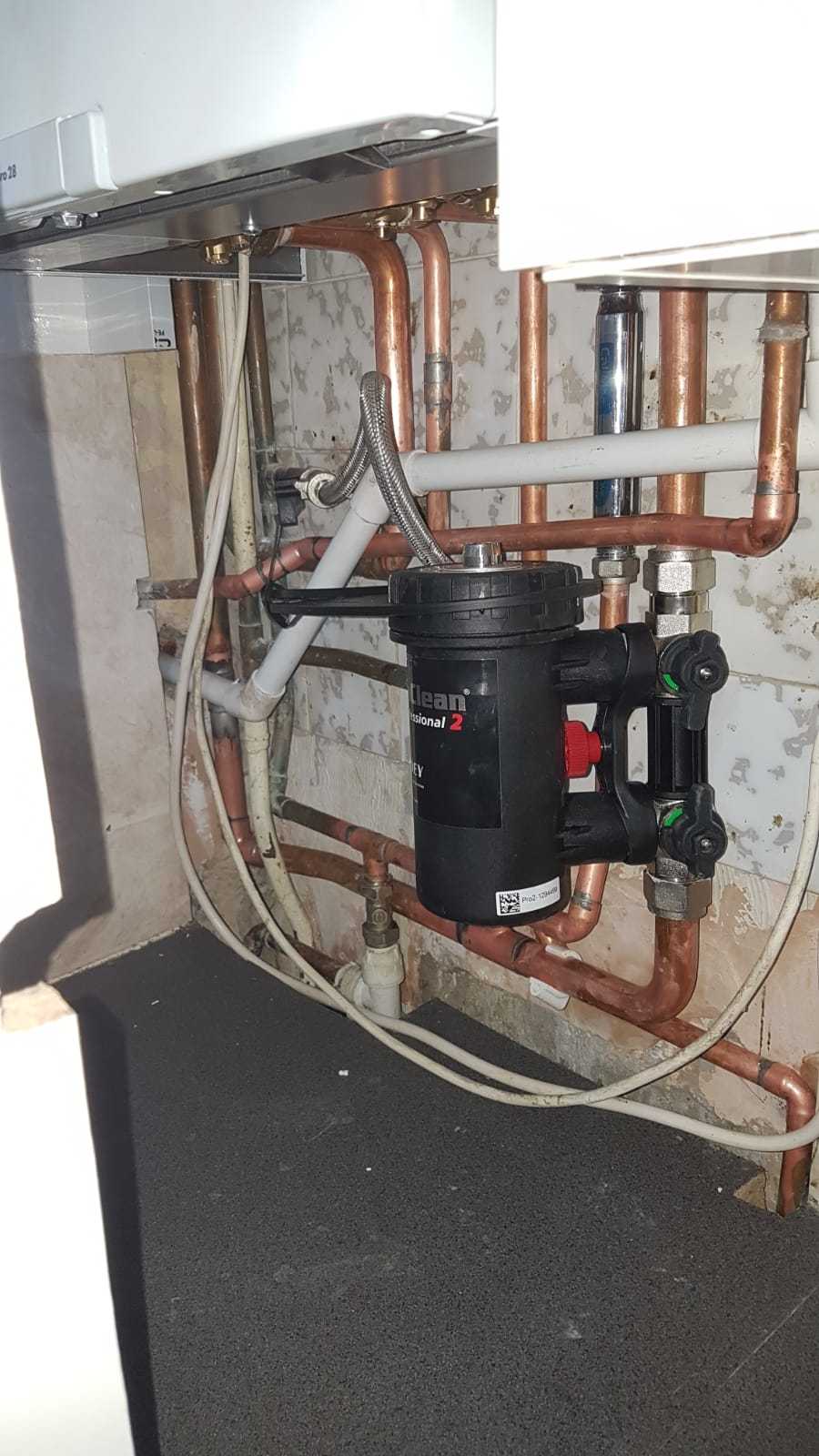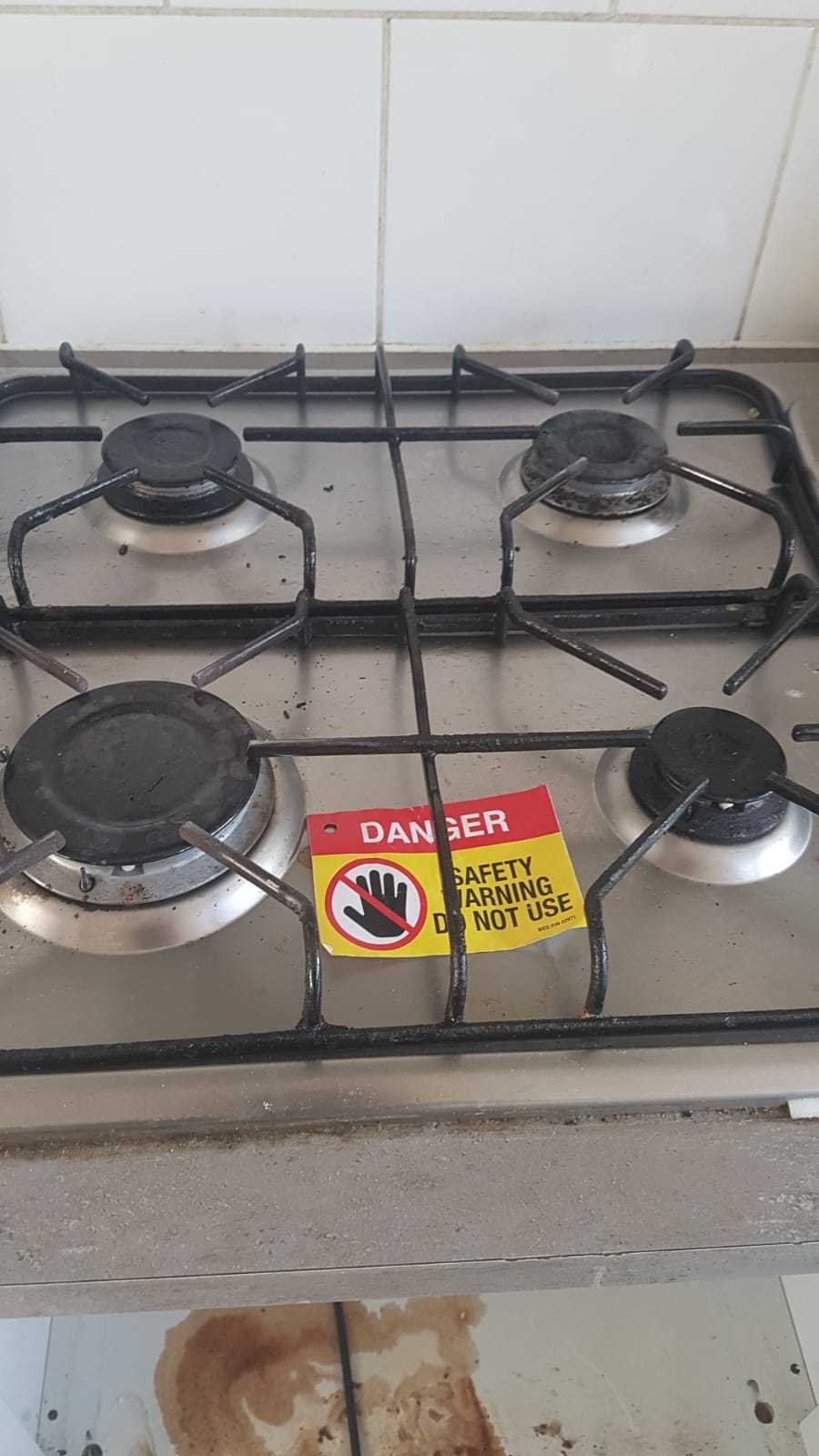
The EICR duration is the time required to conduct the electrical inspection of a property and issue the EICR. The EICR duration for residential properties is 2-5 hours, and for commercial properties is 1-4 days. The EICR duration depends on the inspection procedure, the size of the property, and the complexity and accessibility of the circuits.
The EICR process involves a visual check of the electrical fittings, dead testing (continuity and insulation resistance testing), and live testing of circuits. The EICR process also involves the identification of faults and reporting with classification codes. The electrical inspection starts with isolating circuits, then systematically tests sockets, switches, the consumer unit, the earthing system, and fixed wiring. After the electrical inspection findings are concluded, notes of observations and remedial recommendations.
The EICR duration for a small residential property with a 1-bedroom flat or a studio unit is 1-2 hours. EICR takes 2-3 hours for 2-bedroom houses, and 3-4 hours for 3-bedroom houses, depending on the number of circuits. Larger 4-bedroom properties take 4-5 hours, and 5-6 bedroom properties take between 5-8 hours if there are multiple consumer units or older wiring systems.
The EICR duration for commercial properties varies from 1/2 a day to a full day or more. The load systems of commercial properties are larger, circuits are distributed, and safety compliance testing needs to be done.
Houses in Multiple Occupation (HMOs) and licensed premises require extra hours for inspection. HMOs require 4-8 hours, and licensed premises take 1-2 days for inspection. This EICR extended duration is due to separate electrical points and extra safety requirements on a per-room basis.
The main factors that affect EICR duration include the age of wiring, the number of circuits, ease of access to electrical components, and the condition of the consumer unit. EICR duration is also affected by maintenance history and the number of faults found during the testing process.
The type of electrical installation and the suspected deterioration impact the inspection time, as modern, well-maintained systems shorten the EICR time, according to Chen, titled “Condition Monitoring and Inspection Strategies for Building Electrical Systems,” published in 2024.
How long does a full EICR process take?
A full EICR process takes 2-5 hours for residential and 1-4 days for commercial properties. The time taken in the EICR process depends on the size of the property, the complexity of the electrical system, and the number of electrical units.
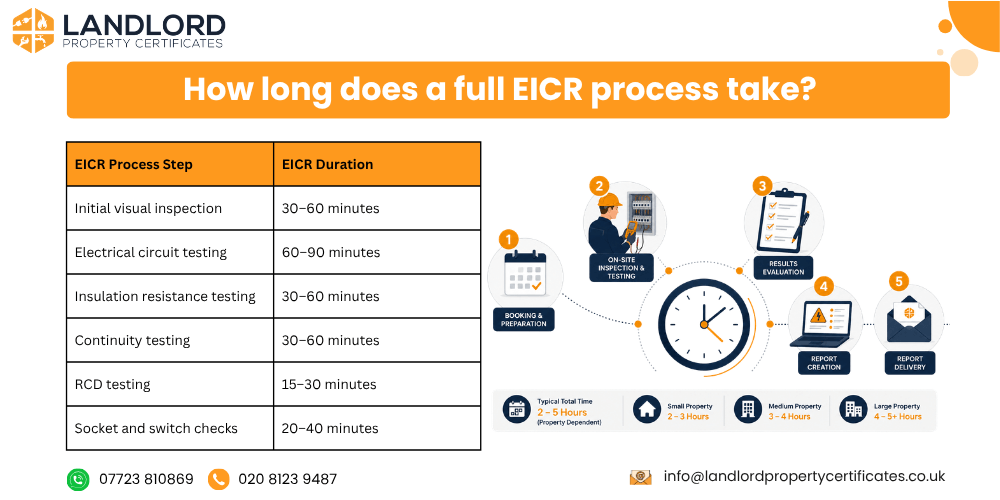
The average time taken for the full EICR process is 30 minutes to 5 days. The minimum time taken in the full EICR process is 30-60 minutes for a simple electrical installation. The maximum time for the full EICR process is 4-5 days for large HMO buildings with a complex electrical system.
The time the full EICR process takes is described in the table below.
| EICR Process Step | EICR Duration |
| Initial visual inspection | 30–60 minutes |
| Electrical circuit testing | 60–90 minutes |
| Insulation resistance testing | 30–60 minutes |
| Continuity testing | 30–60 minutes |
| RCD testing | 15–30 minutes |
| Socket and switch checks | 20–40 minutes |
| Fault investigation (if needed) | 30 minutes – 3 hours |
| Documentation and report writing | 30–60 minutes |
| Total average domestic EICR | 2–4 hours |
How long does an EICR inspection take?
An EICR inspection takes 2-4 hours for residential and 4-5 days for complex commercial properties to complete. The electrician needs to check the entire electrical installation, test various circuits, and ensure that the property meets the current safety standards.
How long does an EICR electrical test take?
The EICR electrical test takes 1-2 hours, as every circuit is individually tested for continuity, insulation resistance, polarity, earthing, and performance of protective devices.
How long does an EICR visual inspection take?
The EICR visual inspection takes between 30 and 60 minutes. The electrician checks visible wiring, sockets, switches, and consumer units and indicates signs of overheating, damage, or poor installation.
How long does an EICR fault-finding take?
An EICR fault-finding takes 30 minutes to several hours, depending on the nature of the electrical fault. Some electrical faults are easy to locate and uncover, and others require a detailed investigation.
How long does an EICR report preparation take?
EICR report preparation takes 30 to 60 minutes, as all observations, test readings, and safety classifications need to be accurately recorded in the official report.
How long does an EICR certificate issuance take?
The EICR certificate is issued on the same day or within 24 to 48 hours of inspection. The electrician needs to check out the results, finalise the documentation, and confirm any observations made before issuing the certificate.
How long does an EICR take by property size and type?
An EICR takes an average of 2 hours to 5 days, depending on the property size and type. A small and modern property with fewer circuits takes a minimum time (1 hour) for the EICR process.
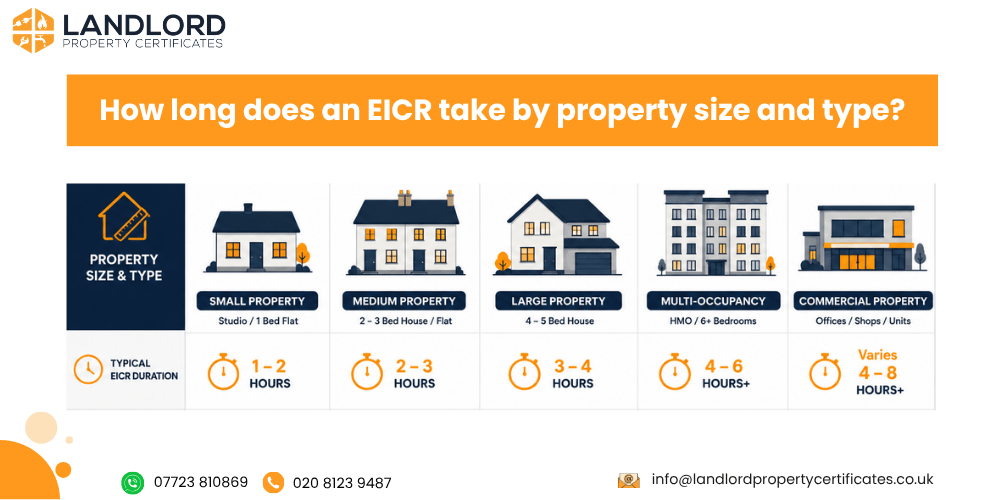
Domestic properties require an average of 2-4 hours for the EICR process. Larger houses (with3-4 bedrooms), older properties, HMOs, and commercial properties take 4-8 days for the EICR process. Large buildings have more circuits that require some further testing and fault investigation.
EICR durations by property size and type are described in the table below.
| Property Size/Type | EICR Duration |
| Studio flat | 1–2 hours |
| 1-bedroom flat | 1.5–2 hours |
| 2-bedroom flat | 2–2.5 hours |
| 2-bedroom house | 2–3 hours |
| 3-bedroom house | 2–4 hours |
| 4-bedroom house | 3–5 hours |
| 5+ bedroom house | 4–6 hours |
| HMO property | 4-8 hours |
| Small office/shop | 3–5 hours |
| Restaurant/pub | 4–6 hours |
| Large commercial building | 4-5 days |
| Industrial property | 4-5 days |
How long does an EICR take for a 1-bedroom property?
An EICR takes 1.5 to 2 hours for a 1-bedroom property. Small properties have a few circuits, sockets, and lighting points, which makes the inspection and testing process simple.
How long does an EICR take for a 2-bedroom property?
An EICR takes 2-3 hours for a 2-bedroom property. The extra rooms and extra circuits need more testing, particularly in bathrooms and kitchens, where more testing is necessary.
How long does an EICR take for a 3-bedroom house?
An EICR takes 2-4 hours for a 3-bedroom house. Family houses have several lighting and power circuits, bigger consumer units, and higher electrical accessories, which increase testing time.
How long does an EICR take for a 4-bedroom house?
An EICR takes 3-5 hours for a 4-bedroom house. Larger houses have extra bathrooms, outdoor electric, a garage, or an extension that needs to be inspected and tested separately.
How long does an EICR take for a 5-bedroom house?
An EICR takes 4-6 hours for a 5-bedroom house. These houses are large, with multiple circuits and high electrical loads. These houses involve more complex installations, which require longer inspection and reporting times.
How long does an EICR take for a 6-bedroom property?
An EICR takes 5-8 hours for a 6-bedroom property, depending on the number of consumer units and the size of the installation. Luxury or extended properties have advanced electrical systems installed.
How long does an EICR take for a studio flat?
An EICR takes 1-2 hours for a studio flat. Studio flats have fewer circuits and accessories to check, and the electrical installation is smaller.
How long does an EICR take for a small flat?
An EICR takes 1-2 hours for a small flat. EICR duration depends on the age of the wiring, the number of circuits, and the accessibility of electrical parts.
How long does an EICR take for a one or two-bedroom flat?
An EICR takes 1.5-3 hours for a one or two-bedroom flat. Older flats or converted buildings need additional testing due to the wiring layout, which is more complex.
How long does an EICR take for a larger home with multiple consumer units or outbuildings?
An EICR takes 5-12 hours for a larger home with multiple consumer units or outbuildings. Multiple consumer units or outbuildings and a complex electrical system need extra time for electrical inspection.
How long does an EICR take for a small commercial unit?
An EICR takes 3-5 hours for a small commercial unit. Commercial properties have more circuits, emergency lighting, and specialty equipment that need more in-depth inspection procedures.
How long does an EICR take for a larger home or commercial building?
An EICR takes 4-5 days for a larger home or commercial building. Large electrical systems, multiple distribution boards, and extensive installations with wiring need extra time for inspection.
How long does an EICR take for HMOs?
An EICR takes 4-8 hours for an HMO (House in Multiple Occupation). HMO’s have many bedrooms, more safety features, and more circuits to inspect and test.
What factors affect the duration of the EICR process?
The factors that affect the duration of the EICR process are listed below.
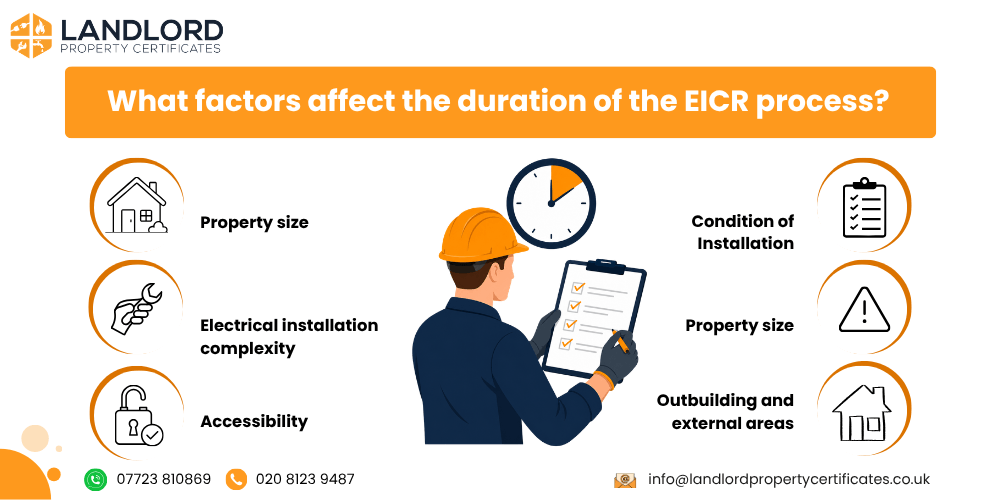
- Property size: EICR duration increases with the size of the house and building. The number of rooms, lighting points, sockets, switches, and fixed electrical equipment to be visually inspected affects the EICR duration. A small studio flat takes 1-2 hours, and a large multi-storey building takes extra hours (4-5) in an EICR due to complex electrical installation.
- Number of electrical circuits: A longer EICR duration is required for properties that have multiple circuits because these circuits have to be tested individually. The electrician performs tests for continuity and insulation resistance, polarity, earthing, and protective devices for each circuit. A home with separate kitchen circuit, cooker circuit, shower circuit, outdoor circuit, garage circuit, and a lighting circuit requires 3-4 hours for EICR.
- Age of Electrical Installation: The EICR duration is longer if the electrical system is older and has old insulation, old fuse boards, or was repaired in the past. Older installations require 30-60 minutes per circuit for electrical inspection to ensure that these installations continue to meet today’s safety standards.
- Condition of wiring: A large house with a poorly maintained or compromised wiring system has a longer EICR duration (4-5 hours). A more detailed investigation is required when the electrician encounters overheating, loose connections, damaged insulation, corrosion, or indications of electrical overloading. Safe testing practices are also lengthier if the installation condition is not certain.
- Accessibility of electrical equipment: The EICR duration is extended (from 2 hours to 5 days) if access to electrical equipment is difficult. The EICR duration increases in conditions like consumer units behind furniture, locked storage areas, inaccessible sockets, and covered junction boxes. The electrician must be able to gain access to all the necessary components before commencing testing.
- Type of property: The EICR duration varies according to the type of property. Domestic properties are less complex (take 4-5 hours) than commercial properties (take 1-4 days), HMOs, factories, or restaurants (take 4-8 hours). Commercial properties have multiple circuits, emergency systems, three-phase supplies, and specialist equipment. These complex electrical systems need further inspection and compliance checks.
- No of consumer units (CU): EICR duration increases (2-3 hours) if there is more than one consumer unit or distribution board. Each consumer unit needs to be inspected and isolated safely, and tested individually. Multiple boards are found on larger homes, extensions, and converted buildings, as well as commercial sites.
- Electrical faults: Electrical faults increase EICR duration from hours to days. Minor electrical issues are found easily, but hidden wiring faults and sporadic tripping take a long time in an EICR. Electricians have to follow wiring patterns, isolate wiring, and retest to safely find the source of the issue.
- Outbuildings and outside electrics: Outbuildings, such as garages, sheds, garden lighting, outdoor sockets, gates, and solar panel systems, require 2-3 hours for electrical inspection. Outdoor electrical systems are more vulnerable to weather damage and need further safety electrical testing:
- Previous electrical alterations: Previous electrical faults, such as extensions, rewiring work, and any do-it-yourself modifications to wiring, increase EICR duration. Electricians need to ascertain if previous modifications have been correctly fitted and meet existing electrical codes. An electrician requires extra time for inspection if Poor-quality modifications are present, like poor wiring, loose connections, and exposed conductors.
- Occupancy of the property: Occupied properties take a longer time to inspect (2 hours to 3 days), as the furniture and appliances make it difficult to access the sockets, switches, and consumer units. Electricians have to arrange access to several rooms for rental properties or HMO’s.
- Commercial equipment and special systems: A detailed inspection procedure (4-5 days) is needed for buildings that have emergency lighting, fire alarm systems, security systems, lifts, air-conditioning, or heavy machinery. These systems have special electrical instruments and safety equipment for the safety of the building and workers, which adds to the overall EICR process (4-5 days).
- Testing equipment and the number of manpower: There is require more time to complete the EICR process if only one electrician is involved, especially on a large property. A team of electricians tests and inspects a building in less time. Modern electrical testing equipment (Digital multimeter, clamp meter, and Oscilloscope) shortens the EICR process duration.
How to speed up the EICR process duration?
The EICR process duration is sped up by preparing the house for the electrician’s visit. Access to the consumer unit (C.U), sockets, switches, and electrical equipment speeds up the EICR process. Hire a qualified electrician (NVQ level 3 diploma) for an electrical inspection. Check and unlock all rooms, garages, storage areas, and outbuildings where electrical installations are located. Ensure the EICR checklist is present, pets are secured, and inform the tenants before inspection time to prevent delays during access and power isolation.
Get organised with your paperwork before the inspection. Collect your previous EICRs, circuit charts, installation certificates, or maintenance records. Proper documentation makes the quick identification of circuits and minimizes the time required to trace and verify the circuits. Clearly label Consumer units and Circuits if possible. Turn off sensitive equipment (computers, alarms, or industrial machines) before testing begins. Isolate the power to the electrical equipment for a short period of time to interrupt and delay inspection.
Fix electrical issues before the inspection, as damaged wires, switches, or loose sockets increase the time to fault-finding. Known issues that have been fixed early on help the electrician inspect in a more efficient manner and reduce the EICR process duration. The inspection of commercial buildings should be during quiet times or when rooms are empty. Less activity means that an electrician moves freely between circuits and testing points without interruptions, according to Adepoju, title “Electrical Installation Testing and Fire Risk Prevention in Residential Buildings” published in 2022.
Does EICR duration affect EICR pricing?
Yes, EICR duration affects EICR pricing. Longer inspections 5 days) result in higher costs (£1,500 to £2,500) for the electrician, as electricians spend more time testing circuits, inspecting the installation, preparing reports, and investigating faults.
The inspection of a small flat with a simple electrical system is done in a short period ( 2 hours) of time, so the inspection cost is lower (£400 – £600). Large houses, HMOs, commercial properties, or older houses require more time and labor, so they have higher EICR costs. (£1,000 – £2,500).
A building with multiple circuits, multiple consumer units, electrics outdoors, solar systems, or areas of difficulty has a higher EICR cost (£350-£550). Fault-finding also adds to the EICR pricing in the UK, as if a fault is identified, then further testing is required for the fault. A 1-bedroom flat is less expensive to inspect (£120-£180) to inspect than a 5-bedroom house or commercial property (£350-£450).