
The Renters’ Rights Act sets out the new landlord rules for 2026 and was initially announced in September 2024, received royal assent in October 2025, and took full effect on May 1, 2026. The UK government ministers introduced this legislation to level the playing field for renters, offering them greater stability in their homes while shielding them from sudden evictions and surprise rent increases.
Landlords no longer serve a Section 21 ‘no-fault’ notice to remove tenants without a legally recognized reason. Fixed-term tenancies have also been scrapped, so every tenancy agreement now operates as a flexible, rolling periodic arrangement from day one. Landlords face several other new rules, such as a ban on over-asking bids in rental bidding wars, and rents increasing only once every 12 months with two months’ formal notice.
New landlord rules also require landlords to accept written requests to keep a pet unless landlords have good reason to refuse. Landlords cannot turn away applicants simply because they have children or claim benefits. Landlords must give every existing tenant an official government Information Sheet outlining their updated rights.
No More No-Fault Evictions
Landlords cannot evict a tenant without a specific lawful reason. UK government ministers announced this policy in September 2024, but it became law on 1 May 2026.
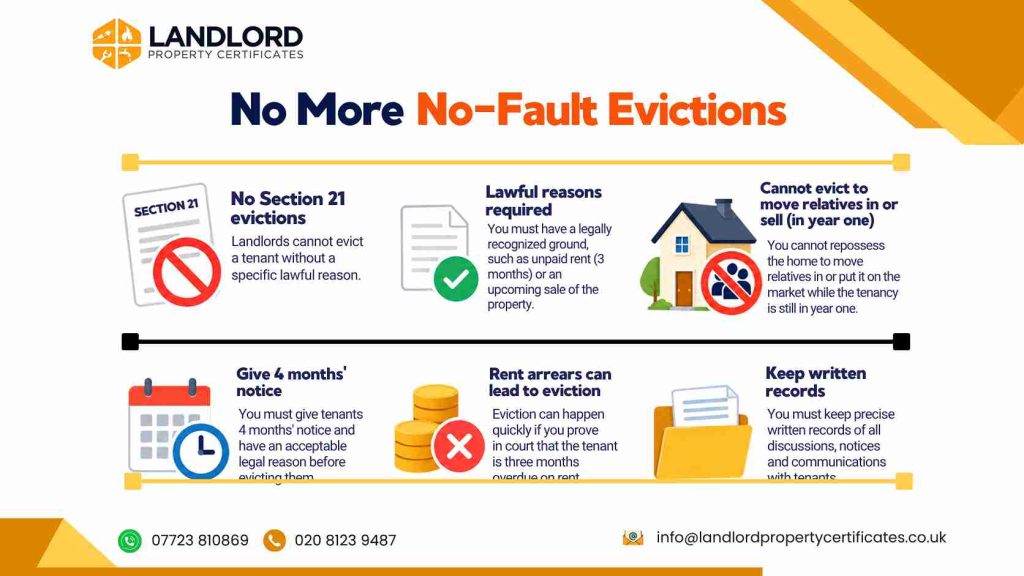
A landlord should have legally recognized grounds before evicting a tenant, such as unpaid rent (3 months) or an upcoming sale of the property. This legislation gives tenants greater security in their homes. A landlord cannot repossess the home to move relatives in or put it on the market while the tenancy is still in year one. A landlord must give 4 months’ notice and an acceptable reason before evicting tenants. Eviction can happen quickly if a landlord proves in court that rent is three months overdue. Landlords must keep precise written records of what they discuss with tenants.
Switch to Rolling Periodic Tenancies
Landlords no longer bind renters to strict 6- or 12-month leases, as all tenancies become open-ended. The UK government first introduced this policy in September 2024, and it became universally binding on 1 May, 2026.

The tenancy has no fixed expiry date as it simply carries over month by month. Tenants must give the landlord two months’ written notice before leaving a property. Renters can move on if their circumstances change, and they can hand in notice as early as move-in day. Landlords must maintain the property and keep all documents up to date to encourage tenants to stay rather than feel forced by a contract.
Strict Caps on Rent Increases
Landlords are legally limited to one rent increase every twelve months to protect renters from sudden spikes. The UK government introduced this rule in September 2024, and it came into force on 1 May, 2026.
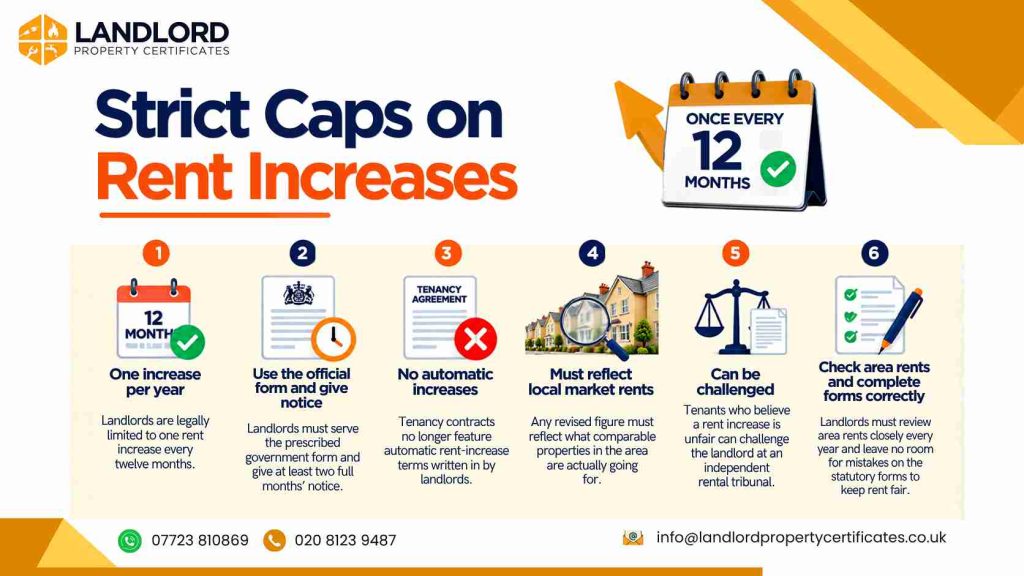
Landlords must serve the prescribed government form and give at least two full months’ notice before charging any higher rate. Tenancy contracts no longer feature automatic rent-increase terms written in by landlords. Any revised figure the landlord requests must reflect what comparable properties in the area are actually going for. Tenants who believe a rent increase is unfair can challenge the landlord at an independent rental tribunal. Landlords must review area rents closely every year and leave no room for mistakes on the statutory forms to keep rent fair.
Outlawing Rental Bidding Wars
Landlords are legally barred from encouraging current or prospective tenants to bid above the advertised rent. The UK government introduced this policy in September 2024, but local councils have applied it since 1 May, 2026.
Every rental advert a landlord publishes must state an exact monthly sum. Landlords cannot encourage bidding wars among applicants. The landlord cannot accept money if an applicant tries to offer more than the online asking rent. The point is to make the rental market transparent and fair for people looking for a home.
The landlord is legally bound to say no, or risk hefty council fines if an applicant tries to leapfrog the competition with extra cash after a property goes live. Landlords must set a firm rent cost before advertising and explicitly instruct their letting agents not to consider higher bids.
The Right to Ask for a Pet
The renters can request an animal in the home, and landlords cannot refuse without a solid reason. The UK government first introduced this policy in September 2024, and it took full legal effect on 1 May, 2026.

The landlord must give proper consideration when a tenant submits a written request to keep an animal. The landlord cannot turn down the request unless they have a genuinely good reason. Landlords can refuse a pet request when it is clearly unreasonable, such as someone wanting to keep a very large dog in a tiny flat without a garden.
Landlords can legally require tenants to buy and maintain pet damage insurance before moving the animal in to protect the property. Landlords must evaluate the pet application on its merits and check formal proof of insurance meant to pay for chewed carpets or specialist deep cleaning.
Outlawing Discrimination Against Tenants
Rejection of tenant applicants because they have children or claim housing benefits is now illegal. UK ministers announced this policy in September 2024, and every landlord must follow it from 1 May, 2026. The UK does not allow listing a rental with wording like “No families”.
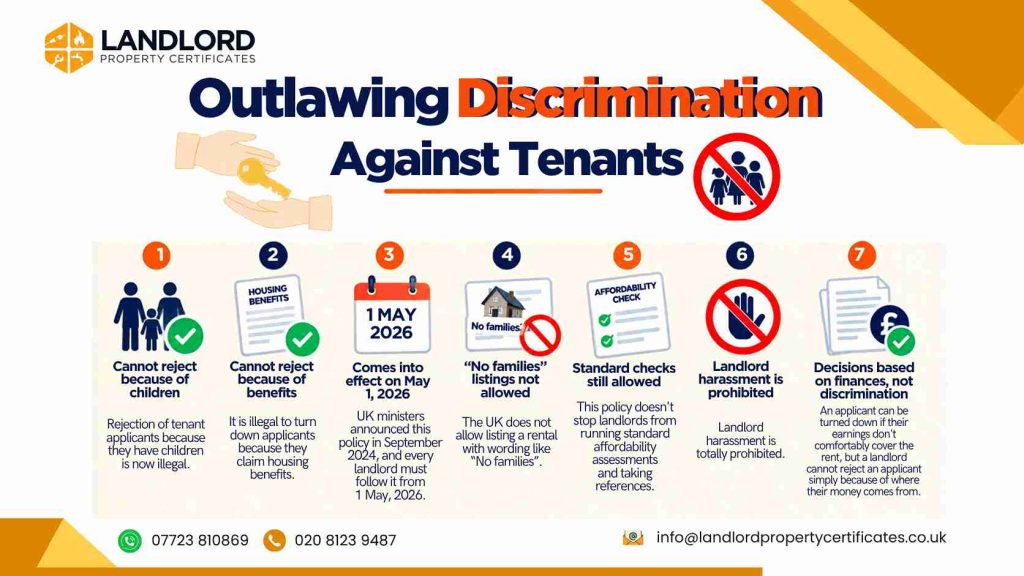
This strips out unfair bias from renting, giving people an even shot at securing a property. This policy doesn’t stop landlords from running standard affordability assessments and taking references. Landlord harassment is totally prohibited. An applicant can still be turned down if the numbers show their total earnings will not comfortably cover the rent each month.
A landlord cannot reject an applicant simply because of where their money comes from. All landlord listings have to be open and welcoming, with any final choice based strictly on dependable financial references.
What are tenants’ rights under the 2026 UK rental rules?
Tenants’ rights under the 2026 UK rental rules are listed below.
- Tenants have the right to remain safely in their home because landlords can no longer repossess a property without proper legal grounds.
- Tenants no longer have to accept a binding 6-month or 12-month term, as they can start with an open, flexible agreement.
- Tenants do not have to face financial penalties for leaving at any time, provided they give the landlord two full months’ written notice.
- Rent can be raised only once every twelve months, and the landlord must give the tenant at least two months’ formal notice before the higher rate takes effect.
- The tenant can contest it before an independent legal tribunal if a landlord tries to raise the rent above the going rate for comparable local properties.
- Tenants are entitled to pay the published rate for a rental home, and landlords break the law if they solicit higher bids to outdo rival applicants.
- Tenants can make an official request to have a pet in the property, and landlords cannot legally turn them down unless they hold a genuine, reasonable justification.
- Landlords cannot reject an applicant for a rental home simply because they have children or claim state housing support, as tenants are legally protected against that bias.
- Landlords must repair serious risks such as damp and mould within set deadlines because tenants are entitled to a safe, healthy home.
- A tenant is entitled to an official government information pack that sets out all statutory tenant rights, along with instructions on how to assert them on moving in.
Are tenants satisfied with the new landlord rules in 2026?
Yes, tenants are satisfied with the new landlord rules in 2026. New landlord rules (2026) are a huge win for tenants because they target the worst anxieties of renting. Renters settle into a neighborhood for the long haul without the lingering dread of an abrupt eviction notice, since surprise removals are off the table. Renters also gain more security and leverage, since they can legally dispute unfair rent spikes and walk away from a bad tenancy whenever they need to. A minority of renters worry that such tight restrictions could drive landlords to sell up, reducing rental supply and pushing rental costs higher.
How did landlords react to the new 2026 UK rental rules?
Frustration and anxiety spread quickly among landlords in response to the new 2026 UK rental rules, leading many smaller investors to sell up and leave the rental market altogether. This legislation added a lot to a landlord’s plate: regaining possession now requires rigorous, documented legal proof submitted to a court, and open-ended rolling tenancies bring ongoing financial unpredictability. Rent hikes are strictly capped at one yearly review tied to fair market rates according to 2026 UK rental rules.
Landlords can no longer issue blanket bans on pets and must address each request under their new responsibilities. Landlords must meet statutory deadlines to fix structural hazards such as mould and damp. These sweeping reforms tilt legal power unfairly toward tenants, increasing the paperwork and financial exposure of running rentals while stripping away landlords’ core control over what happens to the building long term.
Do the 2026 UK Rental rules apply to every landlord type?
No, the 2026 UK rental rules do not apply to every landlord type. This new legislation targets private residential letting; any standard private landlord letting out an entire house or flat must comply with all the rules. An owner who lives in the property and lets out a spare room to a lodger is exempt, so these tight eviction controls and open-ended contract mandates do not apply.
Short-term holiday let operators are also exempt from these tenant safeguards, as the people staying there count as temporary guests rather than permanent tenants. Operators of large, purpose-built student housing get targeted statutory carve-outs from rolling contracts, which lets them match lease dates to the university calendar rather than keep tenancies open-ended.
Why did the government change landlord rules in 2026?
UK government ministers pushed the 2026 reforms through on the view that existing renting arrangements tilted power too heavily toward landlords over tenants. Ministers wanted to stop people being tipped into homelessness without warning, which prompted them to strip landlords of the power to evict without cause. Some landlords had been letting properties fall into disrepair; the updated rules require them to fix health hazards like damp and mould quickly to protect tenants.
Lawmakers barred landlords from stoking bidding wars or demanding massive rent hikes, shielding tenants from severe financial strain. Lawmakers targeted housing discrimination by making it an offense for landlords to turn someone down just for having children or claiming government benefits. The government introduced these measures to give tenants greater security in their homes and compel landlords to meet much higher housing standards.